Final expense lead follow-up in the first 48 hours: when to call, how often and when to hand off
A first-contact plan for real-time final expense web leads: what the five-minute studies measured, how many calls fit a 24-hour cap, and when to hand off to a setter desk.
General information, not legal advice. This guide summarizes the rules in the sources listed at the end, as read between and . Rules change, and they differ by state and by business, so check with a lawyer licensed where you call before relying on it.
On this page
- How soon after delivery should you call a real-time final expense web lead?
- Where does the 'five-minute rule' come from, and what did those studies measure?
- What does a first-contact plan for the first 48 hours look like?
- Should you double-dial a new lead?
- When may follow-up switch to texts or voicemail?
- How do the delivery clock and the lead's inquiry date shape the first 48 hours?
- When should a setter desk take over the follow-up?
- How do you judge the first 48 hours without borrowed benchmarks?
- Questions
- Sources
A 2011 audit timed lead responses in hours, not minutes
Share of 2,241 U.S. companies, by time to respond to a web test lead. Industries not stated; not final expense data.
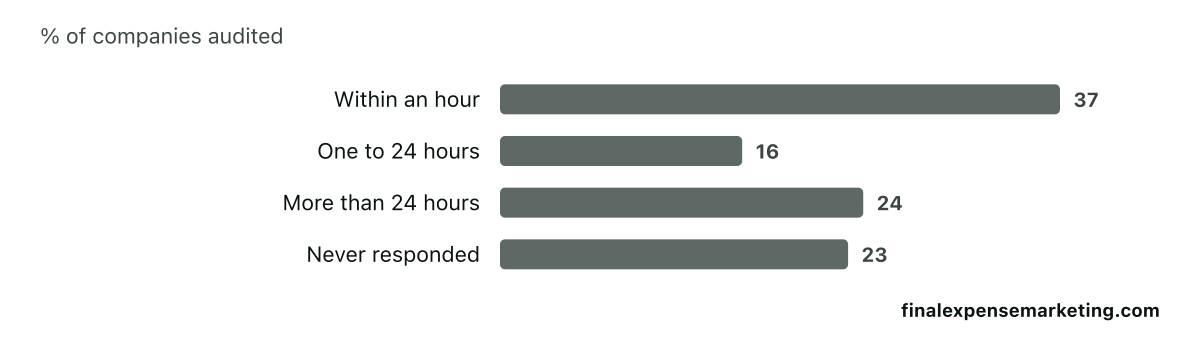
| Row | % of companies audited |
|---|---|
| Within an hour | |
| One to 24 hours | |
| More than 24 hours | |
| Never responded |
Source: Oldroyd, McElheran and Elkington, "The Short Life of Online Sales Leads", Harvard Business Review, March 2011. Industries not stated; not final expense data.
Final expense lead follow-up starts at the delivery timestamp: call a real-time web lead as soon as it lands, if the lead's calling window is open. Over 48 hours, stay within any state call cap (a double dial is two calls, and a three-call cap means six at most), then pass unreached leads to a setter desk.
This plan is for licensed agents, agencies and call centers who work their own real-time web leads. Aged records need a different plan. Every rate in the plan is yours to measure: we publish no contact, answer or close rate of our own. This is not legal advice.
How soon after delivery should you call a real-time final expense web lead?
A real-time final expense web lead should get its first attempt the moment it reaches your CRM, provided the calling window is open where the lead lives. If the window is closed, the first attempt waits until it opens, so how fast you call final expense leads depends on the lead's local time, never your office's.
What the delivery timestamp tells you
The delivery timestamp is the moment the lead reached you, and it is hour 0 of this plan. Our exclusive web leads, sold one buyer per record, are delivered in real time, so the gap after the consumer's inquiry is short: each lead reaches your CRM seconds after the consumer submits the form. A contact-verified lead is delivered only after its five checks are complete, and no delivery time is published for that step. Our page on real-time leads and their delivery clocks keeps that latency apart from the ramp of a new campaign. If you buy from another vendor, get its answer in writing: does its speed promise count from the consumer's form or from your order?
When the lead lands outside calling hours
Hold it, and make the first attempt when the window opens in the lead's time zone. The rules where the lead lives, federal and state, decide that window. For a lead held overnight, measure your speed from the hour the window opened, not from the delivery timestamp, or the log will count hours you could not dial against you.
Where does the 'five-minute rule' come from, and what did those studies measure?
The five-minute rule traces to a 2007 InsideSales.com study of web leads at six companies, which compared the odds of contacting and qualifying a web lead at 5 and at 30 minutes and did not measure sales. Two later documents carry speed-to-lead figures of their own: a 2011 Harvard Business Review article co-written by InsideSales.com's chief executive, and a Velocify report on its clients' 2012 leads. None of the three reports a final expense result or counts issued policies.
What each one measured, from copies read on October 14, 2026:
| Figure you will see | Original source | What it measured | Data behind it | What it did not measure |
|---|---|---|---|---|
| The odds of contact drop 100 times between 5 and 30 minutes | Lead Response Management Study, InsideSales.com with James Oldroyd (October 2007) | Contact, stated as odds the report does not define: a call that reached a live person and lasted a set time, from 2 to 6 minutes depending on the company | Six companies' data over 3 years: more than 15,000 leads, more than 100,000 call attempts | Sales: “This study did not address close ratios.” |
| The odds of qualifying drop 21 times between 5 and 30 minutes | The same study | Qualification as each company defined it, in some cases a booked appointment | The same six companies | Sales |
| “Nearly seven times as likely to qualify the lead” when contact was tried within an hour; “more than 60 times” against 24 hours or longer | Oldroyd, McElheran and Elkington, Harvard Business Review (March 2011) | Qualifying, defined as “having a meaningful conversation with a key decision maker” | 1.25 million sales leads at 29 B2C and 13 B2B U.S. companies | Any interval shorter than an hour; sales |
| 391% higher conversion when the first call comes within a minute | Velocify, “The Ultimate Contact Strategy” (undated; online by September 2013) | Conversion by minutes to the first call, charted as “improvement on lead conversion rate”; the text defines neither conversion nor the comparison point | Almost 3.5 million leads from more than 400 Velocify client companies across industries, generated in the first half of 2012 | Final expense; issued policies |
| 93% of converted leads reached by the sixth call attempt | The same report | Call attempts to first contact, among leads that converted | The same leads | Final expense; any state call cap |
The 2007 study: odds of contact at six companies
The Lead Response Management Study was presented in October 2007 by InsideSales.com's CEO, David Elkington, and James Oldroyd, then a visiting research fellow at MIT. Its data came from the vendor's own platform: “We used the data from the InsideSales.com system”. It names neither the six companies nor their industries, though it says use of its tools was concentrated among “customers from the mortgage and insurance industries”. The link opens an archived copy, because the original PDF address no longer serves the file.
Its headline states the result as odds, but the report never defines the term or says how it was computed, and elsewhere it calls the same result “a 100x increase in contact ratios”. It publishes no contact rate at 5 or at 30 minutes, so the figure cannot tell you how often you will reach a lead. It also found that after 20 hours “every additional dial your salespeople make actually hurts your ability to make contact to qualify a lead”; asked whether those later calls turn people off, it answered: “We don’t know.”
For why speed matters, the report offered “a few educated guesses”. The first: “When a person submits a lead in a web form, you know where they are at that exact moment”. Its authors called this “presence”.
The 2011 article: an hour, not five minutes
The Harvard Business Review article by James Oldroyd, Kristina McElheran and David Elkington measures nothing shorter than an hour, so it cannot support a five-minute rule. Its first dataset is an audit timing how long 2,241 U.S. companies took to respond to a web-generated test lead: 37% within an hour, 16% within one to 24 hours, 24% after more than 24 hours, and 23% never. Among companies that responded within 30 days, the average was 42 hours. The article's author note describes Elkington as “the chairman and CEO of InsideSales.com”.
Velocify's report: 391% and the sixth attempt
Velocify, which described itself as a provider of lead-management and sales-automation software, built “The Ultimate Contact Strategy” from leads at “randomly selected Velocify clients”, generated in the first half of 2012. The report prints no publication date; the copy linked here was archived in September 2013. It concludes that “making a call attempt within a minute of receiving a lead increases conversion rates by 391%”, and cautions that the study “reflects an aggregate of hundreds of organizations across many different types of industries.”
The same figures on final expense pages
Two guides from companies that sell final expense leads, as we do, show speed figures traveling without those limits, or without any source. Aged Lead Store's guide (published June 9, 2025; updated March 30, 2026) credits InsideSales.com with making you “100x more likely to connect than waiting 30 minutes or more”, but the study compared calls at 5 minutes with calls at 30, not with “30 minutes or more”, and published no contact rate. The guide also repeats Velocify's 391% without saying the data was cross-industry. ResultCalls' guide (December 9, 2025) says “Your conversion rate drops 900% if you wait an hour” and names no source; a rate cannot fall by more than 100%. Both pages were read on October 22, 2026.
What does a first-contact plan for the first 48 hours look like?
A first-contact plan is an attempt ladder written down before the first lead arrives: the channel of each attempt, when it happens and the checks it must pass. How many times to call a lead, and when, is the part you set; the lead's calling window and any state cap set the ceiling. The worksheet below is yours to fill in. Its timings are example settings for a lead in a state that caps calls at three in 24 hours on the same subject, not benchmarks.
Check each attempt against the calling window in the lead's state, and space the calls by fitting attempts under a three-call cap, the procedure on our setter page.
| Step | Channel | When you make it (example; you set it) | Lead's calling window open? (lead's local time) | Count toward a three-call cap (texts included) | What to log |
|---|---|---|---|---|---|
| Call 1 | Call | On delivery | Dial if open; if closed, hold the lead until it opens | 1 of 3 | Delivery timestamp, dial time, outcome, voicemail left or not |
| Double dial or text (optional; one or the other) | A second call, or a text if the lead's consent covers texts | Straight after a no-answer on call 1 | Check again | 2 of 3 | Its own time and outcome; for a text, the consent that covers it |
| Next call | Call | Later the same day, at an hour you set | Check again | 3 of 3 after the step above, otherwise 2 of 3; after the third, nothing until 24 hours after call 1 | Outcome |
| Day two | Calls | From 24 hours after call 1, at hours you set | Check again | Never more than 3 in any 24-hour stretch | Outcome of each |
| Hand-off | Setter desk | When your hand-off rule triggers | Ask the desk to check it again | The desk's calls join the same 24-hour count | The attempt log goes with the lead |
Reading the window and cap columns
- The window is the lead's. It follows the rules where the lead lives and the lead's time zone, never your office's hours. The worksheet states no hours: look them up in those rules before the first dial.
- Where no cap applies, write your own daily limit into the cap column before the first dial.
- Under a three-call cap, six calls is the ceiling. At most six fit inside the first 48 hours, three in each 24-hour stretch, and fewer when a text takes a place.
- Two questions are for your counsel: whether a call the lead asked for counts as a solicitation under each state's law, and whether a text counts toward a cap. The worksheet counts every dial and every text as if they do.
Should you double-dial a new lead?
A double dial is two calls: count it as two, and use it only when the 24-hour count has room for both. Under a three-call cap it spends two of the three calls the first 24 hours allow, and when the second call also goes unanswered, your number has placed two short calls to one person back to back.
What a double dial does to a three-call count
Orum, a power dialer for sales teams, describes its double dialing this way: “If the first call goes to voicemail, Orum will immediately call the same number a second time.” It says the feature “helps sales reps improve their connect rates during Power Dialing sessions”. Florida and Maryland count calls toward their caps whatever number they come from (Maryland's statute says “regardless of the telephone numbers used to make the call”), so moving the second dial to another number does not reset the count. Whether a cap binds a licensed agent varies by state: Oklahoma's act, as enacted, exempts licensed agents soliciting within their license, cap included.
In a state with a three-call cap, the first 24 hours after call 1 add up like this, with texts counted:
| Plan for the first 24 hours | Count used | Left under a three-call cap |
|---|---|---|
| Call 1, then two more calls later that day | 3 | 0 |
| A double dial on call 1, nothing else yet | 2 | 1 |
| A double dial on call 1, then a text | 3 | 0 |
| A double dial on call 1 and again on the next call | 4 | None: over the cap |
| Three calls on day one, then one the next morning less than 24 hours after the first | 4 | None: over the cap |
The last row shows how a next-morning call breaks the cap: it stays inside only when it comes at least 24 hours after the first call of day one. If you want a second try soon after the first without a double dial, Velocify's report gives one timing: “prospects contacted on a second call attempt that was made 30-60 minutes after the lead was generated had a higher conversion rate than all other half hour periods following the initial call.” That is cross-industry conversion data, not final expense sales.
What a double dial does to your number
The second cost falls on your caller ID. Orum warns that “Double Dialing may increase the risk that your outbound number is marked as spam by phone carriers or third-party services,” and suggests the feature for organizations “comfortable with slightly higher risk of spam labeling in exchange for more connects.” Settle how dialing patterns can affect your number's spam labels before you turn it on.
When may follow-up switch to texts or voicemail?
A text may follow a missed call only where the lead's consent, federal rules and the lead's state allow it, so settle the consent and hours a follow-up text needs before texts join the ladder. Until your counsel says otherwise, count each text toward a call cap, as the worksheet does.
Voicemail here means a message you leave yourself on a call you dialed, so it rides on a call already counted. Recorded voicemail drops and ringless voicemail sit outside this plan.
How do the delivery clock and the lead's inquiry date shape the first 48 hours?
The 48 hours start at the delivery timestamp, and the inquiry timestamp beside it shows how old the lead already was when it reached you. The inquiry date also starts a three-month window in the FCC's telephone-solicitation rules, where an established business relationship can rest on an inquiry made “within the three months immediately preceding the date of the call” (47 CFR 64.1200(f)(5)); whose business relationship an inquiry creates depends on whom the form named, not on who bought the lead.
The gap between inquiry and delivery
Hour 0 is the delivery timestamp. On our real-time leads it comes seconds after the consumer submits the form, and a new campaign's ramp never enters the 48 hours. Keep the inquiry timestamp beside the delivery timestamp in every record: any gap between them is time the lead lost before you saw it, and a lead that arrives with a long gap is a question for its vendor. The HBR authors named one cause of slow follow-up that sits on the buyer's side: “the practice of retrieving leads from CRM systems’ databases daily rather than continuously”. Route each lead to whoever dials it as it arrives, not in a daily batch.
When should a setter desk take over the follow-up?
A setter desk should take over when your own plan can no longer reach a lead in time, by a hand-off rule you set before the first lead arrives. Write the rule as triggers, and pass the attempt log with every lead you hand off.
A setter desk is calling capacity, not a meeting: you hire callers who follow up the leads you already have, on a defined attempt schedule. Preset appointments are the other purchase, where you buy a booked meeting. Our setter desk and CRM nurture for leads you already have publishes its attempt schedule, and the first line reads “First attempt within five minutes during coverage hours”.
Three hand-off triggers you set
- No one can dial, but the window is open. A lead lands inside the lead's calling window at an hour when no one on your side can call.
- The first attempt is late. A lead has not had its first attempt within the first-attempt target you set.
- Your attempts are spent. A lead is still unreached after the attempts you set for yourself.
Pass the attempt log with the lead
Maryland's statute says a person may not “make or cause to be made” a solicitation to the same person more than three times in 24 hours, so plan as if your calls and the desk's calls on the same lead share one 24-hour count, and ask your counsel how each state counts them. Send the attempt log with every lead you hand off, with each call's time in the lead's time zone, its outcome and any request the lead made. A do-not-call request taken by either side stops the ladder for that lead at once; log it with the time it was made.
Ask any desk, ours included, four questions before the first hand-off: which leads it takes on, what its coverage hours are, how it spaces attempts under a three-call cap, and whether it counts the calls you already made.
How do you judge the first 48 hours without borrowed benchmarks?
Five numbers from your own attempt log are the fair test of the first 48 hours, because the published studies pooled other companies' leads, none reported a final expense result, and two of them warn that results vary from one business to the next. The 2007 report ranked hours of the day and days of the week, then cautioned that “Patterns vary significantly from company to company”; in its own FranklinCovey case, calling back people who had abandoned a purchase, “the worst time to call back was within the first 24 hours.” Velocify called its results “widely applicable” but added that they “may not reflect the optimal strategy for an individual industry or business.” The worksheet leaves the hour of each attempt to you for that reason.
Five numbers from your own log
| Measure | From which fields | What it tells you |
|---|---|---|
| Minutes from delivery to first dial | Delivery timestamp and first dial time; for a lead held overnight, the hour its window opened | Whether your first attempt keeps to the target you set |
| Share of leads reached within 48 hours | First-contact time on each lead | How much of each batch the plan reaches before the hand-off |
| Calls to first contact | The number of calls up to and including each lead's first real conversation | How many calls your leads take, in place of a cross-industry figure |
| Contact rate by attempt number | The outcome logged for every attempt | Which rungs of the attempt ladder earn their place, day-two calls included |
| Defects found and claimed | Dispositions and claim dates | Whether defects surface inside the claim window |
The worksheet schedules calls on day two although the 2007 report found that extra dials after 20 hours hurt contact in its pooled data, so let your contact rate by attempt number decide whether those calls stay. Contact rate is the share of units you reach for a real conversation, and cost per contact is the price per unit divided by that rate. The cost calculator takes contact and close rates as your own inputs and turns them into cost per contact and cost per sale. Judge a source on conversations counted, not leads bought.
Defects you can still claim
Speed stays the buyer's job, and our replacement policy says so: it lists “The prospect did not answer” and “The agent called too slowly” among the cases it does not replace. A defect is different. One listed defect reads “The telephone number is disconnected or belongs to the wrong person”, and a lead with it is replaced or credited when claimed within 72 hours, unless your order confirmation states a different window. Claim a defect such as a disconnected number as soon as your log shows it.