Final expense underwriting guide for agents: knockouts, medication flags and graded triggers in public carrier forms
Which health answers end a final expense application, which send it to a graded or modified plan, and how far back each question looks, quoted from three carriers’ public application forms, with seven carriers’ early-benefit rules side by side.
General information, not legal advice. This guide summarizes the rules in the sources listed at the end, as read on . Rules change, and they differ by state and by business, so check with a lawyer licensed where you call before relying on it.
On this page
- How final expense underwriting works on a phone application
- Which answers end an application, and which lead to a graded plan
- Level, graded, modified and guaranteed issue: seven carriers’ early-benefit rules
- Prescription and medication flags in the public forms
- How a pre-vetted screen estimates a tier
- How this underwriting guide was built: sources and changelog
- Questions
- Sources
How far back three public final expense forms ask about cancer
Cancer other than basal cell, read October 14, 2026. A longer bar is a longer look-back, not a stricter carrier.
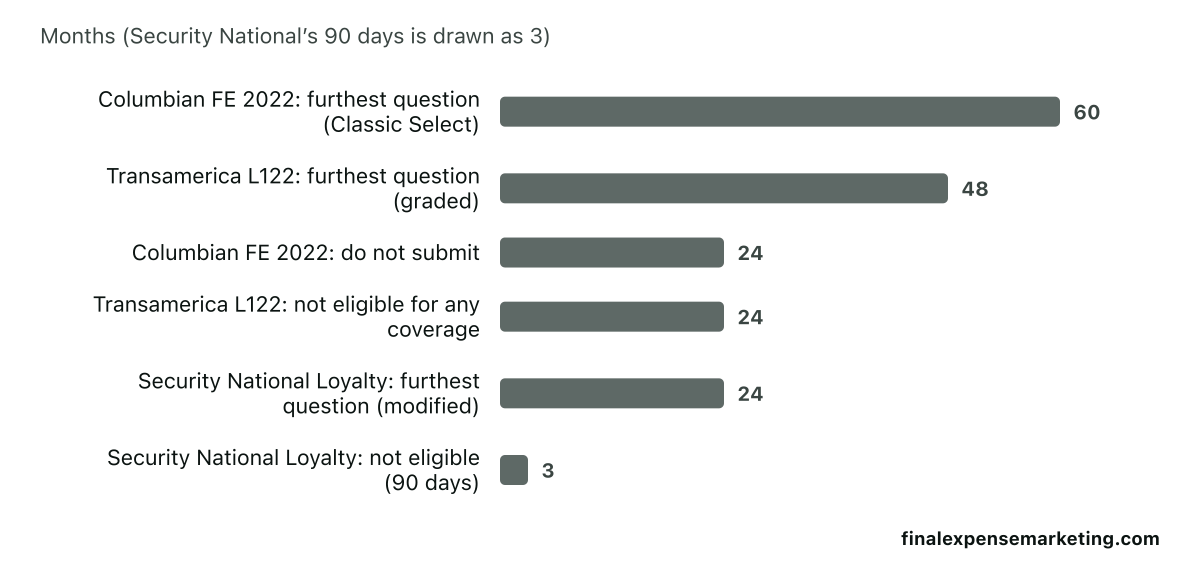
| Row | Months (Security National’s 90 days is drawn as 3) |
|---|---|
| Columbian FE 2022: furthest question (Classic Select) | |
| Transamerica L122: furthest question (graded) | |
| Columbian FE 2022: do not submit | |
| Transamerica L122: not eligible for any coverage | |
| Security National Loyalty: furthest question (modified) | |
| Security National Loyalty: not eligible (90 days) |
Sources: Transamerica L122 1012T PA (2012 print); Columbian ICC21 A746-CL (FE 2022); Security National ICC25-LP APP (08/2025).
Final expense underwriting sorts each applicant into a level plan with the full benefit from day one, a graded or modified plan that limits the benefit for two or three years, or, when the health questions rule both out, guaranteed issue. Each carrier’s questions, look-back windows and database checks decide which; the carrier makes every underwriting decision.
This final expense underwriting guide reads the rules where carriers print them for the public: three application forms that route each answer to a plan, and documents from seven carriers that show how six of them limit early benefits. Most agent guides we found are marked for agent use only, and no marked document is used here. Every rule below is taken from a document read on October 14, 2026, with its form number and edition.
How final expense underwriting works on a phone application
A final expense application is decided on two things: what the applicant answers, and what the applicant lets the carrier check. The public documents describe five checks, and none of them leaves the decision with the agent. Transamerica’s application has the applicant agree “that the agent does not have the authority to waive any question on this application, to decide if insurance will be issued”; Columbian’s says no agent may “pass on insurability”.
- The health questions, asked as written. Each form groups its questions into sections, and each section carries a rule: a “yes” in the first section ends the application, and a “yes” in a later section routes it to a lower class or a graded or modified plan. The matrix below sets those rules side by side.
- The authorizations. The applicant signs releases for MIB and for prescription records: Security National’s authorization names pharmacies, prescription vendors and pharmacy benefit managers, and Columbian’s covers “prescription drug records”.
- The database checks. Security National’s 2023 product overview says “Prescription histories are ordered, regardless of which plan you are writing.” Columbian’s 2020 overview lists an MIB check, a prescription drug database check and, for issue ages 18 to 35, a motor vehicle report. Fidelity Life says its RAPIDecision Final Expense decision depends on “the answers to a few health questions on the application and results from certain database records, like motor vehicle reports.”
- The build chart. Height and weight can end an application on their own. Columbian’s 2020 table declined an applicant 5 feet 6 inches tall who weighed under 103 or over 290 pounds.
- The phone interview, when the carrier wants one. Columbian’s forms warn that “a telephone interview may be necessary to verify or supplement information given to the Company on this application,” though its 2020 overview listed “No telephone interview!” ELCO Mutual’s Silver Eagle brochure offers “a short telephone interview or our e-application, if available.”
MIB is a cross-check, not a verdict. MIB says a member carrier “will cross check the information you provide on your application against any information in your MIB Consumer File”, and a consumer has that file only after applying to a member carrier for life insurance in the last seven years when something of “underwriting significance” was found. Columbian adds that it “does not rely, in whole or in part, on an MIB report in making a final underwriting decision.”
Telesales readiness: signatures, e-apps and disclosures by carrier
A phone sale ends with a signature and the disclosures the applicant receives. The table shows what the carriers’ public documents, read on October 14, 2026, say about each step; “Not described” means a document is silent on it.
| Carrier (public document) | Signature method | E-app or phone submission | Disclosures to the applicant |
|---|---|---|---|
| Columbian (telesale packet 5376CFG-TX-FE and eApp packet 5354CFG-TX, Rev. 11/21, Texas copies) | Phone: the applicant’s “voice signature was secured by digital recording”; eApp: the applicant types a name to sign, and the packet names DocuSign eSignature | Both; the 2020 overview adds a point-of-sale underwriting decision on the eApp | Printed copies of the disclosures; on a phone sale, the documents “read to you during the application process”; no deadline printed |
| Corebridge (brochure AGLC201191, REV1225) | The applicant signs (“Agent fills out and you sign your application”); the method is not described | The agent “transmits” the signed application; eligibility verified “in seconds” | Not described |
| ELCO Mutual (Silver Eagle brochure SEB-03-26) | Not described | An e-application “if available”, or the short telephone interview; “Decisions are made instantly” | Not described |
| Security National (Loyalty application ICC25-LP APP, 08/2025; product overview, 2023) | Paper: the agent certifies the signatures “were signed in my presence”; the telesales signing method is not described | “Applications can be submitted through paper, upload or telesales method.” | Privacy notice “available upon request”; the form carries a conditional receipt |
| Transamerica (application L122, 2012 print) | Paper, signed by the applicant and the producer; the agent’s report asks “I have personally seen the proposed Insured.” (yes or no) | None on the L122; FE Express Solution (2024) is not covered | Receipt of the MIB notice, Notice to Persons Applying For Insurance, Accelerated Death Benefit Disclosure and Conditional Receipt, signed on the application |
Foresters’ PlanRight brochure and Fidelity Life’s RAPIDecision pages describe none of the three steps. Of these seven carriers, only Columbian’s public documents describe a voice signature, and its packets come in state versions, so use the one for the applicant’s state. No public document here prints a deadline for sending disclosures after a phone sale; take that deadline from the carrier’s agent guide and your state’s rules.
Which answers end an application, and which lead to a graded plan
Transamerica, Columbian and Security National each publish a form that states which answer leads to which plan, the only three among the carriers we could read. The matrix lines up 25 conditions and flags across those forms. Read each cell as the result when that answer is the only “yes” on the form; a second “yes” can move the result down a tier or end the application.
The columns are Transamerica’s Life Application L122 1012T PA, the 2012 Pennsylvania print for its Immediate, 10-Pay and Easy Solution products (parts C2 to C4); Columbian’s FE 2022 questions as printed on its public reinstatement form ICC21 A746-CL (parts P1 to P3); and Security National’s Loyalty Plan application ICC25-LP APP of August 2025 (sections S1 and S2). “Knockout” is each form’s own stop rule. Columbian’s Select is a full-benefit plan and Classic Advantage its graded plan. All three forms were read on October 14, 2026.
| Condition or flag | Transamerica L122, 2012 print | Columbian FE 2022, ICC21 A746-CL | Security National Loyalty, 08/2025 |
|---|---|---|---|
| In a hospital, nursing home or hospice, or bedridden | Knockout if now, home health care included (C2 Q1) | Knockout if now, assisted living and home health care included (P1 Q1) | Knockout if in the past 30 days (S1 Q1) |
| Terminal illness | Knockout: death expected within 18 months (C2 Q2a) | Knockout: death expected within 12 months (P1 Q2) | Knockout: life expectancy of 12 months or less (S1 Q3C) |
| HIV or AIDS | Knockout, ever (C2 Q2b) | Knockout, ever (P1 Q2) | Knockout, ever (S1 Q3A) |
| Alzheimer’s, dementia or ALS | Knockout, ever; memory loss included (C2 Q2a) | Knockout, ever (P1 Q6) | Knockout, ever (S1 Q3B) |
| Organ transplant | Knockout, ever, received or advised; corneal excepted (C2 Q2d) | Knockout, ever: a transplant recommended, or a heart, lung, liver or bone marrow transplant received (P1 Q3) | Knockout, ever (S1 Q3B) |
| Kidney dialysis | Graded if in the past year (C3 Q6e) | Knockout if in the last 12 months (P1 Q3) | Knockout if in the past 30 days (S1 Q1) |
| Cancer, other than basal cell | Knockout within 2 years (C2 Q3a); graded within 4 years (C3 Q5) | Knockout within 24 months (P1 Q7); Select within 5 years (P3 Q1) | Knockout within 90 days (S1 Q2); modified within 2 years (S2 Q4C) |
| Heart attack | Graded within 1 year (C3 Q6d); Standard within 2 years (C4 Q8b) | Knockout within 6 months (P1 Q8); graded at 7 to 24 months (P2 Q7) | Modified within 2 years (S2 Q4A) |
| Stroke or TIA | Graded within 1 year (C3 Q6d); Standard within 2 years (C4 Q8b) | Graded within 24 months, TIA included (P2 Q5) | Modified within 2 years for stroke (S2 Q4B); TIA not named |
| Congestive heart failure | Graded within 1 year (C3 Q6b); Standard within 2 years (C4 Q8c) | Knockout, ever, taking medication included (P1 Q6) | Modified within 2 years (S2 Q4A) |
| Stent, angioplasty, bypass or pacemaker | Graded within 1 year (C3 Q6c); Standard within 2 years (C4 Q8a) | Graded within 24 months (P2 Q5); a defibrillator implant, ever, is a knockout (P1 Q6) | Not named; S2 Q4A covers heart surgery and “any heart or circulatory diseases, or disorders” (modified) |
| Atrial fibrillation | Standard within 2 years (C4 Q8a) | Select, ever (P3 Q2) | Not named; S2 Q4A covers “any heart or circulatory diseases, or disorders” (modified) |
| COPD or emphysema | Standard, ever (C4 Q10) | Graded, ever (P2 Q1) | Modified within 2 years (S2 Q4D) |
| Oxygen | Graded if used in the past year, sleep apnea included (C3 Q6e) | Graded if ever used, sleep apnea excepted (P2 Q1) | Modified if the applicant depends on oxygen (S2 Q6) |
| Wheelchair, scooter or walker | Graded if a wheelchair or electric scooter was used in the past 2 years (C3 Q7) | Knockout if confined to a wheelchair by illness or disease now (P1 Q1) | Modified if the applicant depends on a wheelchair or walker (S2 Q6) |
| Insulin | Standard if used in the past 2 years (C4 Q8c); diabetes diagnosed before age 18 is graded (C3 Q4) | Graded if insulin was used before age 50 (P2 Q6b) | Modified if insulin was used before age 40 (S2 Q4F) |
| Diabetic coma or amputation | Knockout, ever (C2 Q2c) | Knockout, ever, for an amputation due to disease (P1 Q3); graded for diabetic coma or insulin shock within 36 months (P2 Q6a) | Modified within 2 years (S2 Q4F); an amputation due to illness is also modified (S2 Q6) |
| Kidney disease, not on dialysis | Standard within 4 years (C4 Q9); kidney failure in the past year is graded (C3 Q6e) | Graded within 36 months, kidney failure included (P2 Q2a) | Modified within 2 years (S2 Q4E) |
| Cirrhosis or hepatitis | Graded within 1 year (C3 Q6b); Standard within 2 years (C4 Q8c) | Graded within 36 months for liver disease or chronic hepatitis (P2 Q2a) | Knockout, ever, for cirrhosis or untreated hepatitis C (S1 Q3B); modified within 2 years for liver disease or hepatitis B or C (S2 Q4E) |
| Alcohol or drug abuse | Graded within 1 year (C3 Q6a); Standard within 2 years (C4 Q8d); prescription drugs included | Graded within 36 months (P2 Q2a) | Modified within 2 years, prescription drugs included (S2 Q4H) |
| Tests pending, or surgery advised and not done | Knockout (C2 Q3b) | Knockout (P1 Q4) | Modified (S2 Q5) |
| Parkinson’s or multiple sclerosis | Standard, ever (C4 Q10) | Graded within 36 months (P2 Q2b) | Not named; S2 Q4G covers “any neurological or mental diseases or disorders” (modified) |
| Seizures | Graded: more than 12 in the past year (C3 Q6b); Standard: more than 12 in 2 years (C4 Q8c) | Not named | Knockout: a seizure in the past 90 days (S1 Q2) |
| Help with daily living | Not named; home health care now is a knockout (C2 Q1) | Select if help is needed now, taking medications included (P3 Q3) | Knockout if help was needed in the past 30 days (S1 Q1) |
| Arrests, convictions and driving | Not asked | Graded: probation, parole or a conviction, or 3 or more moving violations or a DUI, within 36 months (P2 Q4) | Not asked |
How each form routes the answers
Transamerica (L122). Any “yes” in Part C2 ends the application. One “yes” in Part C3 routes it to the Graded Death Benefit product, and two end it. Part C4 counts only when Part C3 is all “no”: all “no” routes to Preferred, one “yes” to Standard, two or more to Graded.
Columbian (FE 2022). Any “yes” in Part 1 means do not submit. One “yes” in Part 2 routes to Classic Advantage, the graded plan, and two mean do not submit. One “yes” in Part 3 routes to Classic Select, and two route to Classic Advantage. All “no” routes to Classic Elite.
Security National (Loyalty, 2025). Any “yes” in Section One ends the application. Any “yes” in Section Two routes to the Modified Plan, and more than three end it. All “no” routes to Preferred.
One applicant, three forms
A hypothetical applicant shows how far the forms diverge. She is 68. Her cancer treatment ended three years ago, with no cancer care or advice since. She has used insulin since age 45, with no complications. Her COPD was diagnosed five years ago and is treated with a daily inhaler, and she does not use oxygen. Run through each form’s printed rules:
- Transamerica: cancer within four years is a Part C3 “yes” (C3 Q5). One C3 “yes” routes to the Graded Death Benefit product, and Part C4 is never reached.
- Columbian: nothing in Part 1, but two Part 2 answers are “yes”: COPD, ever (P2 Q1), and insulin used before age 50 (P2 Q6b). Two Part 2 answers mean do not submit.
- Security National: nothing in Section One. The cancer is more than two years old and her insulin began after 40, so the only “yes” is COPD treated in the past two years (S2 Q4D). One Section Two “yes” routes to the Modified Plan.
Same answers, three results: graded, do not submit, modified. Each carrier’s database checks and underwriters can still change the outcome, which is why any tier set before the application is an estimate.
Level, graded, modified and guaranteed issue: seven carriers’ early-benefit rules
A graded or modified plan pays less than the face amount when death from natural causes comes in the first policy years, and carriers limit that early benefit in different ways. The table shows each carrier’s plan names and early-benefit rule as its public document prints them, read on October 14, 2026, sorted by carrier name.
| Carrier and plan (document) | Full benefit from day one | Limited early benefit | Guaranteed issue | Issue ages and amounts |
|---|---|---|---|---|
| Columbian Dignified Choice (product overview, November 2020) | Classic Elite; Classic Select | Classic Advantage: return of premiums plus 6% in the first two years; full benefit after year two, and for accidental death in any year | Not in this overview | Full-benefit plans 18 to 85, $2,500 to $35,000 by age band; Classic Advantage 40 to 85, $2,500 to $20,000 |
| Corebridge SimpliNow Legacy (consumer brochure AGLC201191, REV1225) | Legacy Max: 100% of the policy amount from the first day it is in force | Legacy: 110% of premiums paid if death occurs in the first two years | A separate product, named only in the fine print | Ages 50 to 80; $5,000 to $35,000; the fine print caps Legacy, Legacy Max and Guaranteed Issue at $25,000 combined |
| ELCO Mutual Silver Eagle (brochure SEB-03-26) | Premier, Plus and Standard | Graded: 30% of the face amount in year one, 70% in year two; Modified: return of premium plus interest for two years | GI: return of premium plus interest for two years | Immediate plans 50 to 85, $2,500 to $35,000; graded, modified and GI 50 to 80, $2,500 to $25,000 |
| Fidelity Life RAPIDecision (product pages) | Final Expense: full coverage from the start, no waiting period | None listed | Guaranteed Issue: reduced death benefit in policy years one through three, full from year four and for accidental death | Ages 50 to 85; Final Expense $5,000 to $50,000; Guaranteed Issue up to $25,000 |
| Foresters PlanRight (consumer brochure 503340 US, 06/25) | Preferred, up to $35,000; Standard, up to $20,000 | Basic: premiums paid plus 10% annual interest in the first two years, 100% of the face amount from year three and for accidental death; up to $15,000 | None | Ages 50 to 85; $5,000 to $35,000 |
| Security National Loyalty (application ICC25-LP, 08/2025; product overview, 2023) | Preferred | Modified: return of premium plus 10% for two years, full benefit after year two | None in the Loyalty application | Ages 40 to 90, modified to 85; $2,500 to $50,000 (2023 overview) |
| Transamerica Solutions (application L122, 2012 print) | Not printed for Preferred or Standard | Graded; the formula is not printed on the application | None on this application | Issue ages 45 to 85 |
Columbian’s 2020 overview also capped graded sales: “Sales of graded death benefit policies may not exceed 30% of applications issued and paid in the past 365 days.”
The labels do not travel between carriers. Foresters calls its premiums-plus-interest plan graded, Security National calls a premium refund plus 10% modified, and ELCO Mutual’s graded plan pays a percentage of the face amount. Fidelity Life’s guaranteed issue plan reduces the benefit for three years; every other plan with a printed formula reduces it for two. Quote the formula, not the label.
Two regulatory texts frame these plans. The first is the Insurance Compact’s graded-benefit standard, for policies filed through the Compact. It names the two designs in the table, a graded benefit that is “a percentage of the ultimate face amount” and one “equal to premiums paid plus interest”, or “a combination of the two”. It limits the reduced period to “not more than the first three policy years”, sets the reduced benefit at no less than “the amount of premiums paid to the time of death with interest”, requires “the full ultimate face amount” for accidental death at any time, and puts “This policy has a limited graded death benefit – Please read your contract carefully.” on the cover page. It also requires the specifications page to show “the dollar amounts of the early duration reduced benefits for death from natural causes” for each policy year and, for a premiums-plus-interest design, to “describe the calculation and state any interest rate or other coefficient”, so the issued policy carries the exact schedule a brochure summarizes.
The second, NAIC Model 570, which states adopt in their own form, says an advertisement for a policy with graded or modified benefits “shall prominently display any limitation of benefits”, and that “no medical examination required”, where issue is not guaranteed, needs a disclosure that issuance “may depend upon the answers to the health questions set forth in the application.”
Prescription and medication flags in the public forms
Medication counts as treatment on these forms. Columbian asks whether the applicant was “diagnosed or treated (including taking medication)” for congestive heart failure, Alzheimer’s disease, dementia or ALS, so a heart-failure prescription alone answers its Part 1 question “yes”. Security National’s Section Two asks about conditions the applicant was “diagnosed, tested positive for, treated, prescribed medication, or been given advice” for in the past two years.
The flags the public forms name, medication by medication:
- Insulin. Transamerica routes insulin used in the past two years to Standard (C4 Q8c) and diabetes diagnosed before 18 to Graded (C3 Q4). Columbian routes insulin used before age 50 to Classic Advantage (P2 Q6b). Security National routes insulin used before age 40 to Modified (S2 Q4F). An applicant who started insulin at 45 trips Columbian’s threshold and not Security National’s.
- Oxygen. Transamerica counts oxygen used in the past year with sleep apnea included (C3 Q6e); Columbian counts oxygen ever used except for sleep apnea (P2 Q1); Security National asks whether the applicant depends on oxygen (S2 Q6). Oxygen used only for sleep apnea is a “yes” on Transamerica’s form and a “no” on Columbian’s.
- Prescription drug misuse. Transamerica and Security National name prescription drugs inside their alcohol and drug questions (C3 Q6a and C4 Q8d; S2 Q4H).
- The medication list. Security National’s application asks for “a complete list of medications (including oxygen), and the dosages and time periods”, and its completion guide tells the agent to enter “all current prescriptions taken”.
- No medical history at all. Columbian’s 2020 overview made applicants aged 71 or older with no prescription drug history ineligible for its Elite plan, and those 71 or older who had not seen a doctor in the past three years ineligible for any coverage.
Drug-by-drug lists sit in carriers’ agent-only prescription guides, so no drug name in this guide is matched to a tier; use the carrier’s own guide from your agent portal for that. Treat the prescription history as part of the application: Security National orders one on every plan.
How a pre-vetted screen estimates a tier
A pre-vetted transfer adds health and medication questions to the interest, age and state check, and estimates a Guaranteed Issue or Level/Graded tier before the handoff. The estimate prices the transfer, at $250 per Guaranteed Issue transfer and $300 per Level/Graded transfer. It does not settle the plan: the carrier makes every underwriting decision.
The matrix shows why there are two estimates, not three. Each form above either routes the answers to one of its health-question plans, the family a Level/Graded estimate points to, or stops the application; when the health-question forms stop it, guaranteed issue is the plan family left. The screen does not split level from graded, because that split depends on the carrier, as the hypothetical applicant shows, and on database checks no screener runs. You present, recommend and complete the application with the carrier you choose, and which plan the prospect can get is a conversation for you, the licensed agent; see where the screener stops and the licensed agent starts.
If you would rather hear every health answer yourself, an interest-verified live transfer stops at interest, age and state, at $110 per transfer. If you want the health and medication answers gathered before the call connects, see pre-vetted final expense transfers. Whoever screens your transfers, ask which questions sit behind the estimate, one of the questions to put to any transfer vendor before you buy.
How this underwriting guide was built: sources and changelog
This guide uses only documents a carrier publishes with no restriction on public use, read on October 14, 2026, and links each carrier’s own copy; we host none. The matrix comes from three application forms: Transamerica L122 1012T PA, Columbian ICC21 A746-CL (checked against its policy-change form ICC21 A747-CL) and Security National ICC25-LP APP. The early-benefit table adds product documents from Corebridge, ELCO Mutual, Fidelity Life and Foresters, and overviews from Columbian (2020) and Security National (2023). The telesales table adds Columbian’s telesale and eApp disclosure packets (5376CFG-TX-FE and 5354CFG-TX), found through its public forms search.
Left out, because each carries a restriction: Transamerica’s Final Expense Guide (form 84405), marked “For agent use only. Not for public distribution.”; Columbian’s point-of-sale underwriting guide (5398CFG), agent reference guide (5378CFG) and eApp guide (5365CFG), marked “For agent use only. Not for use with consumers.”; Foresters’ PlanRight Producer Guide (503306 US), marked “For producer use only. Not for use with the public.”; Corebridge’s simplified issue underwriting guide (AGLC201453), marked “For financial professional use only - not for public distribution.”; Americo’s Final Expense Products at a Glance, marked “For agent use only. Not for public use.”; and Security National’s underwriting and medication guides, which carry a confidentiality agreement. Mutual of Omaha’s producer documents, and the Royal Neighbors, Gerber Life and Aetna sites, did not load from our network that day, so they are not in this edition.
Edition notes: Transamerica introduced a digital product, FE Express Solution, in September 2024, and its questions are not on the L122 form. We found no public copy of the Part 1 to Part 3 health questions on Columbian’s new-business application, ICC21 A745-CL (its telesale packet reprints only pages 3 and 5 of 5); its reinstatement form prints the same Part 1 to Part 3 questions as its FE 2022 policy-change form and states the routing. Check the current form for your applicant’s state before you quote.
- Changelog, October 14, 2026: first edition, built from the documents above as read that day.
- October 22, 2026: every linked document re-read before publication; each still says what this guide quotes, and Columbian’s public forms list still shows the FE 2022 forms and Rev. 11/21 packets used here.