How to vet a final expense lead vendor: certificates, credit terms and 25 questions
What TrustedForm and Jornaya records prove, how to audit a certificate before it expires, how seven vendors word their credit and exclusivity terms, and 25 questions to send any final expense lead vendor before the first order.
General information, not legal advice. This guide summarizes the rules in the sources listed at the end, as read between and . Rules change, and they differ by state and by business, so check with a lawyer licensed where you call before relying on it.
On this page
- What TrustedForm and Jornaya actually record
- How to audit a vendor’s certificates before you scale
- What the consent text has to say about you
- What “exclusive” means in writing
- When a lead or transfer becomes billable
- What vendors publish about replacements and credits
- What record and delivery details to ask for
- After the first order: how many leads before you judge, and the claim file
- Vendor red flags that already have an enforcement record
- The 25-question vendor scorecard
- Questions
- Sources
What six final expense vendors’ published terms state
Each vendor’s own product and policy pages, read October 22, 2026. Our terms are not counted. Not a market sample.
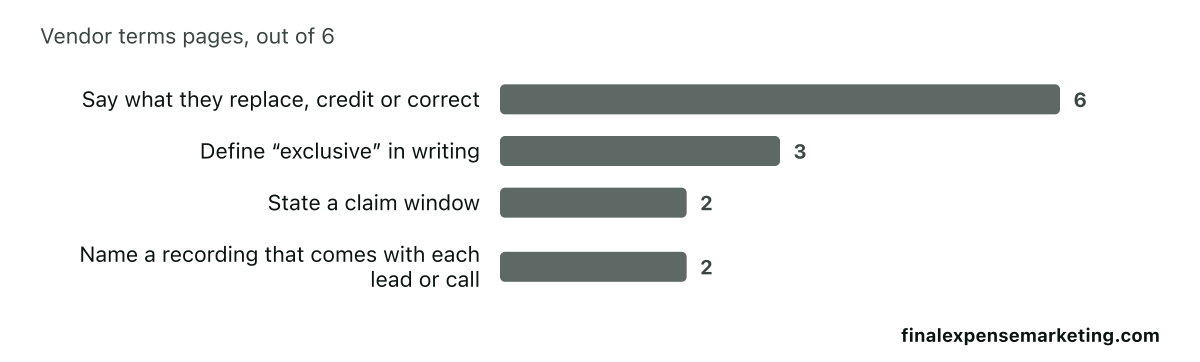
| Row | Vendor terms pages, out of 6 |
|---|---|
| Say what they replace, credit or correct | |
| Define “exclusive” in writing | |
| State a claim window | |
| Name a recording that comes with each lead or call |
Source: Final Expense Marketing review of six vendors’ published terms, October 22, 2026.
To vet a final expense lead vendor, get five things in writing before you pay: the consent text and whose name it carries, the certificate sent with each lead, the vendor’s definition of “exclusive”, the rule that makes a lead or transfer billable, and the replacement terms and claim window. Then audit the certificates on your first order.
Every answer a final expense lead vendor gives can be checked against something outside the sales call: the certificate maker’s documentation, the federal consent rule or the vendor’s published terms. This guide uses all three as published on October 22, 2026, and ends with 25 questions to send any vendor, us included.
What TrustedForm and Jornaya actually record
A consent certificate is evidence of a web session, not a legal verdict. The two systems named in our own campaign builds record that session differently. TrustedForm, made by ActiveProspect, issues a certificate URL for each form session. Jornaya issues a LeadiD token, which a buyer audits through Jornaya’s TCPA Guardian service. Since January 8, 2026 the two have one owner: ActiveProspect announced that day that it had acquired Verisk Marketing Solutions, a business “formed primarily through the combination of Infutor and Jornaya.”
TrustedForm certificate fields worth reading
Fields from ActiveProspect’s API reference that matter most when you vet a vendor:
| Field | What ActiveProspect’s documentation says | Check it against |
|---|---|---|
| created_at | “The UTC ISO8601 formatted date and time when the TrustedForm script was loaded” | The submit and delivery times on the lead record |
| page_url and domain | “The URL of the page hosting the TrustedForm script”, and that page’s domain | The source the vendor told you it uses |
| is_framed and parent_page_url | Whether “the form was displayed within an iframe”, and the parent page if it was | Whose site carried the form |
| approx_ip_geo | “Approximate geolocation based on IP” | The state on the lead, remembering the location is approximate |
| form_input_method | Whether the form was filled by “autofill”, “paste” or “typing” | A batch where most forms were pasted: ask why |
| age_seconds | “Number of seconds since the last user interaction with the certificate” | The vendor’s real-time delivery claim |
| expires_at | When “the claim period for the certificate will expire” | Your deadline to claim or retain it |
| masked_cert_url | “A certificate url that masks the lead source url and snapshot” | Whether you still get the consent text when the source is hidden |
What a Jornaya audit returns
Jornaya returns codes rather than a page replay. ActiveProspect’s documentation for its Jornaya TCPA Guardian integration lists, among others:
- Authentic: “True if LeadiD is authentic.”
- Data Integrity: a rating code, “0: mismatch, 1: match, 2: mismatch with disclosure, 3: default value.”
- Consent: whether TCPA consent was captured, coded from “0: none required” through “1: active consent, 2: passive consent” to “3: passive decline, 4: active decline”.
- Lead Age and Lead Duration: the lead’s age in seconds, and the “Time the consumer was on the form as a number of seconds.”
What neither system can show
Neither system shows who typed. ActiveProspect’s own guidance on answering a consumer’s complaint concedes that “it is still possible that someone else might have input their information into the form.” Neither shows, on its own, that the consent named you, that it met every element of the federal written-consent rule, or that the consumer has not revoked it since. The consent text and your own records answer those questions.
How to audit a vendor’s certificates before you scale
Run these checks on the first order, while the batch is small and every certificate is still inside its claim period.
- Get the certificate in the lead record. Each record should carry a TrustedForm certificate URL or a Jornaya LeadiD token at delivery, not on request after a complaint.
- Check the address before you claim. ActiveProspect tells account holders not to send a claim request “unless the URL starts with https://cert.trustedform.com, otherwise you may expose your TrustedForm credentials to someone else.”
- Claim or retain before expires_at. ActiveProspect deletes a certificate that is not retained within 90 days, “with no possibility of ever retrieving it”, and its API reference gives web certificates a 72-hour default claim period that extends to 90 days when the form’s submission is detected. A retained certificate is kept “per your account retention setting (defaults to 5 years).”
- Match the lead to the session. Retaining must be paired with ActiveProspect’s match_lead step, which “ensures that the lead with which you received the certificate matches the lead data collected on the cert.” Claim with the phone and email you were sent: if they differ from what the form collected, the claim warns “none of the provided fingerprints match”.
- Scan the page for your name. A claim can carry required and forbidden scan terms. If the vendor says the consent names your agency, put your agency’s name in the required list: a page that never showed it returns “string not found in snapshot”. ActiveProspect’s own example of a forbidden term is “free iPhone”.
- Compare the session with the record. The page_url should match the source the vendor named, and created_at should fall before the delivery time. An IP location far from the lead’s state is a question to ask, not proof of fraud.
- Audit every Jornaya token. Set aside any LeadiD that comes back not authentic, with a Data Integrity mismatch or with a consent decline code, and note whether consent was active or passive.
- Write down what failed. Record each failure and the vendor’s answer. That file supports any replacement claim and the decision to order again.
What the consent text has to say about you
The consent text, not the certificate, decides whom the consumer authorized. Under 47 CFR 64.1200(f)(9), written consent for telemarketing by autodialer or by artificial or prerecorded voice is a signed agreement that “clearly authorizes the seller” to make those calls, names the phone number, and discloses that signing authorizes those calls and is not a condition of purchase. Section 64.1200(f)(10) defines the seller as “the person or entity on whose behalf a telephone call or message is initiated” to encourage a purchase, so when you call a lead to sell a policy, the seller is you. Permission to call a number on the National Do Not Call Registry must be evidenced by a signed, written agreement stating that the consumer “agrees to be contacted by this seller” (64.1200(c)(2)(ii)).
The FCC’s 2023 rule limiting consent to one seller at a time never took effect. The Eleventh Circuit vacated it in Insurance Marketing Coalition v. FCC on January 24, 2025, and the FCC’s conforming rule took effect on August 29, 2025. A vendor offering “1:1 consent on every lead”, as TTC Leads’ statewide page does, is describing its own practice, not a federal requirement. Either way the useful question is whose name the text carries. Ask for:
- the exact consent text and its version date for the campaign you are buying, to read line by line against what each consent clause must say;
- whether it names your agency, the vendor alone, or a list of partners, and how many companies are on that list;
- which contact methods it covers: autodialed calls, artificial or prerecorded voices, and texts.
Revocation, do-not-call duties and state calling hours are set out in our summary of the federal consent rules and the records we keep. Nothing here is legal advice.
What “exclusive” means in writing
“Exclusive” means at least three different things on final expense vendor pages, and some pages use the word without saying which. The wording we found on October 22, 2026:
- One buyer per record. Lead Heroes: “You’ll be the only agent to ever receive these leads – period.” TTC Leads: “Your leads are never resold.” Our own wording, for exclusive leads built to order for one buyer, is that each lead is delivered to one buyer.
- One buyer per call. Liv Calls, which sells transfers: “that call is exclusive to you. No other agent gets it.” Neither transfer vendor page we read says whether a prospect transferred to you is offered to another buyer later.
- A time window. FexAds describes vendor-run Facebook leads on which “the lead is exclusively yours for at least 24 to 72 hours depending on the vendor.”
- No stated meaning. Game Changer Leads titles its Facebook leads “Exclusive Lead - County Specific” or “Exclusive Lead - Statewide”; its collection page does not define the term.
Territory is a separate promise. On this site, territory exclusivity is a separate paid reservation at $500 a month on top of normal purchases, and aged segments are sold as not exclusive, because an aged record may already have been sold to other buyers. Ask every vendor to put its definition in the order terms, including what happens to a record or a caller once your window ends.
When a lead or transfer becomes billable
A billable rule says when a unit counts against your money. A web lead is priced per lead or per pack, so its protection sits in the replacement clause. A live transfer needs its own rule, because a call can end before a real conversation starts. Published transfer rules differ in kind, not just in length:
- A buffer in seconds. Final Expense Leads Specialist sells 120-second and 180-second buffers, inside which “you can hang up without being charged.”
- A qualitative test. Liv Calls charges for “qualified, connected calls”, meaning calls that “connect and meet your criteria”; its page sets no minimum call length.
- A list of conditions. Ours: an interest-verified live transfer is billable only when all five billing rules hold, including at least 90 seconds connected, and pre-vetted transfers follow the same five rules. Four outcomes, among them the agent not closing, are not refundable.
Get three answers in writing, whatever form the rule takes: what starts the billing clock, what happens when the prospect fails a screening question after the buffer, and who pays for a transfer that rings while you are unavailable.
What vendors publish about replacements and credits
Every page below says something about replacements or credits, and no two say the same thing. Each row quotes or paraphrases the vendor’s own product page and any refund, replacement or terms page it links to, as published on October 22, 2026. Rows are sorted by vendor name.
Final Expense Marketing sells some of the products in this table; how we compiled it.
| Vendor (pages read October 22, 2026) | Replaced, credited or corrected | Claim window and remedy | “Exclusive”, as written | Consent or call evidence named |
|---|---|---|---|---|
| Badass Insurance Leads (aged lead product page; refund policy) | Data from a territory not chosen at checkout is corrected. Otherwise: “Leads are sold as is and no refunds will be given for any reason.” | No window stated; corrected data, no refunds | Not defined; the page says you will not be sent the same lead twice if you order with the same email address | None named |
| Final Expense Leads Specialist (live transfers page; refund and replacement policy) | Leads with missing information or outside your specified area, checked against the lead’s recording. Transfers: hang up inside the buffer at no charge | Seven days from receiving the leads; replacement leads; “we do not entertain refund requests” once leads are received | Not defined | Lead recordings “accompanying each generated lead” |
| Final Expense Marketing, this site (lead replacement policy) | Disconnected or wrong-person numbers, leads outside your agreed filters, duplicates within one order, materially false or missing fields, and a consent record that cannot be produced where required | Replacement or account credit, not a cash refund, claimed within 72 hours unless your order confirmation states another window | One buyer per record; territory is a separate paid reservation; aged leads are not exclusive | Consent capture with TrustedForm or Jornaya in every campaign build; consent records kept |
| Game Changer Leads (Facebook lead collection page; lead replacement policy, last updated 01-04-2024; refund policy) | Out-of-territory leads. With the paid Replacement Option: no phone number, disconnected numbers, non-existent or commercial addresses, duplicates in the same order, and final expense leads aged 81 and older. “Wrong phone numbers are not eligible for replacement.” | 48 hours from delivery of the last lead in the order; replacement leads; refunds “on a case by case basis” | “Exclusive Lead” in product titles; no definition on the collection page | None named |
| Lead Heroes (final expense leads page; order page terms) | “We’ll replace telemarketing leads that did not request more information; there are no replacements for orders” | No window stated; the order terms limit the remedy to commercially reasonable efforts to adjust or repair, and bar chargebacks | The only agent ever to receive the leads | None named for buyers; call recordings are “sent to management for review” |
| Liv Calls (final expense page) | Calls from the wrong state, for the wrong coverage type, or “not a genuine final expense inquiry” are not charged | No window stated; a credit requested “in one click from your dashboard” | Each call exclusive to one agency | Call recordings: “Full call recordings and transparent reporting on every transfer” |
| TTC Leads (statewide leads page) | “Duplicates, disconnected numbers, over 85’s and out of state leads are all covered.” | No window stated; lead credits | “Your leads are never resold.” | “1:1 consent on every lead”, and “1:1 Consent” among the data points listed for each lead; no certificate named |
Of the six other vendors, all six say what they replace, credit or correct. Three define “exclusive” in writing, two state a claim window, and two name a recording that comes with each lead or call: Final Expense Leads Specialist’s lead recordings and Liv Calls’ call recordings. Terms change, so check the live page and your order confirmation before you buy. Our full rules, including what we do not replace, are in the lead replacement and credit policy.
What record and delivery details to ask for
A sample record shows what you will be able to check later. Ask for one with every field filled in with dummy values, never a real consumer’s data, and compare it with this list:
| Field | Why you need it |
|---|---|
| Vendor lead ID | Names the lead in a replacement claim; Final Expense Leads Specialist’s policy asks for it |
| Submit time, with time zone | Dates the consent; compare it with the certificate’s created_at |
| Delivery time | Starts the claim window in both vendor policies above that state one |
| Source page URL and campaign | Lets you match the certificate’s page_url and question any page you did not approve |
| Consent text and version | Shows whose name the consumer agreed to, in the words they saw |
| Certificate URL or LeadiD token | Lets you claim, retain and audit before the claim period ends |
| Name, phone, state, and age or date of birth | Tests your filters; six of the seven sets of terms above cover leads outside your area |
| Buyers per record and original opt-in date | For shared or aged records: how many agents bought it before you, and how old the consent is |
| Screening answers and recording reference | For transfers and call-verified leads: what the prospect said, and where to hear it |
A transfer also leaves records on the vendor’s side. Ask whether the vendor keeps the Telemarketing Sales Rule records for transferred calls where that rule reaches your calls, and whether it will produce them in a dispute.
The delivery method decides how fast you can act and when a claim window starts. On the pages we read, TTC Leads says leads are delivered “to your portal and CRM in real-time”, Badass Insurance Leads says its leads “will be in CSV format and sent via email”, and Game Changer Leads counts a lead as delivered once it is placed on a Google Sheet shared with you. Ask which method you will get and whether each record carries both the submit and the delivery time. Our ordering, delivery and billing process keeps two clocks apart: the ramp (first leads within days, full volume in 2–4 weeks) and delivery latency (seconds after the consumer submits the form).
After the first order: how many leads before you judge, and the claim file
Check a first order for defects you can document before you judge its close rate. Telling two vendors apart on close rate can take hundreds of leads from each, as the example below shows, while the terms that state a claim window give you hours or days: 72 hours on our terms unless your order confirmation states another window, and 48 hours or seven days in the two other vendors’ terms above that state one.
How many leads a close rate needs
A close rate from a small batch is a range, not a number. Here close rate means sales ÷ leads bought, not ÷ conversations as in our calculator, because a vendor’s contact rate is part of what you are judging. Take 10 sales from 200 leads, an example rather than a benchmark: the rate is 5%, but its 95% Wilson interval, a method the NIST/SEMATECH e-Handbook sets out for proportions, runs from 2.7% to 9.0%. Telling apart two vendors whose leads close at 5% and 10% for you, again examples, takes 435 leads from each with a two-sided test at the 5% level and 80% power (the sample-size calculation in R’s power.prop.test, rounded up). That is $21,750 per vendor at $50 an exclusive web lead, or $30,450 at $70 a contact-verified lead.
Four record checks on the first batch
- Ages outside the band. Compare each record’s age or date of birth with your order’s age filter and count the misses. Our terms cover a lead outside the agreed age filter, Game Changer Leads’ paid option names final expense leads aged 81 and older, and TTC Leads’ page covers leads over 85.
- Duplicate phones across sources. Match the batch’s phone numbers against your CRM and every other source you buy from. A number that also came from another vendor can mean the consumer filled in two forms or that a record was sold more than once, so put each one to the vendor against its definition of “exclusive”. Our terms replace or credit a duplicate within one order.
- Do-not-call hits. Before anyone dials, check the batch against your own do-not-call list, the National Do Not Call Registry and each state list that binds you, and count the hits. A number on the national registry needs the signed permission naming you, described in the consent section above, or an exemption of your own before you call it, so read the consent text on each registry hit.
- Reassigned-number hits. Query the FCC’s Reassigned Numbers Database, a paid subscription, with each number and the date consent was given. A “yes” means the number has been disconnected, and possibly reassigned, since that date, and the FCC says the caller “should not call the number unless they have separate consent from the current holder of the number.” On a lead whose consent is days old, a “yes” is a question for the vendor.
The replacement-claim file and the stop-or-extend rule
Open one file per order when its first lead arrives, and work each lead inside its claim window: the calls that find disconnected or wrong-person numbers are also the evidence for a replacement claim. For each defect, note the lead ID if the vendor issues one, the phone number, the delivery date, what you found and when (an out-of-service message, a wrong person, an age outside your filter, a duplicate inside the order), and any certificate or token that failed the audit above. File each replacement claim inside its window and keep the vendor’s answer in the file.
Write the stop-or-extend rule down before the leads arrive. Stop on a failure no sample size excuses: consent text that does not name you when the vendor said it would, a certificate that fails its audit, or replacement claims the vendor will not answer under its own terms. For close rate, set the lead counts at which you will look before you start, and keep the looks few: every extra look raises the chance of a wrong stop or a wrong extension. At each look, take the interval on every lead bought so far, not only those since the last look, and set it against your break-even close rate per lead: the lead price ÷ your commission per sale after chargebacks, which is the break-even close rate our calculator returns × your contact rate. Stop when the interval’s upper end falls below it, extend when its lower end clears it, and treat an interval that still spans it as no answer yet.
Vendor red flags that already have an enforcement record
Federal agencies have already acted on four warning signs a buyer can spot. Each row pairs what you might see with what the agency described and the check that catches it.
| What you might see | What the agency described | The check |
|---|---|---|
| One checkbox that consents to calls from many companies | FTC, July 18, 2023: Fluent “has operated as a consent farm lead generator”, collecting consent through a “single click of a button or checkbox” to calls from “dozens or even hundreds of third parties.” The FTC said Fluent would pay a $2.5 million civil penalty and accept a robocall ban. | Read the partner list behind the consent; scan certificates for your name |
| Job offers or gift cards in the funnel | The same case: the FTC said Fluent drew consumers in “using deceptive ads that falsely promise employment opportunities or free valuable items.” | Ask to see the ads and pages behind your leads; add incentive words to your forbidden scan terms |
| Ads that look like a government program | FTC, August 7, 2025: MediaAlpha’s ads allegedly “faked an affiliation with the government”, and the FTC wrote that “MediaAlpha will pay $45 million.” | Refuse any funnel built on a government-program angle |
| Robocalls or prerecorded calls behind transfers or callbacks | FTC, July 18, 2023: “third-party lead generation for robocalls is illegal under the Telemarketing Sales Rule (TSR).” Its own guide adds that for insurance, whether the TSR applies “depends on the extent to which state law regulates insurance telemarketing.” | Ask how the vendor contacts consumers before they reach you |
Buying leads, appointments or transfers does not move your calling exposure to the vendor. In its 2013 DISH ruling the FCC said a seller “may be held vicariously liable under federal common law agency principles for a TCPA violation by a third-party telemarketer.” The FTC’s MediaAlpha post adds that “A company can’t avoid responsibility for deception it facilitates by intentionally burying its head in the sand.” The FTC wrote that about a lead generator, not a buyer; a dated vetting file is the buyer’s record of what it checked and when. Your own calls carry per-violation damages under the TCPA: for each violation of its autodialer and prerecorded-voice rules, 47 U.S.C. § 227(b)(3) lets a consumer recover $500 or actual loss, whichever is greater, and the court may raise the award to as much as three times that on finding the violation willful or knowing.
The 25-question vendor scorecard
Send these before the first order and file the answers with your order confirmation. Mark each one answered in writing, answered only on a call, or refused, and put the same 25 to us. For choosing a lead type and placing the order itself, see how to buy final expense leads.
Consent and certificates
- What exact consent text does my campaign use, and what is its version date?
- Does it name my agency, only your company, or a partner list, and how long is that list?
- Does every record arrive with a TrustedForm certificate URL or a Jornaya LeadiD token?
- Who claims or retains each certificate before it expires, and how long is it kept?
- If a consumer denies filling in the form, what evidence do you send, and how fast?
Exclusivity and resale
- What does “exclusive” mean in your order terms: one buyer per record or per call, a time window, or a territory?
- Is any record, or any prospect transferred to me, ever sold or offered to another buyer later? When?
- For shared or aged records, how many buyers has each record had, and do you show the original opt-in date?
- Is territory exclusivity sold separately, and what does it cost?
- Do you check new records against everything I have bought from you, or only within one order?
Billing and replacements
- What event makes a lead or transfer billable, word for word?
- For transfers, how many connected seconds start billing, and what happens if the prospect fails a screening question after that?
- Which defects do you replace or credit, and which outcomes do you exclude?
- How long is the claim window, what event starts it, and how do I file?
- Is the remedy a replacement, an account credit or cash, and what happens to prepaid money you cannot fill?
Records and delivery
- May I see a sample record with every field you deliver, filled with dummy data?
- How will records reach me (webhook, CRM integration, emailed file or shared sheet), and what happens when a delivery fails?
- Does each record carry both the consumer’s submit time and your delivery time?
- Which screening answers and recordings come with each transfer or call-verified lead?
- How long do you keep source, timestamp, landing page and consent records, and will you produce them in a dispute?
Sourcing and calling practices
- Which ads and landing pages produce my leads, and may I see them?
- Does any funnel use sweepstakes, gift cards, job offers or government-style claims?
- How are consumers contacted before they reach me: manual dialing, an autodialer, prerecorded or AI voices, or texts?
- For calls made on my behalf, do you scrub the National Do Not Call Registry and follow state calling hours?
- Has your company, or a source you buy from, faced a regulator action or a TCPA lawsuit, and what changed afterward?
A “yes” to the do-not-call question is where reading a vendor’s DNC-scrub claim starts: ask which lists the scrub covered, the registry download date behind it and whose registry account it ran under.
Written answers to all 25 give you terms to hold a vendor to. A refusal is an answer as well.