How to work aged final expense leads: an age-band dial plan
A band-by-band plan for dialing aged final expense records: consent, the 31-day registry scrub, reassigned numbers, state call caps, a cadence you set, CRM dispositions and cost per sale.
General information, not legal advice. This guide summarizes the rules in the sources listed at the end, as read on . Rules change, and they differ by state and by business, so check with a lawyer licensed where you call before relying on it.
On this page
- How to work an aged segment in eight steps
- What changes as an aged record gets older, and what doesn't
- Consent on an aged record: whose name it carries and how it ends
- How to scrub an aged segment before the first dial
- Calling windows and call caps for aged records
- A contact cadence you set inside those limits
- The CRM workflow: fields, dispositions and the clocks behind them
- Which age band pays: cost per sale with your own numbers
- When a setter desk should dial your aged records
- Questions
- Sources
Aged records each $100 of commission pays for, by age band
Whole records per $100 of commission after chargebacks, at published prices. Aged leads are not exclusive.
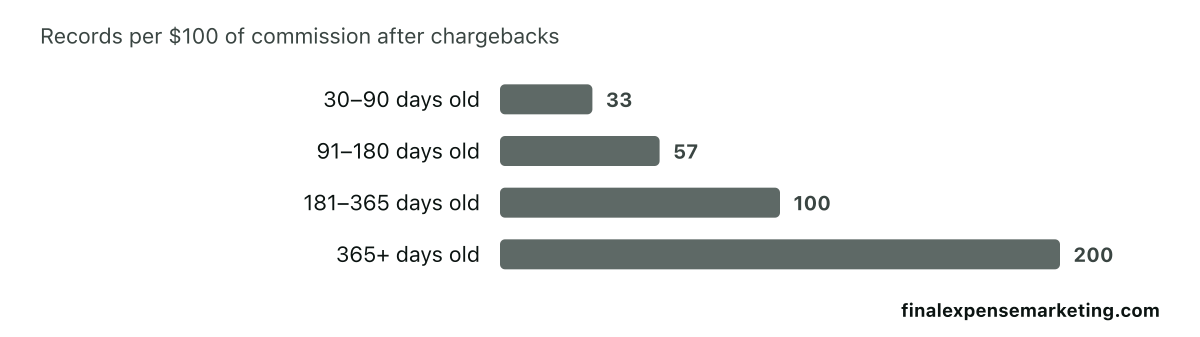
| Row | Records per $100 of commission after chargebacks |
|---|---|
| 30–90 days old | |
| 91–180 days old | |
| 181–365 days old | |
| 365+ days old |
Source: Final Expense Marketing published rate card, as of 2026-10-15. Record cost only; dialing time, data checks and tools excluded.
To work aged final expense leads, check whose name the consent carries, scrub every record against the National Do Not Call Registry on a 31-day clock, dial by hand unless the consent names you as the seller, keep inside each state's calling window and call cap, and judge each age band on cost per sale.
The price falls as an aged record gets older; the rules you dial under don't relax. On our rate card an aged record costs $0.50–$3.00 per lead by age band, while the consent, do-not-call and calling-hour rules are the same at 30 days as at three years. This plan works through each check, band by band, for licensed agents, agencies and call centers. It is not legal advice, and every rate in the math is yours: we publish no contact or close rates.
How to work an aged segment in eight steps
- Set up access before the segment arrives. Segments are delivered immediately on purchase, but a Reassigned Numbers Database account is not: its support team can take up to 7 calendar days to process a registration. Registry access for your area codes has to be in place before the first call, too.
- Load each record with its age band, opt-in date and consent text. Ask for the last two before you buy, because the consent check and the reassigned-number query run on them. Add two states: the one in the address and the one the phone number's area code belongs to. Calling hours need both.
- Read whose name the consent carries. If it doesn't name you or your agency as the seller, the record gets live, hand-dialed calls and nothing automated.
- Scrub before the first dial. Check every number against a registry copy no more than 31 days old, your own do-not-call list and the Reassigned Numbers Database, and log the date of each check.
- Set each record's calling window and daily cap from the consumer's time zone and the strictest state rule that could apply.
- Dial by hand, on a cadence written down in advance. Give your name, the business you call for and a callback number on every call.
- Disposition every attempt the same day. Stop requests go on your do-not-call list at once; wrong-person, disconnected and duplicate records go into a claim inside the window your order's replacement terms set.
- Re-scrub before day 31, then judge each band on cost per sale. Reorder the bands that pay and drop the ones that don't.
What changes as an aged record gets older, and what doesn't
An aged record is a consumer inquiry past its real-time window. Here "age band" always means the age of the record in days, never the consumer's age, and this plan counts it from the consumer's inquiry; confirm that your vendor's bands count from the same date. We sell aged final expense leads by state and age band, and the band sets the price:
| Record age | Price per lead |
|---|---|
| 30–90 days | $3.00 |
| 91–180 days | $1.75 |
| 181–365 days | $1.00 |
| 365+ days | $0.50 |
Aged leads are not exclusive unless they have genuinely never been resold. Work every record on the assumption that another agent has called it. A record that goes to you alone is a different product: exclusive leads, sold to one buyer per record.
The dial plan by age band
Four things move with a record's age: price, time since the inquiry, the federal inquiry window, and the time its number has had to change hands.
| Age band | Price per record | Time since the inquiry | Three-month inquiry window | Reassigned-number check |
|---|---|---|---|---|
| 30–90 days | $3.00 | One to three months | May still be open, but only for the business the consumer inquired with | Query with the opt-in date; a disconnected number must wait at least 45 days before it can be reassigned |
| 91–180 days | $1.75 | Three to six months | Closed for every business after three months | Query with the opt-in date |
| 181–365 days | $1.00 | Six months to a year | Closed | Query with the opt-in date |
| 365+ days | $0.50 | More than a year, with no upper limit | Closed | Query with the opt-in date; a date before January 27, 2021 can return “no data” |
Each band cuts the price and lengthens the gap since the inquiry; no band relaxes a rule. The 365+ days band adds one limit of its own, because an opt-in date before January 27, 2021 can return “no data” from the reassigned-number check.
What stays the same in every band
- Consent. Automated, prerecorded, AI-voice and ringless-voicemail contact needs written consent that names you as the seller, whatever the record's age.
- The registry. A registration stays in force until the consumer cancels it or the number is removed, so a record that was clean at 30 days can be registered at 300.
- Your own do-not-call list. A stop request binds you for five years under the federal rule, and for ten in Virginia.
- Calling windows and caps. They follow the consumer's state and time zone, not the age of the record.
- The exclusivity label. Aged records are not exclusive in any band.
Consent on an aged record: whose name it carries and how it ends
Two consents decide how you may call an aged record, and the consumer gave each, if at all, to whichever business the original form named:
- For automated or prerecorded calls: prior express written consent, a signed agreement that "clearly authorizes the seller" to call with an autodialer or an artificial or prerecorded voice (47 CFR 64.1200(f)(9)). The seller is the business the call is made for (64.1200(f)(10)); on your dials, that is you.
- For a registered number: "a signed, written agreement" in which the consumer "agrees to be contacted by this seller", with the number to call (64.1200(c)(2)(ii)).
Read the consent text before the first dial
If the consent text names your agency as the seller and carries the required signature and disclosures, it may support automated contact. If it names another business, it doesn't cover your calls. If it lists many companies or links to a list, ask your counsel whether your name on that list is enough. Before you buy, work through the consent questions to ask any vendor; our own practice is in how we keep consent and source records.
The inquiry window belongs to someone else
Federal do-not-call rules recognize an established business relationship from a purchase within 18 months or an inquiry "within the three months immediately preceding the date of the call" (64.1200(f)(5)). That relationship belongs to the business the consumer inquired with, and no wording in the rule hands it to a buyer of the record. Treat every aged record as carrying no relationship with you: a 30–90 day record can sit inside the window only for the original business, and once three months have passed it has closed for everyone.
Voicemail drops, ringless voicemail and AI voices
Without consent that names you, keep every touch live, which rules out ringless voicemail under another seller's consent. A voicemail you leave yourself on a hand-dialed call is a live message; a prerecorded drop is an artificial or prerecorded voice under 64.1200(a)(2) and (a)(3). The FCC found that ringless voicemail to a wireless phone "requires consumer consent because it is a 'call' made using an artificial or prerecorded voice" (FCC 22-85, 2022), and that those voice rules "encompass current AI technologies that generate human voices" (FCC 24-17, 2024). An AI voice agent needs the same consent as a prerecorded message.
Stop requests and revocation
Consent can be revoked "by using any reasonable method". A key-press opt-out, or a texted "stop," "quit," "end," "revoke," "opt out," "cancel" or "unsubscribe", counts automatically; you have ten business days to honor it and, until FCC 26-67 takes effect, may not require one exclusive way to revoke (64.1200(a)(10)). On a hand-dialed sales call, "don't call me again" is a do-not-call request, recorded "at the time the request is made" (64.1200(d)(3)).
A change is pending. Under FCC 26-67, adopted September 30, 2026, a revocation sent in reply to a telemarketing call or text will end consent to all of that caller's future telemarketing, and a caller that discloses its chosen method may limit revocation to an automated key-press or voice opt-out, a standard reply word, or a website or number it names. The order takes effect 30 days after Federal Register publication. As of October 22, 2026 it had not been published; search federalregister.gov for FCC 26-67 to find its publication date and count 30 days from it. Build for it now: one suppression flag per phone number, across every campaign and each vendor and setter dialing for you.
How to scrub an aged segment before the first dial
Run all three checks before any aged record is dialed, whatever a vendor's "scrubbed" label says about each list a segment must clear. Two of the checks expire while you work the segment.
The National Do Not Call Registry, on a 31-day clock
No telephone solicitation may go to a registered number without the signed agreement above or a business relationship of your own, and a registration "must be honored indefinitely" until the consumer cancels it or the number is removed (64.1200(c)(2)). The rule's safe harbor for errors needs written procedures, trained callers, a recorded list of numbers you may not call, and a registry version obtained "no more than 31 days prior to the date any call is made", with records of the process (64.1200(c)(2)(i)).
That 31-day clock keeps running while you work a segment. A scrub is only as current as the registry download behind it, so a segment you work for six weeks needs a re-scrub against a fresh download before the first one turns 31 days old. Store "scrub valid until" on each record and let the CRM block dials past it.
The safe harbor also requires buying your own access from the registry's administrator, with no cost-sharing arrangement (64.1200(c)(2)(i)(E)). In fiscal year 2027 the first five area codes are free, each additional one costs $85 a year, and access to all area codes nationwide is capped at $23,425 (FTC, August 26, 2026).
Your own do-not-call list
Every business making telemarketing calls needs a written do-not-call policy "available upon demand", trained callers, a record of each request made when it is made, and honoring within ten business days (64.1200(d)(1)–(3)). A request lasts five years federally (64.1200(d)(6)) and at least ten in Virginia (Va. Code §59.1-514). Each call must give the caller's name, the business the call is made for and a telephone number or address (64.1200(d)(4)), and these rules reach telemarketing texts to cell phones too (64.1200(e)). Never let a do-not-call flag expire, and keep one list for everyone calling under your business name.
Reassigned numbers: query with the opt-in date
The FCC estimated in 2018 that about 35 million numbers "are disconnected and made available for reassignment to new consumers each year" (FCC 18-177), and it created the Reassigned Numbers Database to catch them. A query takes the number and a date, normally the opt-in date, and returns one of three answers:
- Yes: the number was permanently disconnected on or after that date, so it may no longer reach the consumer on the record.
- No: no permanent disconnection since that date. It doesn't make the number safe to call: the consent, do-not-call and calling-hour rules apply whatever the answer.
- No data: the number is not in the database and the date is before January 27, 2021, so the check can't clear it.
A disconnected number must sit at least 45 days before it is reassigned, and the database expects callers to query monthly, so re-query any record you are still dialing a month on. Its safe harbor covers only the consent rules for autodialed and prerecorded or artificial-voice calls, and only a caller that held consent for the number when the database wrongly answered "no" (64.1200(m)); on hand-dialed aged records, the query catches numbers that may reach a stranger before you spend a dial. Maine goes further: since August 9, 2024, a telephone solicitor must use the database to check that a Maine consumer's number has not been reassigned before a telephone sales call, live calls included (10 M.R.S. §1499-B(6)).
A vendor that scrubs or dials for you may run the query, but a check against a commercial reassigned-number database earns no safe harbor: the FCC declined to extend it to other commercial databases (FCC 18-177). The FCC's consumer bureau clarified in 2022 that a caller may rely on a query made "by a duly authorized agent", but the caller, not the agent, must prove that the most recent version of the database was queried and wrongly answered "no", and that it authorized the agent before the calls (DA 22-378). A Reassigned Numbers Database Tier 1 subscription costs $8 for 1,000 queries over a month or $86 for 12,000 over a year (pricing effective April 28, 2025): $0.008 a query, about 1.6% of the price of a $0.50 record.
Calling windows and call caps for aged records
Federal rules allow telephone solicitations between 8 a.m. and 9 p.m. at the called party's location (64.1200(c)(1)). Several states are stricter, and the stricter rule is the one you dial to. These five rules were checked against the statute or regulation text on October 22, 2026:
| Jurisdiction | Calling window, consumer's local time | Calls per 24 hours, same subject | What else applies |
|---|---|---|---|
| Federal (47 CFR 64.1200) | 8 a.m.–9 p.m. | No federal count | Abandoned calls capped at 3% of live-answered telemarketing calls per campaign, measured over each 30-day period, with two seconds to connect a live person |
| Florida (Fla. Stat. §501.616, §501.059) | 8 a.m.–8 p.m. | 3, "regardless of the phone number used" | Binds licensed agents too (§501.604); area-code presumption; consent for an automated system "for the selection and dialing" of numbers |
| Maryland (Laws of 2023, Ch. 413; in force January 1, 2024) | 8 a.m.–8 p.m. | 3, regardless of the numbers used | No insurance exemption; area-code presumption; consent for an automated system "for the selection or dialing" of numbers |
| Oklahoma (15 O.S. §775C; in force November 1, 2022) | 8 a.m.–8 p.m. | 3, regardless of the number used | As enacted, exempts licensed insurance agents soliciting within their license (§775C.5), a text that names licensed persons only |
| Virginia (Va. Code §59.1-511, §59.1-514) | 8 a.m.–9 p.m., unless the consumer gave prior consent | No count | Stop requests kept at least 10 years; texts opted out by "STOP" or "UNSUBSCRIBE" |
Compute each record's window from both the address and the area code, and dial only when both are open, because Florida, Maryland and Oklahoma presume that a call to one of their area codes reaches someone in the state. Don't rotate caller IDs to stretch a cap that counts calls "regardless of the phone number used". And transmit caller ID, never show a different number to hide who is calling, and display one that takes do-not-call requests during business hours (64.1601(e); Fla. Stat. §501.616(7)).
Whether a power dialer or click-to-dial tool is an automated system under the Florida, Maryland or Oklahoma wording is a question for counsel; dialing by hand, one number at a time with a person on the line, is the cautious default. Other states set their own hours and caps, so read the statute behind each state's hours before your first call there.
A contact cadence you set inside those limits
The rules set ceilings, not a schedule. Write your cadence down before the first dial, apply it the same way in every band, and change it only when your own dispositions say so. This table supplies no contact rates: it pairs each setting with the ceiling it sits under.
| Setting | What you decide | The ceiling it sits under |
|---|---|---|
| Calling window | One window for every record: 8 a.m. to 8 p.m. in the consumer's time zone meets every window in the table above | Federal 8 a.m.–9 p.m.; Florida, Maryland and Oklahoma 8 a.m.–8 p.m. |
| Calls per record per day | A cap the CRM enforces, at three or fewer, counted per person across all of their records | Three per 24 hours in Florida and Maryland, and in Oklahoma for callers outside its exemption |
| Length of the cadence | A fixed number of days, with a re-scrub scheduled inside it | A registry copy no more than 31 days old on every call |
| Voicemail | A live message from you: your name, the business you call for and a callback number | No prerecorded drops or ringless voicemail without consent that names you |
| Text messages | Treated like calls: the same window, cap and checks; automated texts only where the consent names you | Do-not-call rules reach texts, and "stop" ends consent |
| A short sequence from your own domain | CAN-SPAM: identify the message as an ad, show a valid postal address, honor opt-outs within 10 business days | |
| Stop rule | The attempt count after which a record closes | A do-not-call request ends contact at once, whatever the count |
In a July 2020 Pew Research Center survey of 10,211 U.S. adults, eight in ten said they don't generally answer their cellphone when an unknown number calls, and 67% said they don't answer but do check a voicemail if one is left. A live message with your name, the business and a callback number gives a prospect who screens calls a reason to call back. Hiya, which labels calls as spam, flags numbers whose calling patterns match "known spam behavior (high volume, short duration)", so plan the cadence around keeping your numbers clear of spam labels.
The CRM workflow: fields, dispositions and the clocks behind them
Each rule above needs a field or a disposition in your CRM, on screen at the moment of the dial.
Fields every aged record needs
- Source: segment ID, age band, purchase date and opt-in date.
- Consent: the consent text, the seller or sellers it names, and a yes or no for "names us".
- Location: the address state, the area-code state and a time zone for each; the calling window is the overlap.
- Checks: the registry download date and result, "scrub valid until" (download date plus 31 days), the company-list check, and the reassigned-number query date and answer.
- Attempts: date, the consumer's local time, the number you called from, the result, and a running count for the last 24 hours.
- Outcome: application date, issue date and first-premium date, so your close rate counts issued, paid policies.
Dispositions and what each one triggers
| Disposition | What you do | The clock that applies |
|---|---|---|
| Do not call, or stop | Put the number on your do-not-call list at the time of the request and suppress it in every campaign | Honored within 10 business days and kept 5 years (10 in Virginia), so never expire it |
| Wrong person | Stop calling that number for the record and file a claim | The claim window in your order's replacement terms |
| Disconnected | File a claim and skip the remaining attempts | The same claim window |
| Duplicate in the same order | Merge the records and file a claim | The same claim window |
| No answer, or voicemail left | Log it against the 24-hour count and schedule the next attempt | The record's window and cap; not a defect |
| Not interested | Close the record, or schedule a later attempt if your written cadence allows one | Not a defect; "don't call me" turns it into a do-not-call request |
| Bought a policy elsewhere | Close the record | Not a defect |
Which of these defects earn a replacement or credit, and inside what window, depends on the replacement terms on your order. Read the defects our replacement policy covers before you build the claim step into your workflow.
Which age band pays: cost per sale with your own numbers
The calculator's formula holds for aged records with one step added in front, because a scrub removes records you have already paid for:
- Dial-ready share = records left after your scrubs ÷ records bought.
- Cost per dial-ready record = price per record ÷ dial-ready share.
- Cost per contact = cost per dial-ready record ÷ contact rate.
- Cost per sale = cost per contact ÷ close rate, counting a sale when the policy is issued and the first premium is paid.
Records your scrubs remove stay in your cost unless the replacement terms on your order credit them, so check which defects those terms cover. Record all three rates separately for each band, because a blended rate hides the band that is carrying the others.
How many records one sale can afford
Divide your commission per sale after chargebacks by the price per record, and you have the most records one sale can consume before the records alone cost more than the commission. Per $100 of that commission, the published prices give:
| Age band | Price per record | Records each $100 of commission pays for |
|---|---|---|
| 30–90 days | $3.00 | 33 |
| 91–180 days | $1.75 | 57 |
| 181–365 days | $1.00 | 100 |
| 365+ days | $0.50 | 200 |
Multiply the last column by your own commission per sale after chargebacks ÷ 100. The table counts record cost only: dial time, your dialer and CRM, registry access and reassigned-number queries come on top. Run your own rates through the final expense lead cost calculator and reorder the band with the lowest cost per sale, not the lowest price.
When a setter desk should dial your aged records
Aged segments carry no minimum spend, so a floor can buy more records than its agents can dial inside the windows above. At that point the purchase to weigh is calling capacity, not data: a final expense setter desk, where you hire callers who follow up the leads you already have on a defined attempt schedule. Seats run $1,500–$4,000 a month, sized by new leads, so ask whether a desk works aged records, and how they count toward a seat, before you plan around one. Buying a booked meeting is a different product, preset appointments, and needs no records of your own.
Calls a setter makes for you are made on your behalf. Every do-not-call request the desk records has to reach your own list, because the rule makes the business the calls are made for liable when another party keeps the list (64.1200(d)(3)). When you are ready to test a band, order an aged segment for one licensed state.