Final expense appointment setter cost: in-house, setter desk or preset appointments
What a kept final expense appointment costs under three models: an in-house setter priced from BLS wage data, a setter desk seat, or a preset appointment, with the break-even math and the calling rules for each.
General information, not legal advice. This guide summarizes the rules in the sources listed at the end, as read between and . Rules change, and they differ by state and by business, so check with a lawyer licensed where you call before relying on it.
On this page
- Final expense appointment setter cost: the three ways to pay
- What does an in-house appointment setter cost?
- What does a setter desk seat cost per lead worked?
- What does a preset appointment cost per kept appointment?
- Side by side: monthly cost and the break-even against buying kept appointments
- How to work out your own cost per kept appointment
- Who carries the calling and licensing rules in each option?
- Which option fits your lead volume and team?
- Questions
- Sources
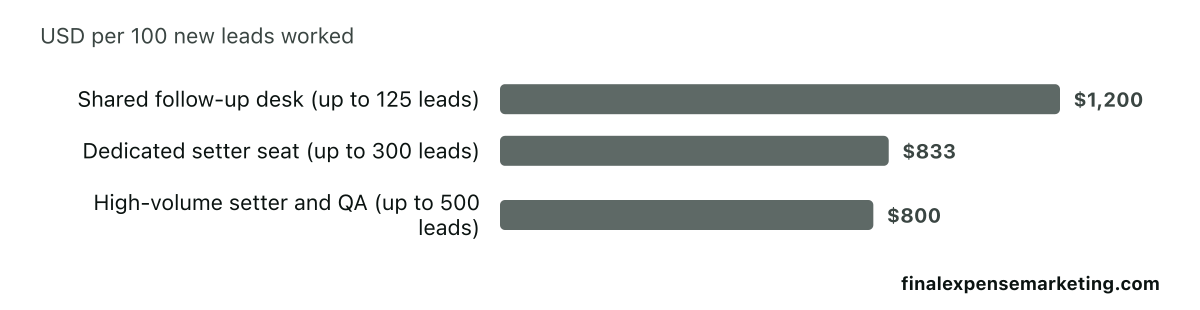
Setter desk cost per 100 new leads worked, seat filled to capacity
Monthly seat fee ÷ seat capacity in new leads a month, × 100. Lead costs are separate.
| Row | USD per 100 new leads worked |
|---|---|
| Shared follow-up desk (up to 125 leads) | |
| Dedicated setter seat (up to 300 leads) | |
| High-volume setter and QA (up to 500 leads) |
Source: Final Expense Marketing published rate card, as of 2026-10-15. Calling capacity, not appointments.
Final expense appointment setter cost depends on which of three things you pay for. An in-house setter costs wages, plus benefits and tools: Bureau of Labor Statistics (BLS) data put the median telemarketer at $17.04 an hour in May 2025. A setter desk seat costs $1,500–$4,000 a month plus your leads. A kept preset appointment costs $225, prospect included.
This guide prices all three for licensed final expense agents, agencies and call centers: the in-house setter from public wage data, the other two from one published rate card. We publish no appointment counts, show rates or kept rates for any of them. Wherever a result depends on how many appointments you keep, you get the formula and the break-even, not a forecast.
Key takeaways
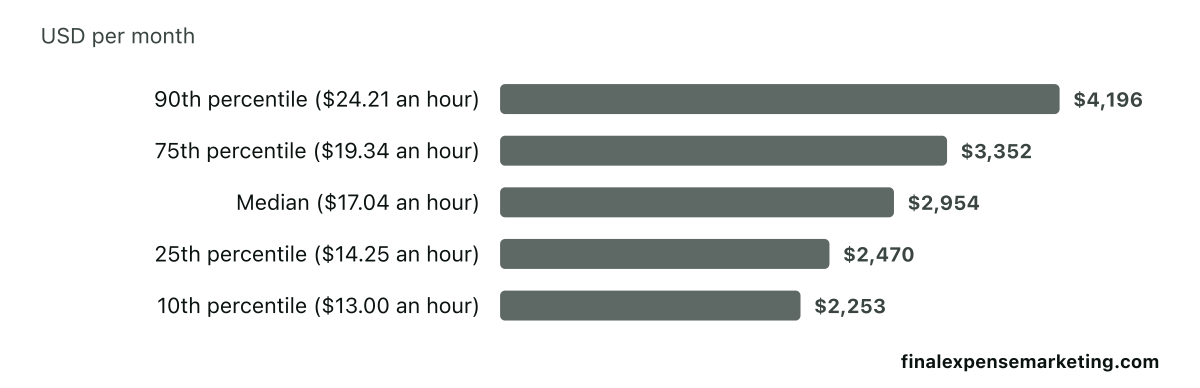
- One full-time telemarketer paid the BLS median wage costs $2,954 a month in wages alone, before benefits, phone, CRM and supervision.
- A setter desk seat filled to capacity costs $800 to $1,200 per 100 new leads worked, and twice that half full. Leads cost extra.
- Kept billing fixes the price of a kept preset appointment at $225. With a setter or a desk, that cost depends on how many appointments your leads produce.
- With a setter or a desk, the calls are made on your behalf: each call must name your agency, and do-not-call failures are yours to answer for.
Final expense appointment setter cost: the three ways to pay
A kept final expense appointment can be paid for three ways: wages for a setter you employ, a monthly seat for callers you hire, or a price per meeting you buy. Each one puts something different on your invoice and leaves a different risk with you.
| Compare | In-house setter | Setter desk | Preset appointments |
|---|---|---|---|
| The bill pays for | An employee's hours | A monthly seat sized by new leads | Each meeting booked for you |
| Price basis | Wages, plus benefits, payroll taxes, tools and supervision | $1,500–$4,000 a month per seat; lead costs separate | $175 per confirmed or $225 per kept appointment |
| Leads needed | Yours, bought or generated | Yours, sent to the desk | None: the prospect is part of the purchase |
| Capacity | Whatever the hours you pay for can work | Up to 125, 300 or 500 new leads a month, by seat | The appointments you order |
| When few appointments are kept | Wages are owed anyway | The seat fee is the same | Kept billing: you pay only for kept ones. Confirmed billing: the no-show terms apply |
The in-house setter and the desk do the same job, following up leads you already have; they differ in who employs the caller. Preset appointments skip the job: you buy a booked meeting, and the prospect comes with it. One definition of a kept appointment runs through this guide, the rate card's: The prospect attended, or completed a substantive telephone consultation. The desk sits with the other final expense marketing services, including managed advertising.
What does an in-house appointment setter cost?
An in-house appointment setter costs wages for the hours you schedule, the employer costs that ride on those wages, and the phone, software and supervision the job needs. Public data covers the first two. The rest you price yourself.
Wages: what BLS measured for telemarketers
This guide uses the BLS telemarketer occupation, SOC 41-9041, as the wage benchmark for an outbound setter. BLS defines telemarketers as workers who “solicit donations or orders for goods or services over the telephone,” which we treat as the closest published match to calls that book sales appointments. Its Occupational Employment and Wage Statistics for May 2025 count 58,430 telemarketers nationwide. Their median wage was $17.04 an hour and their mean $17.97.
| BLS wage, May 2025 | Per hour | Per month at 40 hours a week | Per month at 20 hours a week |
|---|---|---|---|
| 10th percentile | $13.00 | $2,253 | $1,127 |
| 25th percentile | $14.25 | $2,470 | $1,235 |
| Median | $17.04 | $2,954 | $1,477 |
| 75th percentile | $19.34 | $3,352 | $1,676 |
| 90th percentile | $24.21 | $4,196 | $2,098 |
| Median, insurance agencies and brokerages | $17.25 | $2,990 | $1,495 |
Each monthly figure is the hourly wage × hours a week × 52 ÷ 12, wages only. Telemarketers in the industry that includes insurance agencies (BLS's “Agencies, Brokerages, and Other Insurance Related Activities”) earned a median $17.25 an hour across 2,330 jobs. Pay also varies by place: Colorado had the highest state mean, $24.71 an hour. Price the role with your own state's figure from the BLS profile.
Benefits and payroll costs on top of wages
Wages are not the whole employer bill. The BLS Employer Costs for Employee Compensation survey for June 2026 puts benefits at 24.7% of total compensation for private-industry sales and related workers: $8.86 of $35.85 per hour worked. Legally required benefits alone, meaning Social Security, Medicare, federal and state unemployment insurance and workers' compensation, came to 7.5%.
That average mix is a benchmark, not your plan. If your benefits follow it, wages are 75.3% of what a setter costs you, so divide wages by 0.753. A full-time setter at the median then costs about $3,922 a month. Your own figure depends on what you offer: paid leave, a health plan or a retirement match each move it.
What the wage data leaves out
BLS measures pay, not the cost of running a calling seat. These lines are yours to price, and none of them has a public benchmark this guide could cite:
- Phone and dialer: lines, minutes and any dialer subscription.
- CRM: a user seat for the setter, plus the calendar the setter books into.
- Recruiting and training: job ads, interviews and the training time before a new setter works alone.
- Supervision: your time or a manager's, spent reviewing calls and dispositions.
- Coverage: leads arrive outside a single shift, and a second shift is a second wage line.
The setter desk's published attempt schedule is a fair yardstick for the work one new lead takes:
- First attempt within five minutes during coverage hours
- Six to eight call attempts
- SMS and email follow-up
- Appointment confirmation
- CRM disposition notes
- Weekly contact and appointment report
At six to eight call attempts a lead, following up 300 new leads a month means 1,800 to 2,400 call attempts, before texts, emails and confirmations. Count the attempts your setter could make in the hours you pay for before you set a wage beside a seat.
What does a setter desk seat cost per lead worked?
A setter desk seat costs a flat monthly fee for a block of calling capacity. Seats are sized by new leads a month, and the fee excludes the leads. Divide the fee by the leads you actually send, and you have the cost of each lead worked; the table shows it per 100 leads.
| Seat | Monthly fee | Capacity | Per 100 new leads worked, seat full | Per 100 new leads worked, seat half full |
|---|---|---|---|---|
| Shared follow-up desk | $1,500 | Up to 125 new leads | $1,200 | $2,400 |
| Dedicated setter seat | $2,500 | Up to 300 new leads | $833 | $1,667 |
| High-volume setter and QA | $4,000 | Up to 500 new leads | $800 | $1,600 |
Larger seats cost less per lead worked, but only when full: $800 per 100 leads on the high-volume seat against $1,200 on the shared desk. The fee is per month, not per lead, so capacity you leave empty still costs you. Take the smallest seat whose capacity covers your monthly flow. CRM and automated nurture, $500 to set up and $350 a month, adds SMS and email automation without a caller.
A seat buys calling capacity, not a number of appointments. No appointment count is promised, and the weekly report shows what the attempts produced. The setter desk page sets out seat prices, the attempt schedule and state calling limits in full.
What does a preset appointment cost per kept appointment?
A preset appointment on kept billing costs $225 per kept appointment, and that is the whole cost. You pay no wages, no seat fee and no lead costs, because you buy a booked meeting and the prospect comes with it. It is the only model of the three that prices a kept appointment before you start.
Confirmed billing costs less per appointment, $175, and leaves more of the no-show risk with you. These terms apply to confirmed appointments:
- One free rebooking attempt if a confirmed appointment no-shows
- Replaced if the prospect denies ever agreeing to the appointment
- No automatic refund for every no-show
On confirmed billing, your cost per kept appointment is $175 ÷ the share of confirmed appointments that end up kept. If fewer than 77.8% are kept, kept billing costs less per kept appointment. Above that share, confirmed billing does.
The minimum first order is 5 appointments or $1,250, whichever is higher. You still supply calendar time, by phone or at the kitchen table, so ask which format is offered in your licensed states. The product page covers confirmed and kept billing, with the no-show terms, and the steps for measuring your own kept share.
Side by side: monthly cost and the break-even against buying kept appointments
Put the three models on one month and one question. How many kept appointments must an in-house setter or a desk seat produce before it costs less per kept appointment than buying them at $225? That number is a break-even, not a forecast: no kept count is measured or promised for any model here.
| Monthly line | In-house setter, full time at the BLS median | Dedicated setter seat | Kept preset appointments |
|---|---|---|---|
| Caller | $2,954 in wages, or about $3,922 at the average benefits mix | $2,500 seat fee | None |
| Phone, CRM and supervision | Yours to price | Your CRM and calendar | Your calendar |
| Leads | Yours to buy or generate | Yours to buy or generate, up to 300 new leads a month | Included in the price |
| Cost per kept appointment | Monthly total ÷ kept appointments | Monthly total ÷ kept appointments | $225 |
| Break-even, caller cost only | 13.1 kept appointments a month on wages, 17.4 at the average mix | 11.1 kept appointments a month | Not applicable |
Wages alone for one full-time setter at the BLS median, $2,954 a month, already exceed the $2,500 dedicated seat fee before benefits, tools or supervision. That compares cost, not output. The seat's capacity is published and capped; your employee's output depends on the hours and management you give it.
Break-even with lead costs included
Leads change the comparison, because a preset appointment includes the prospect and the other two models do not. If your leads are already paid for and sitting unworked, compare the caller cost alone. If you would buy leads to feed a seat, add them:
| Seat, filled to capacity | Leads already paid for | Plus aged leads, 30–90 days old, at $3.00 each | Plus exclusive web leads at $50 each |
|---|---|---|---|
| Shared follow-up desk, 125 leads | 6.7 (5.3% of leads) | 8.3 (6.7%) | 34.4 (27.6%) |
| Dedicated setter seat, 300 leads | 11.1 (3.7% of leads) | 15.1 (5.0%) | 77.8 (25.9%) |
| High-volume setter and QA, 500 leads | 17.8 (3.6% of leads) | 24.4 (4.9%) | 128.9 (25.8%) |
Each cell is the number of kept appointments a month at which the seat, plus those leads, costs the same as buying kept appointments at $225. The share in parentheses is that number as a share of the leads worked. With exclusive web leads, the leads set the bar, not the seat: about one lead in four has to become a kept appointment. Aged leads lower the bar because they cost less, and they are not exclusive. Weigh aged leads, sold by state and age band against exclusive web leads, one buyer per record before you choose what feeds a seat.
How to work out your own cost per kept appointment
Your cost per kept appointment is one month's total cost for a model, divided by the appointments kept that month. Every input below is yours, and none has a default.
- Total the caller cost for one month. For an in-house setter: hourly wage × hours a week × 52 ÷ 12, plus your benefits, payroll taxes, phone, CRM, recruiting and supervision. For a desk: the seat fee.
- Add the leads worked that month. Leads bought × price per lead. Count leads already paid for when you judge the whole program; leave them out when you judge only the calling.
- Count kept appointments. Use one definition for every model, such as the rate card's: The prospect attended, or completed a substantive telephone consultation. A booked or confirmed appointment is not a kept one.
- Divide. Step 1 plus step 2, divided by step 3, is your cost per kept appointment.
- Compare and carry it forward. Set the result beside the $225 kept price and the break-even counts above. Then type it into the calculator for cost per sale as your price, with a 100% contact rate as the calculator suggests for kept appointments and your own close rate, to see cost per sale and the close rate you need to break even.
Run it on at least a full month of appointments, separately for each lead source. Re-run it whenever a wage, a seat fee or a lead price changes.
Who carries the calling and licensing rules in each option?
You carry most of the calling and licensing rules when you use an in-house setter or a desk, because the calls are made on your behalf. With preset appointments, it depends on the arrangement. Across the three, what changes is who places the call and how much of the arrangement you control.
The seller and the telemarketer
Federal telemarketing rules name two roles. The seller is “the person or entity on whose behalf a telephone call or message is initiated for the purpose of encouraging the purchase or rental of, or investment in, property, goods, or services.” In the rule's sense, the telemarketer is the person or entity that initiates the call (47 CFR 64.1200(f)(10) and (f)(12)).
- In-house setter: your agency is both. Every duty, from naming the caller to keeping the do-not-call list, runs through your own staff and systems, including the dialer: check which dialer modes need written consent before you choose one.
- Setter desk: the desk places the calls and your agency stays the seller. Each call must name the caller and your agency and give a number or address where you can be reached (64.1200(d)(4)). If the desk keeps the do-not-call list and misses a request, the liability is yours (64.1200(d)(3)). The FCC has also said a seller “may be held vicariously liable under federal common law principles of agency” for violations “committed by third-party telemarketers” (FCC 13-54, 2013).
- Preset appointments: the company you buy the appointments from makes any booking calls. Whether those calls are made on your behalf depends on the arrangement, so ask whose name they give and what the prospect consented to. The vicarious-liability ruling is why the answer matters.
What an unlicensed setter may say
Whoever employs the setter, the script has the same limit. Florida's rule on unlicensed agency personnel says an unlicensed person “may telephone persons to set appointments for licensed and appointed agents” (appointed in the licensing sense: an insurer has given the agent authority to transact insurance on its behalf, Fla. Stat. § 626.015(4)). The same rule adds: “The unlicensed person may not engage in a substantive discussion of insurance products” (Fla. Admin. Code R. 69B-222.060). New York's Insurance Department drew a similar line in 2004. Its opinion says telemarketing firms may call to learn whether a prospect wants to speak with a licensed agent “if there is no discussion of specific insurance policy terms and conditions,” and it adds a condition on their pay, covered below (OGC Opinion 04-04-20). An in-house script is yours to write and police. On a desk or preset program, ask to see the script.
How you may pay a setter
Pay design is where the in-house model carries a risk the other two do not, because you write the pay plan. The NAIC Producer Licensing Model Act, a model law whose state versions govern, says an insurer or producer “shall not pay a commission, service fee, brokerage or other valuable consideration to a person for selling, soliciting or negotiating insurance” if that person must be licensed and is not (§13A). New York's 2004 opinion approved a non-licensee's calls on condition that “the non-licensees' compensation is not based on the purchase of insurance.”
An hourly wage is not based on policies sold, and neither is a desk billed by the seat. A bonus for each policy sold is, so keep it out of an unlicensed setter's pay. Whether a bonus per appointment set or kept is allowed in your states is a question for counsel before it goes into an offer letter.
AI voices
An AI voice does not get around these rules. In 2024 the FCC confirmed that the TCPA's restrictions on “artificial or prerecorded voice” calls “encompass current AI technologies that generate human voices” (FCC 24-17). A telemarketing call to a cell phone in an artificial voice needs “the prior express written consent of the called party” (47 CFR 64.1200(a)(2)). Check what each lead consented to before any AI setter dials it. Ask the same before you buy avatar and AI-voice leads from vendors: in 2020 the FCC's consumer bureau ruled that a call opened with recorded clips needs the same consent as any other prerecorded-voice call, unless an exemption applies, even when a live agent plays them (DA 20-1507). None of this is legal advice, and state calling windows and 24-hour call caps add their own limits.
Which option fits your lead volume and team?
Start from two facts you already know: whether you have leads, and how many new ones arrive each month. The rest of the choice follows from them.
| Your situation | Price this first | Why |
|---|---|---|
| No leads of your own, or no time to work them | Preset appointments on kept billing | The price of a kept appointment is fixed in advance, and the prospect comes with it |
| Up to 125 new leads a month going unworked | Shared follow-up desk | The smallest seat that covers the flow |
| 126 to 300 new leads a month | Dedicated setter seat | Sized for up to 300 new leads a month |
| 301 to 500 new leads a month | High-volume setter and QA | Sized for up to 500 new leads a month |
| More than 500 a month, or you want your own script, hours and dialer | An in-house team, or more than one seat | You control the work and carry the employer costs and the rules above |
Team shape adjusts the answer. For a solo agent, every hour spent dialing is an hour not spent presenting, which favors buying appointments or hiring a seat over employing someone you must manage. An agency has more calendars to fill and may have a manager who can supervise a setter. A call center that already runs a dialer and a supervised floor adds mostly wages when it adds a setter.
The sales channel matters as well. Field agents need in-home appointments and telesales agents need phone appointments, so ask each option which format it books before you price it. If the bottleneck is lead supply rather than calling time, start with how to buy leads to feed a setter. If you already have leads and the gap is calling time, price a setter desk seat for your lead flow.
Monthly wages for one full-time telemarketer, by BLS percentile
Hourly wage × 40 hours × 52 weeks ÷ 12. Wages only: no benefits, payroll taxes, tools or supervision.
| Row | USD per month |
|---|---|
| 90th percentile ($24.21 an hour) | |
| 75th percentile ($19.34 an hour) | |
| Median ($17.04 an hour) | |
| 25th percentile ($14.25 an hour) | |
| 10th percentile ($13.00 an hour) |
Source: U.S. Bureau of Labor Statistics, Occupational Employment and Wage Statistics, May 2025, SOC 41-9041 Telemarketers.