Caller ID reputation for final expense call floors: why calls show “Spam Likely” and what fixes it
Spam labels on a final expense floor’s calls come from dialing patterns, number history and recipients’ reports, and attestation and branded caller ID don’t clear them. Register each number, change the pattern, then request review on each network, and measure answer rates on your own floor.
General information, not legal advice. This guide summarizes the rules in the sources listed at the end, as read on . Rules change, and they differ by state and by business, so check with a lawyer licensed where you call before relying on it.
On this page
- What is caller ID reputation, and why do final expense calls get labeled 'Spam Likely'?
- Which dialing patterns damage a number's reputation?
- Does STIR/SHAKEN attestation fix spam labels, and who signs a floor's calls?
- How does a floor register its numbers and ask carriers and analytics providers to review a label?
- What does branded caller ID cost, where does it display, and does it work?
- Why doesn't rotating to fresh numbers fix reputation?
- Does local presence dialing help or hurt answer rates?
- Which questions about numbers, attestation and caller ID should you put to a setter desk, dialer or transfer vendor?
- How do you measure answer rates on your own floor without borrowed benchmarks?
- Questions
- Sources
Adults 65 and over by telephone status
Personal telephone status, adults 65 and over, United States, July to December 2025
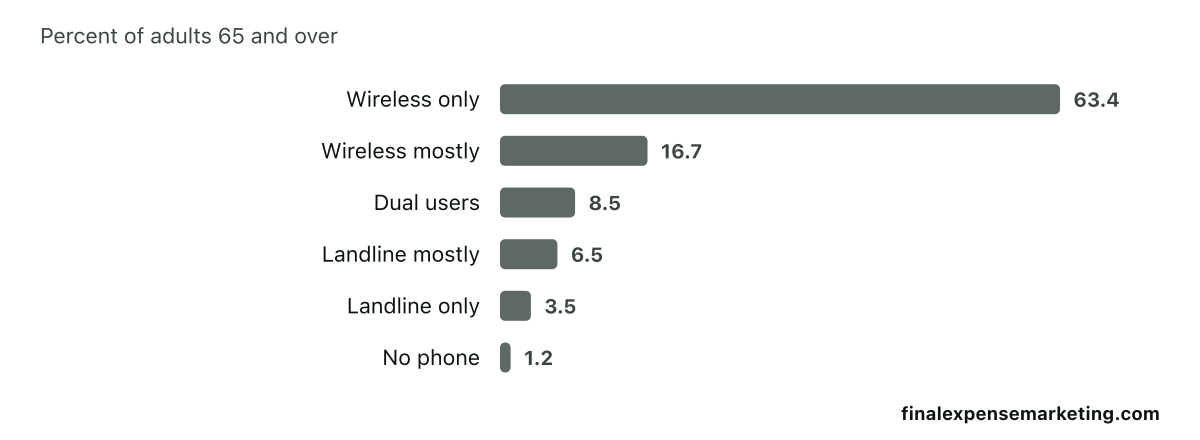
| Row | Percent of adults 65 and over |
|---|---|
| Wireless only | |
| Wireless mostly | |
| Dual users | |
| Landline mostly | |
| Landline only | |
| No phone |
Source: National Center for Health Statistics, National Health Interview Survey, Wireless Substitution early release for July to December 2025 (released September 2026), Table 2. Unknown status (0.2 percent) not shown. 95 percent confidence intervals are in Table 3. Data collection paused October 1 to November 12, 2025; NCHS reweighted the reduced sample.
Caller ID reputation is the score analytics providers such as Hiya, First Orion and TNS give a final expense floor’s outbound numbers from calling patterns and recipients’ reports; a poor one can get calls labeled “Spam Likely”. Attestation and branding don’t clear labels. Register each number, change the dialing pattern, then request review on each network; none guarantees removal.
It is written for agency owners, floor managers and agents who hire callers to follow up the leads they already have. Every page cited was read on October 22, 2026. We publish no answer rates, and this is not legal advice.
What is caller ID reputation, and why do final expense calls get labeled 'Spam Likely'?
Caller ID reputation is the score an analytics provider keeps on an outbound number. The prospect’s phone carrier, the called network, acts on it: it shows the bare number, shows a label such as “Spam Likely”, or blocks the call. The FCC calls the warning practice call labeling.
Who puts the label on the call
- AT&T: Hiya, whose spam labeling is “used by major mobile networks worldwide including AT&T in the U.S.”
- T-Mobile: First Orion, which tells businesses they can “Know when you’re tagged on T-Mobile and the reason why”.
- Verizon: its Spam Feedback form passes reports to a “third party spam analytics provider” it does not name.
The Free Caller Registry, which First Orion, Hiya and TNS offer together, says each analyzes calls independently, so a number can carry a label on one network and none on another. Phone number reputation can also differ between two lines on one floor, though a provider can act on a number’s range or carrier, and caller-ID apps label calls too. First Orion’s pages word labels “Scam Likely” and “Potential Spam”.
What the score is built from
Hiya grades a business’s numbers on Maturity (“Are numbers well established?”), Connection (whether recipients answer), Engagement (whether they stay on the line) and Sentiment (whether they complain or block). TNS lists “called party feedback, contact rate and duration analysis” among its metrics. Hiya’s help center gives four reasons for a label: people reported the number, its calling patterns “matched known spam behavior (high volume, short duration)”, a previous owner was flagged, or the carrier or a business using the same number range was flagged.
A final expense floor can trip those reasons in ordinary work: aged records are sold by segment and are not exclusive, so another agent may already have called and some numbers may have changed hands; attempt schedules call each record more than once; and numbers bought in bulk carry their history. No source here measures how often that happens.
Which dialing patterns damage a number's reputation?
Dialing patterns damage a number’s reputation when they look like the calling analytics providers exist to catch. The providers name patterns but, on the pages cited here, no calls-per-number limit. The FCC’s 2019 call-blocking ruling adds examples a blocking program might combine, from “large bursts of calls in a short timeframe” to “sequential dialing patterns” and “neighbor spoofing patterns” (FCC 19-51, paragraph 35): examples of reasonable blocking analytics, not rules or any network’s labeling criteria. The last two columns are our reading.
| Pattern | What the provider or the FCC says | On a final expense floor | What to change |
|---|---|---|---|
| Many short calls | Hiya: patterns of “high volume, short duration” | Large segments dialed fast; answered calls that end within seconds | Fewer dials per number per day |
| Repeat calls to one person | Hiya: people report a number when “They recognize your number…because you call them excessively” | Double-dialing a new lead, or several attempts inside an hour | If you double-dial, count both calls and watch that number’s answer rate |
| Reports and blocks | Hiya: “user reports and manual blocks as a percentage of total calls”; TNS: “called party feedback”; FCC: “comparison of dialed numbers to the National Do Not Call Registry” | Records with old consent, reassigned numbers or registry listings | Check consent, reassigned numbers and the registry before the first dial |
| Few answers, little time on the line | Hiya’s Connection and Engagement grades; TNS’s contact-rate and duration metrics | The same list redialed by several agents | Track answer rate per number |
| Too many calls per number | First Orion: “Try to tone down the amount of calls per number” | One number carrying a whole floor’s dials | Fewer dials per number; register any number you add and keep it in service rather than cycling it |
| Number history | Hiya: a flagged previous owner; First Orion: bought numbers may have been “misused at the hands of previous businesses” | A new block of numbers bought for a campaign | Register each number before its first dial |
If you double-dial, first read how a double dial counts against a cap and your number, and before an aged segment’s first dial, run the consent-age and scrubbing checks for aged records.
Every dial feeds the reputation of the number that carries it, whoever places the call. If you hire callers who follow up the leads you already have on a defined attempt schedule, ask for a setter desk’s dialing and disposition records: which numbers carried your leads’ calls, how often and with what result. Our desk’s published attempt schedule includes “Six to eight call attempts” and “CRM disposition notes”.
Does STIR/SHAKEN attestation fix spam labels, and who signs a floor's calls?
No. Attestation tells the called network how much the signing provider knows about the caller and the number, not whether people want the call. Numeracle notes that labeling usually runs on separate reputation systems, so “even fully authenticated calls can still receive Spam or Scam labels”, and the FCC said in 2020 that STIR/SHAKEN “will not itself stop a malicious party from using the voice network to commit fraud”.
What A, B and C attestation mean
FCC 20-42 summarizes the three levels the industry’s SHAKEN specification allows (paragraph 8, quoted below); as of October 22, 2026, no FCC rule defined them. The third column is one provider’s documented rule, Twilio’s (page modified August 19, 2026); others set their own.
| Level | What the signing provider confirms | When a floor’s call gets it at Twilio | Left unconfirmed |
|---|---|---|---|
| A (full) | “it can confirm the identity of the subscriber making the call, and that the subscriber is using its associated telephone number” | Twilio numbers assigned to an approved Business Profile and SHAKEN/STIR Trust Product | Whether people want the call |
| B (partial) | “it can confirm the identity of the subscriber but not the telephone number” | An approved primary Business Profile and Trust Product, numbers not assigned; the most a non-Twilio number can get, as Twilio “can’t attest to a customer’s right to use a phone number if it is not a Twilio phone number” | The caller’s right to use the number |
| C (gateway) | “it is the point of entry to the IP network for a call that originated elsewhere” | “No approved Business Profile(s) and SHAKEN/STIR Trust Product(s)” | Who is calling, and from which number |
Who signs your calls
The provider that originates your calls signs them on its IP network (47 CFR 64.6301(a)). Since September 18, 2025, a provider that uses a third party to sign its calls must have them signed with its own certificate, and the provider “Makes all attestation-level decisions” (64.6301(b)); a gateway provider signs unauthenticated calls arriving with U.S. numbers (64.6302(d)). Certificates go to providers, “not directly to most enterprises”, Numeracle notes, and the signer “is not always the company with which you have a direct commercial relationship”.
How to see the level your calls get
Ask your provider for the level on each call record; Twilio reports it as StirStatus. A Verizon Fios Digital Voice test line shows “[V]” on verified calls, though Verizon verifies only calls from a network with “the same capabilities” as its own. FCC 26-32, a proposal adopted May 20, 2026, would codify the levels and define improper attestations; reply comments were due September 8, 2026, and as of October 22, 2026, no final rule had been published in the Federal Register. Before relying on the levels above, search the Federal Register for a final rule citing FCC 26-32.
How does a floor register its numbers and ask carriers and analytics providers to review a label?
A floor registers each number once, changes the dialing pattern behind a label, and only then asks each network to review a label that remains. Registration tells analytics providers who calls from a number; it has nothing to do with the National Do Not Call Registry.
- Find the labels. Call test phones on each network from every outbound number, and use Hiya’s free label status (AT&T) and, once a number is registered, First Orion’s Watchlist (T-Mobile).
- Register every outbound number once. The Free Caller Registry is free, and one form (up to 20 numbers, or a file for more) reaches First Orion, Hiya and TNS, but only “for businesses that make calls on their own behalf”: a desk or BPO registering a client’s numbers must go to each provider directly. Registration “does not guarantee redress”, and repeat submissions “provide no additional value”. Hiya’s free registration takes a business only through its own representative; First Orion’s registration API, for T-Mobile only, is open to “businesses and BPOs”.
- Change the dialing pattern that earned the label (table above). Calling patterns are among Hiya’s label reasons, so a reviewed number that dials the same way can be labeled again.
- Then ask for review where a route exists (table below). Hiya’s review of a business number is one-time, which is why the pattern changes first. Verizon takes reports from callers who believe calls were “incorrectly blocked or labeled”. On T-Mobile we found no review form we could read: its reporting pages refused our requests on October 14 and again on October 22, 2026.
- Then consider branded caller ID, which names the caller on supported phones but does not clear a label (next section).
Network by network
| Called network | Analytics provider | Register | Ask for review | What the provider says about results |
|---|---|---|---|---|
| AT&T | Hiya | Hiya Connect Number Registration, or the Registry | One-time review of a business number | Registration and branding “can both reduce the likelihood” of a label; one stays possible “even after registering your numbers or adding branding” |
| T-Mobile | First Orion | First Orion, free, or the Registry | No form we could read; the Watchlist shows when and why a number is tagged | Registration helps carriers “influence more accurate call labels” |
| Verizon | An unnamed “third party spam analytics provider” | The Registry | Spam Feedback: up to 50 numbers typed in, plus a file | A submission “may not result in a change to how future calls are labeled” |
| Carriers using TNS Call Guardian | TNS | The Registry | The TNS portal, for enterprise users; ask TNS about access | The Registry: registration “does not guarantee redress” |
Hiya says vetting takes less than a day, and First Orion that “Within days, your number will be registered”; no page gives a time for a review, so log the date you file and test again.
What does branded caller ID cost, where does it display, and does it work?
Branded caller ID puts a business name, and sometimes a logo and call reason, on the called person’s smartphone, carried as “Rich Call Data (name, logo, call reason)” in CTIA’s Branded Calling ID. Apple Business offers a Business Caller ID through delegated partners, in beta and US-only.
What it costs
Final Expense Marketing sells none of the products in this table; how we compiled it.
| Vendor (pages read October 22, 2026) | Price as published | Fixed fees shown | Display coverage, as the vendor states it | 1,000 branded calls in a month (our arithmetic; rows sort on it) |
|---|---|---|---|---|
| Aloware (pricing guide) | $0.09 to $0.12 a call by Aloware plan, billed “only when your name actually shows on the recipient’s phone” | None; a paid add-on to an Aloware plan | T-Mobile and Verizon, “with AT&T coming soon” | $90–$120, plus the Aloware plan |
| First Orion INFORM (pricing; INFORM page) | $31 (250 calls) to $1,115 (15,000) a month, $104 for 1,000; from 20,000 calls, an annual agreement with a $1,200 monthly minimum; taxes and fees may apply | $25 one-time certification | “all major U.S. carriers including T-Mobile, AT&T, Boost Mobile, and Verizon” | $104, plus $25 once |
| Twilio (pricing; setup guide) | $0.12 a call | None shown; requires a Twilio phone number | “T-Mobile and Verizon networks only” | $120, plus Twilio voice usage |
| Telnyx (pricing) | Telnyx Branded Call Display, $0.075 a call (the page’s cost example uses $0.02) | Telnyx brand registration, $50 once and $50 a month per brand | Not stated; the page lists “STIR/SHAKEN A level attestation, CNAM, and rich call display” | $125, plus $50 once |
| Hiya Connect (pricing; how it works) | From $0.14 a branded call, no minimum spend | A one-time, non-refundable setup fee, set by country (not shown); Hiya Connect plans from $99 a month for 750 calls; enterprise from $500 a month | Branding “depends on which operators and devices are supported” | $140 at the per-call rate, plus the setup fee |
Ask whether calls that don’t display are billed; CTIA says enterprises “only pay when Branded Calling ID confirms their information was delivered”.
Where it displays
Twilio and Aloware describe branding as mobile-only: it “doesn’t display on landlines” (Twilio), where “landlines keep standard caller-name display” (Aloware). A landline with name display shows a caller name (CNAM), which Twilio says to use “for landline caller ID” and Telnyx lists with its branded calling. Telemarketers must transmit their name when their carrier makes it available (47 CFR 64.1601(e)(1)); Free Caller Registry data is not used to deliver one.
Landlines still matter at 65 and over: in NCHS estimates for July to December 2025, 6.5% of adults 65 and over were landline-mostly and 3.5% landline-only, against 0.9% and 1.2% at 45 to 64, and 8.5% were dual users (National Center for Health Statistics, released September 2026). Set the caller name with your provider as well as any branding.
Does it work?
Branding names the caller on supported phones but does not clear a label: Hiya says it can make a label less likely but cannot rule one out, Aloware that a call “can show your brand and still carry a spam label”, and Twilio that “carriers may reject calls if you have poor reputation”. Test it against an unbranded group (last section). FCC 25-76, a proposal adopted October 28, 2025, would have terminating providers show a verified caller name or other identity on calls they mark A-attested; as of October 22, 2026, no final rule on it had been published in the Federal Register.
Why doesn't rotating to fresh numbers fix reputation?
Rotation means swapping labeled numbers for new ones, or cycling a list so no number carries much volume, and the analytics providers warn against both. First Orion calls rotating, or “recycling”, numbers “a tactic scammers use to trick people into answering their calls” and advises fewer calls per number and registered numbers instead. Hiya tells legitimate callers “Don’t change numbers often”, and a new number has not yet become “well established” under Hiya’s Maturity grade; a bought one may arrive labeled.
CallHippo, which sells rotation so that “no single number ever crosses the volume threshold that triggers carrier flagging”, says there is no fixed threshold, then gives an unsourced figure we don’t repeat. Neither side publishes a measured effect, so test before you rely on rotation.
Rotation does not reset state call caps either: Florida’s three-call cap counts calls “regardless of the phone number used to make the call” (Fla. Stat. §501.616(6)(b)) and Maryland’s “regardless of the telephone numbers used to make the call” (Md. Com. Law §14-4502(c)(2)), so a call from a new number still counts toward those state call caps. Florida’s cap applies to a commercial telephone seller or salesperson, and the act’s exemption for licensed insurance agents does not extend to it (§501.604); Maryland’s applies to any person who makes, or causes to be made, a telephone solicitation, and the section has no insurance exemption.
Does local presence dialing help or hurt answer rates?
Local presence dialing shows the prospect a local area code. Aloware, which sells it, says it “lifts answer rates for some teams and quietly hurts others”, and the FCC’s blocking examples include “neighbor spoofing patterns”, which local numbers can resemble; test local numbers against your usual ones on matched leads (last section).
The caller-ID rules a local number has to meet
Federal law bars knowingly causing caller ID to transmit misleading or inaccurate information “with the intent to defraud, cause harm, or wrongfully obtain anything of value” (47 U.S.C. §227(e)(1); 47 CFR 64.1604(a)). Telemarketers must transmit caller ID and may not block it, and the FCC order adopting that rule says any number supplied, including a seller’s customer-service number shown instead of the calling number, must take do-not-call requests during regular business hours for the campaign (47 CFR 64.1601(e); FCC 03-153, paragraph 180). Florida bars a commercial telephone seller or salesperson making a solicitation call from using technology that “deliberately displays a different caller identification number than the number the call is originating from to conceal the true identity of the caller”, and the act’s exemption for licensed insurance agents does not extend to that subsection (Fla. Stat. §501.616(7)(b); §501.604). Use numbers your provider “owns or leases on your behalf”, in Aloware’s words, and route callbacks to someone who can take a do-not-call request.
Which questions about numbers, attestation and caller ID should you put to a setter desk, dialer or transfer vendor?
Ask any setter desk, dialer or transfer vendor, ours included:
- Whose numbers carry the calls, and who holds the right to use them?
- Which provider signs the calls, at what attestation level, and can I see the level per call?
- Does that provider’s filing appear in the FCC’s Robocall Mitigation Database?
- Who registered the numbers, with which provider, and in whose business name? The Free Caller Registry does not accept registrations made for another business.
- How many numbers carry the calls, how many calls a day does each carry, and how long does each stay in service?
- Who checks each network for labels, how often, and who files the review requests?
- What name shows on a smartphone, and what caller name (CNAM) on a landline?
- If local numbers are used, are they owned or leased, and where do callbacks ring?
- For a transfer vendor: which number and name does the screener’s call show?
- Which dialer mode places the calls, and what happens when a prospect answers and no agent is free?
Our desk’s published schedule includes a “Weekly contact and appointment report”; ask whether any desk’s report, ours included, splits answers by outbound number and called network, and get every answer in writing.
How do you measure answer rates on your own floor without borrowed benchmarks?
Answer rate is the share of dials a person picks up. It differs from contact rate, “the share of units you reach for a real conversation”, which the calculator takes as your own contact-rate input; a labeled number shows up first as fewer answers, then as fewer conversations.
What to log for every dial
| Field | Why log it |
|---|---|
| Outbound number | Labels attach to numbers |
| Called network | Each network has its own analytics provider |
| Attempt number | Separates first calls from redials |
| Number age | Shows whether new numbers start out labeled |
| Attestation level, from the call record | What the signing provider gave each call |
| Label seen on test phones | What prospects saw |
| Answered by a person (yes or no) | The answer-rate count |
| Seconds on the line | Short calls are a pattern the providers score |
| Disposition | Links answers to outcomes |
Use one disposition list on every record; the aged-lead plan has a disposition list you can split by age band.
When a change is real
- Split dials by outbound number and called network, and change one thing at a time: registration, branding or pacing. Assign leads to the two groups at random, or alternate lead by lead, within the same hours and segment.
- Put a 95% Wilson interval around each group’s answer rate, the NIST/SEMATECH e-Handbook’s method for a proportion: (p + z²/2n ± z√(p(1 − p)/n + z²/4n²)) ÷ (1 + z²/n), with p the answer rate, n the dials and z = 1.96.
- Compare the groups with the handbook’s test for two proportions: z = (p₂ − p₁) ÷ √(p(1 − p)(1/n₁ + 1/n₂)), where p₁ and p₂ are the old and new answer rates and p is all answers over all dials. A z beyond ±1.96 marks a difference at the 5% level.
- With example inputs: 100 answered of 1,000 dials (8.3%–12.0%) against 120 of 1,000 (10.1%–14.2%) gives z = 1.43: too early to call, so keep both groups running. At the same rates over 2,000 dials each (200 and 240 answered), z = 2.02, a difference at the 5% level, although the Wilson ranges (8.8%–11.4% and 10.6%–13.5%) still overlap.
Survey and vendor answer-rate figures describe other people’s numbers; the benchmark that fits your floor is your own log.