TCPA fines and exposure for final expense call floors: per-call damages, vendor liability and litigator scrubs
What a TCPA violation can cost a final expense agency, who can collect, when a vendor’s calls become yours, and what litigator scrubs and indemnities can and cannot do.
General information, not legal advice. This guide summarizes the rules in the sources listed at the end, as read between and . Rules change, and they differ by state and by business, so check with a lawyer licensed where you call before relying on it.
On this page
- How much are TCPA fines per call or text, and who can collect them?
- When are damages trebled, and what makes a violation willful or knowing?
- Which state laws add private suits and higher penalties?
- Can an agency be liable for a lead or transfer vendor’s calls?
- What did the Fluent and MediaAlpha orders cost, and what conduct did they cover?
- What does a litigator scrub catch, and what can’t it do?
- What indemnity and records should a buyer demand from vendors?
- A worked exposure table: calls x per-call damages x treble
- Questions
- Sources
Not a TCPA amount: the FTC’s Telemarketing Sales Rule penalty ceiling, 2021 to 2026
The FTC Act ceiling per knowing rule violation, applied where the Telemarketing Sales Rule reaches a call. TCPA damages are a separate amount set in 47 U.S.C. § 227.
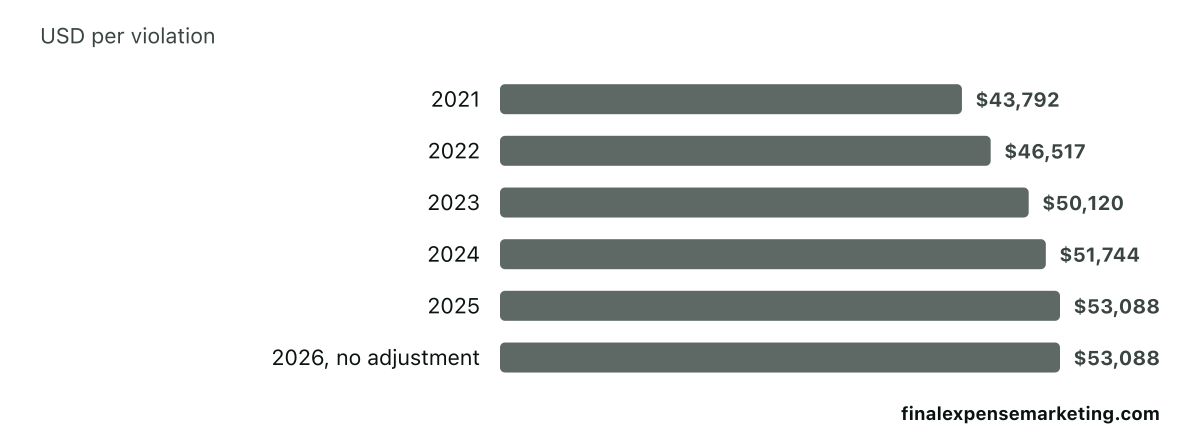
| Row | USD per violation |
|---|---|
| 2021 | |
| 2022 | |
| 2023 | |
| 2024 | |
| 2025 | |
| 2026, no adjustment |
Sources: FTC civil penalty adjustment notices, 86 FR 2539, 87 FR 1070, 88 FR 1499, 89 FR 1445, 90 FR 5580, and 91 FR 58446 (no 2026 adjustment).
TCPA fines in a private suit are $500 per violation (up to $500 on do-not-call claims) or actual loss if greater, and a court may treble them for willful or knowing violations, to $1,500 unless loss is higher (47 U.S.C. § 227). Regulators and states add penalties, and a final expense agency can be liable for a vendor’s calls.
What people call TCPA violation fines covers three different things: statutory damages (private suits, and state attorneys general under 47 U.S.C. § 227(g)), civil penalties (the FTC under the Telemarketing Sales Rule, and state officials under state law) and FCC forfeitures. Each amount below is the one in force on October 22, 2026, for agency owners and floor managers who buy leads, transfers or appointments. This is not legal advice, and the points marked for counsel turn on facts or on how a court reads the rule.
How much are TCPA fines per call or text, and who can collect them?
Four kinds of enforcer can collect: consumers and state attorneys general sue for statutory damages under 47 U.S.C. § 227, the FCC imposes forfeitures, and the FTC seeks civil penalties of up to $53,088 per knowing violation where the Telemarketing Sales Rule applies. Texts count too under the FCC’s rules: its do-not-call rules cover “telemarketing calls or text messages to wireless telephone numbers” (47 CFR 64.1200(e)), which includes sales texts to final expense leads.
| Who can collect | Law | Amount per violation | Conditions |
|---|---|---|---|
| A consumer, in a private suit | 47 U.S.C. § 227(b)(3): autodialed calls and artificial or prerecorded voices | $500 in statutory damages, or actual loss if greater | Up to three times that amount on a finding of willful or knowing violation |
| A consumer, in a private suit | 47 U.S.C. § 227(c)(5): the do-not-call rules | Up to $500 in statutory damages, or actual loss if greater | Two or more calls in 12 months from or for the same entity; a due-care defense; trebling as above |
| A state attorney general | 47 U.S.C. § 227(g)(1) | Actual loss or $500 in damages | A pattern or practice of unlawful calls to residents; trebling as above; federal court only |
| The FCC | 47 U.S.C. § 227(b)(4)(B); 47 CFR 1.80(b)(5) | A forfeiture set by the violator’s class, plus up to $12,266 | The add-on needs “the intent to cause such violation” |
| The FCC | 47 U.S.C. § 227(e); 47 CFR 1.80(b)(4): caller ID spoofing | Up to $14,432, or three times that per day of a continuing violation | Causing caller ID to knowingly transmit misleading or inaccurate information with intent to defraud, cause harm or wrongfully obtain anything of value (§ 227(e)(1)); a continuing violation is capped at $1,443,275 for any single act or failure to act |
| The FTC | Telemarketing Sales Rule (16 CFR 310), through FTC Act § 5(m)(1)(A); ceiling at 16 CFR 1.98(d) | A civil penalty of up to $53,088 | Only for a knowing violation, in a federal court action (15 U.S.C. 45(m)(1)(A)), and only where the rule reaches the call; for insurance, that turns on state regulation |
Every amount is counted per violation, so exposure scales with the number of calls. A consent record shows what a consumer agreed to; it does not by itself make a call lawful. On exclusive leads with a consent record kept for every lead, each lead is delivered to one buyer and we keep the source, timestamp, landing page and consent record; how and when you call, your do-not-call list and your scripts still determine your exposure.
Private suits and state attorneys general
Under 47 U.S.C. § 227(b)(3), a consumer may sue to recover actual monetary loss or “$500 in damages for each such violation, whichever is greater” for calls that break the autodialer and prerecorded-voice rules.
The do-not-call action under 47 U.S.C. § 227(c)(5) needs “more than one telephone call within any 12-month period by or on behalf of the same entity”, pays “up to $500” per violation, and lets a defendant show it “established and implemented, with due care, reasonable practices and procedures” to prevent such calls. State attorneys general sue over “a pattern or practice of telephone calls” to residents (§ 227(g)(1)) and can also enforce the Telemarketing Sales Rule (15 U.S.C. 6103).
The FCC
For § 227(b) violations the FCC can fine a company that holds no FCC license without first sending the citation it normally requires (47 CFR 1.80(d)). The base amount depends on the violator’s class under the Communications Act, a question for counsel; the intent add-on and the spoofing amount are in the table. Both are 2025 figures that still apply: the FCC confirmed in June 2026 that “for 2026 there will be no adjustments of civil forfeiture penalties for inflation”.
The FTC, where the Telemarketing Sales Rule reaches the call
The FTC’s guide says “Anyone who violates the TSR is subject to civil penalties of up to $53,088 for each violation”, and its September 2026 notice keeps “the 2025 civil penalty levels”. Under the statute, that penalty is recovered in a federal court action, and only for a violation made “with actual knowledge or knowledge fairly implied on the basis of objective circumstances” that it is prohibited (15 U.S.C. 45(m)(1)(A)). For insurance, whether the rule reaches a call “depends on the extent to which state law regulates insurance telemarketing”, the guide says, because of the McCarran-Ferguson Act. Private suits under the rule need more than “$50,000 in actual damages for each person adversely affected” (15 U.S.C. 6104(a)).
Why published figures disagree
Pages listing TCPA penalties often print a regulator’s ceiling with no year or law. The FTC’s ceiling was $43,792 in 2021, $46,517 in 2022, $50,120 in 2023, $51,744 in 2024 and $53,088 in 2025, unchanged for 2026: FTC Act ceilings for knowing violations of rules such as the Telemarketing Sales Rule, not TCPA damages. The FTC’s own Notices of Penalty Offenses page still showed the 2023 level, “civil penalties of up to $50,120 per violation”, on October 22, 2026. Another page, giving no year, puts FCC penalties “as high as $26,000 per violation”, an amount found nowhere in 47 CFR 1.80. The chart plots the FTC series.
When are damages trebled, and what makes a violation willful or knowing?
Only after a finding that the violation was willful or knowing, and even then trebling is optional. 47 U.S.C. § 227(b)(3) says:
“If the court finds that the defendant willfully or knowingly violated this subsection or the regulations prescribed under this subsection, the court may, in its discretion, increase the amount of the award to an amount equal to not more than 3 times the amount available under subparagraph (B) of this paragraph.”
- A finding. The court must find willfulness or knowledge; an allegation is not enough.
- Discretion. “May”, not “shall”: a finding allows a higher award but does not require one.
- A ceiling. “Not more than 3 times the amount available” caps a trebled award under 47 U.S.C. § 227(b)(3) at three times the greater of actual loss or $500, which is $1,500 per violation unless actual loss exceeds $500. It is never a default.
The same test and ceiling appear in § 227(c)(5), § 227(g)(1) and Florida Statutes § 501.059(10)(b), while Pennsylvania’s penalty needs “wilful” use (UTPCPL § 8(b)). Section 227(a), the TCPA’s definitions, defines neither word, which leaves their meaning to the courts. The FCC’s add-on uses a different trigger, “the intent to cause such violation” (§ 227(b)(4)(B)).
Which state laws add private suits and higher penalties?
Several do. Florida adds a private suit with trebling and two-way attorney fees, plus agency penalties; Pennsylvania routes telemarketing violations into its consumer-protection law, where the Attorney General or a district attorney recovers civil penalties; and Georgia, Virginia and Washington have private suits that can pay more per violation than the TCPA.
| Law | Who collects | Amount per violation | Conditions |
|---|---|---|---|
| Florida Statutes § 501.059(10) | A called party aggrieved by a violation | Actual damages or $500, whichever is greater | Up to three times if willful or knowing; the winning side recovers attorney fees and costs (§ 501.059(11)) |
| Florida Statutes § 501.059(9) and § 570.971(1)(d) | Florida’s Department of Agriculture and Consumer Services or Department of Legal Affairs | Class IV: “a fine of $10,000 or more” | After the department investigates a complaint; may be waived after full restitution; the department may instead impose a Class III administrative fine (§ 501.059(9)(b)) |
| Florida Statutes § 501.619 and § 501.625, the Telemarketing Act | The department; a person injured by a violation | Class III: up to $10,000 (Florida Statutes § 570.971(1)(c)); actual or punitive damages | Licensed insurance agents soliciting within their license are exempt from this Act except a few sections, including its hours, three-call cap and caller-ID rules (§ 501.604); how these remedies apply to a licensee’s breach of those rules is a question for counsel |
| UTPCPL § 8(b), via Telemarketer Registration Act § 6(a) | Pennsylvania’s Attorney General or a district attorney | A civil penalty of up to $1,000, or up to $3,000 where the victim is 60 or older | A court must find wilful use |
| UTPCPL § 9.2 | A consumer who bought primarily for personal, family or household purposes and lost money or property | Actual damages or $100, whichever is greater | Up to three times actual damages; the court may add costs and reasonable attorney fees |
Florida Statutes § 501.059 has no exemption for licensed insurance agents. Georgia allows up to $1,000 per violation once a person receives more than one violating call in 12 months (O.C.G.A. § 46-5-27(i)); Virginia sets $500 for a first violation, $1,000 for a second and $5,000 for each later one (Virginia Code § 59.1-515); and Washington awards at least $1,000 per violation to a person aggrieved by repeated violations (RCW 80.36.390(13)). The rest are in every state’s private-action and penalty columns.
Pennsylvania’s Act 47 of 2026 changes the calling rules but not these amounts: Kelley Drye’s August 13, 2026 summary says the monetary penalties “remain unchanged”, while the Act deletes the Attorney General’s separate power to revoke a repeat violator’s registration. The UTPCPL section holding the 60-or-older cap was last amended in 1996. If your lists include people 60 or older, the higher ceiling is the one for calls to them.
Can an agency be liable for a lead or transfer vendor’s calls?
Yes. In its 2013 DISH ruling the FCC said a seller “is not directly liable for a violation of the TCPA unless it initiates a call, but may be held vicariously liable under federal common law agency principles for a TCPA violation by a third-party telemarketer” (FCC 13-54, paragraph 24). District courts hearing TCPA suits are not bound by that reading: the Supreme Court held in 2025 that they “must determine the meaning of the law under ordinary principles of statutory interpretation, affording appropriate respect to the agency’s interpretation”.
Seller and telemarketer
The seller is “the person or entity on whose behalf a telephone call or message is initiated”, and the telemarketer “the person or entity that initiates” it (47 CFR 64.1200(f)(10), (f)(12)). A transfer vendor that dials a consumer initiates the call; whether it does so on your behalf is the question at the center of TCPA vicarious liability.
What the FCC’s 2013 DISH ruling says
The ruling covers “not only formal agency, but also principles of apparent authority and ratification” (paragraph 28). A seller may be liable if it ratifies a telemarketer’s acts “by knowingly accepting their benefits” (paragraph 34). In the FCC’s view, a seller that has authorized a telemarketer “to market its goods or services” should answer for its calls (“we see no reason that a seller should not be liable”), while “an action taken for the benefit of a seller by a third-party retailer, without more” is not enough (paragraph 47). For § 227(b) violations, the FCC gave “illustrative examples” of evidence of apparent authority (paragraph 46):
- access to “information and systems that normally would be within the seller’s exclusive control”, such as pricing or customer information;
- the ability “to enter consumer information into the seller’s sales or customer systems”;
- “the authority to use the seller’s trade name, trademark and service mark”;
- a seller that “approved, wrote or reviewed the outside entity’s telemarketing scripts”.
The same paragraph says a seller “would be responsible” for the unauthorized conduct of a telemarketer “otherwise authorized to market on the seller’s behalf” if the seller “knew (or reasonably should have known)” of the violations and “failed to take effective steps within its power to force the telemarketer to cease that conduct.”
Some states settle part of it by statute: Virginia makes the seller and the telephone solicitor “jointly and severally liable” for the solicitor’s violations (Virginia Code § 59.1-514.1), and Georgia rejects the defense that the defendant “did not make the telephone solicitation” when it was made under an agreement or request, unless the defendant had and enforced effective compliance procedures for that caller (O.C.G.A. § 46-5-27(j)).
For do-not-call requests the federal rule is explicit: when another party records them, “the person or entity on whose behalf the call is made will be liable for any failures to honor the do-not-call request” (47 CFR 64.1200(d)(3)). Where the Telemarketing Sales Rule applies, it also reaches a seller that causes a telemarketer to break its calling rules (16 CFR 310.4(b)(1)) and anyone who gives substantial assistance while knowing, or consciously avoiding knowing, of violations (310.3(b)).
How that maps onto what a final expense floor buys:
- Interest-verified live transfers. A screener confirms the prospect’s interest, age and state before warm-transferring the call to you; when the vendor placed the call that reached the consumer, the agency questions above decide whether it is also yours. We sell live transfers, where each transfer is connected live to a single agent; buying transfers from anyone does not move your calling exposure to the vendor.
- Exclusive web leads. Your agency places the first call, so a claim about it concerns your own dialing.
- A setter desk. The callers you hire follow up your leads on your behalf, so the do-not-call rule above puts any request they record and fail to honor on you.
What did the Fluent and MediaAlpha orders cost, and what conduct did they cover?
Fluent was ordered to pay a $2.5 million civil penalty in 2023, and MediaAlpha agreed in 2025 to a $45 million judgment for consumer refunds, which the court entered that October. Both were lead generators. Fluent’s case was about how it collected consent and whom it sold leads to; MediaAlpha’s was about ads and websites that, the FTC alleged, misled people shopping for health insurance, some implying a government connection, so their information could be sold to telemarketers.
| Case | Money, and what kind | Conduct alleged | Order terms a buyer will notice | Status |
|---|---|---|---|---|
| U.S. v. Fluent, LLC et al., S.D. Fla., No. 9:23-cv-81045 (FTC release) | $2.5 million “as a civil penalty”, “not compensation for actual pecuniary loss” | A “consent farm lead generator”; one click consenting to calls from “dozens or even hundreds of third parties”; ads promising jobs or free items; “more than 620 million telemarketing leads” sold in 2018 and 2019 | A ban on prerecorded-message calls; a disclosure naming “every Person to whom the Covered Information will be sold”, with no hyperlink to click; a consent screen with “a clear option to proceed without providing consent”; signed contracts or certifications from data recipients; compliance notices for 20 years | Entered August 11, 2023; closed |
| FTC v. MediaAlpha, Inc., C.D. Cal., No. 2:25-cv-07263 (FTC release) | $45 million to “provide refunds to harmed consumers”; not called a civil penalty | Sold “approximately 119 million leads” in 2024; domains “that imply they are associated with the government”; consumers “flooded with robocalls and telemarketing calls”; alleged FTC Act, TSR and Impersonation Rule violations | Requires “robust monitoring practices” and consumers’ “express informed consent to collect, sell, or disclose any personal information” | Complaint and stipulation filed August 6, 2025; order entered October 16, 2025 (ECF 17). The FTC’s case page still read “Pending” on October 22, 2026. |
What the two orders tell a buyer
Three points for a buyer, in our reading rather than the FTC’s: both orders settled allegations without a trial; Fluent’s money was a civil penalty and MediaAlpha’s was refunds; and the terms land on paperwork a buyer handles, from named-recipient disclosures to signed contracts or certifications from data buyers. The warning signs are collected as vendor red flags with an enforcement record.
What does a litigator scrub catch, and what can’t it do?
A litigator scrub removes numbers a vendor ties to TCPA plaintiffs, their attorneys or people who have threatened suit, so you avoid dialing a known serial plaintiff. It is not consent, and it is not part of the federal do-not-call safe harbor.
What vendors say their lists contain
Vendors describe their lists differently (their own claims, seen October 22, 2026). TCPA Litigator List says it has “over 600,000 names in its register”, down to “DNC complainers (just threatening to sue)”. The DNC Project checks numbers against “known TCPA litigators, serial plaintiffs, and the attorneys” behind them, “compiled from court and complaint records”, for $449 a month, paid annually, with unlimited scrubs. Trestle sells Litigator Check as a $0.005-a-query add-on to its phone APIs, with data “refreshed daily” from court filings across “TCPA, CFPB, FDCPA, and FCRA” cases. The lists count different things, so two scrubs of one file can flag different numbers.
What a litigator scrub can’t do
- Make a call consented. Consent comes from the consent text and its record.
- Count toward the safe harbor. None of the FCC’s five safe-harbor elements (47 CFR 64.1200(c)(2)(i)(A)–(E)) is a known-litigator list; the full scrub matrix covers each.
- Clear a registered or revoked number. A clean litigator result makes neither callable.
- Catch a first-time plaintiff, who is on no list yet.
- Replace the registry scrub. The safe harbor asks for a registry copy no more than 31 days old (64.1200(c)(2)(i)(D)); a litigator list is not one.
Whether a litigator scrub helps the due-care defense in 47 U.S.C. § 227(c)(5) is a question for counsel.
What indemnity and records should a buyer demand from vendors?
Both, in writing, before the first order. The FCC’s DISH ruling says sellers can “protect their legitimate commercial interests” by exercising reasonable diligence in selecting and monitoring reputable telemarketers and by including indemnification clauses in their contracts (paragraph 44), and that imposing vicarious liability on the seller “would in no way absolve the third-party telemarketer of joint liability.” An indemnity moves money after a claim; records decide whether you can answer one.
Indemnity terms to put in writing
- Defense costs and settlements, not only judgments, since the telemarketer stays jointly liable with you.
- No subcontracted dialing without your written approval, with every service provider that dials for you named.
- Proof the vendor can pay: a certificate of insurance and what the policy covers.
These are requests, not a template: have counsel draft the clause.
Records to request before the first order
- The consent request “in the same manner and format in which it was presented” (16 CFR 310.5(a)(8)(ii)), which shows whose name the consumer’s consent carries.
- The do-not-call request log, with the date each request was honored, since 47 CFR 64.1200(d)(3) puts unhonored requests on you.
Where the Telemarketing Sales Rule applies to an insurance call, it requires more, including transfer, registry-version and service-provider records. A seller and telemarketer may split those duties by written agreement; with no agreement, or an unclear one, “both the telemarketer and the seller are responsible” (16 CFR 310.5(e)).
Scripts cut both ways under paragraph 46, set out above: reviewing a vendor’s scripts is one of the FCC’s examples of apparent authority, and the same paragraph says a seller “would be responsible” for an authorized telemarketer’s violations it knew or should have known about and did not act on. For our own leads, see how this site captures and keeps consent records.
A worked exposure table: calls x per-call damages x treble
Multiply the amount per violation by the number of violations. The table uses example call counts, not a forecast, at one violation per call; it shows scale, not an award.
| Law and amount per violation | 1 call | 10 calls | 100 calls | 1,000 calls |
|---|---|---|---|---|
| 47 U.S.C. § 227(b)(3), statutory damages | $500 | $5,000 | $50,000 | $500,000 |
| 47 U.S.C. § 227(b)(3), trebled, on the $500 statutory base | $1,500 | $15,000 | $150,000 | $1,500,000 |
| 47 U.S.C. § 227(c)(5), up to $500 each, where each person called received more than one call in 12 months | No claim: needs more than one call in 12 months | $5,000 | $50,000 | $500,000 |
| Florida Statutes § 501.059(10), statutory damages | $500 | $5,000 | $50,000 | $500,000 |
| Florida Statutes § 501.059(10), trebled, on the $500 statutory base | $1,500 | $15,000 | $150,000 | $1,500,000 |
| UTPCPL § 8(b), Pennsylvania ceiling for wilful use | $1,000 | $10,000 | $100,000 | $1,000,000 |
| UTPCPL § 8(b), Pennsylvania ceiling where the victim is 60 or older | $3,000 | $30,000 | $300,000 | $3,000,000 |
| FTC Act § 5(m)(1)(A) ceiling (16 CFR 1.98(d)) for a knowing violation where the Telemarketing Sales Rule applies | $53,088 | $530,880 | $5,308,800 | $53,088,000 |
How to read it
- Rows are separate laws with separate conditions and are never added together; whether one call supports claims under two rows is a question for counsel.
- Actual loss replaces the $500 base under 47 U.S.C. § 227(b)(3) when it is greater, and trebling then multiplies the larger figure.
- The Pennsylvania and FTC rows are ceilings: the FTC alleged that Fluent sold more than 620 million telemarketing leads, and its order set a $2.5 million civil penalty.
- The Florida rows apply only to calls Florida Statutes § 501.059 reaches.
- The FCC is left out: its base forfeiture depends on the violator’s class.