Telemarketing calling hours by state (2026): windows, call caps and insurance carve-outs for final expense floors
Calling windows, barred days, 24-hour caps and licensed-agent carve-outs for all 50 states and DC, each row linked to its statute and dated, plus state do-not-call lists, remedies, recording consent and registration.
General information, not legal advice. This guide summarizes the rules in the sources listed at the end, as read between and . Rules change, and they differ by state and by business, so check with a lawyer licensed where you call before relying on it.
On this page
- What are the telemarketing calling hours in each state, and where is the window narrower than the federal 8 a.m.–9 p.m.?
- Which states cap calls per 24 hours, and does dialing from a new number reset the count?
- Which state limits still apply to a licensed insurance agent who is exempt from the rest of the law?
- What does Pennsylvania's Act 47 of 2026 change for calling hours, Sundays and holidays, and what can a call to someone 60 or older cost?
- What do the mini-TCPA states (Florida, Oklahoma, Maryland) add beyond hours and caps?
- Whose clock and whose state law apply when the floor and the prospect are in different time zones or states?
- Which states keep their own do-not-call list, require telemarketer registration, or require every party's consent to record a call?
- How was this table built, and what changed since the last check?
- Questions
- Sources
Do Not Call complaints per 100,000 people, top 10 states, FY 2025
Unverified consumer complaints to the FTC, fiscal year 2025
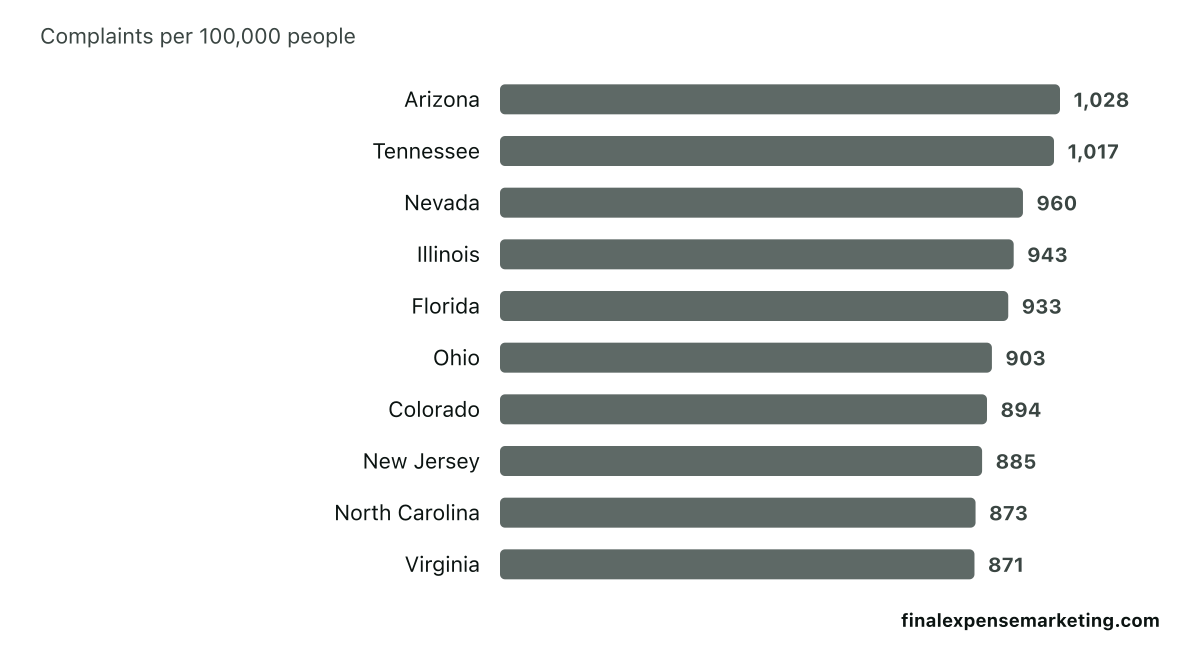
| Row | Complaints per 100,000 people |
|---|---|
| Arizona | |
| Tennessee | |
| Nevada | |
| Illinois | |
| Florida | |
| Ohio | |
| Colorado | |
| New Jersey | |
| North Carolina | |
| Virginia |
Source: FTC, National Do Not Call Registry Data Book, Fiscal Year 2025 (December 2025). Population: 2019-2023 American Community Survey 5-year estimates.
Telemarketing calling hours by state start from the federal rule: no telephone solicitation before 8 a.m. or after 9 p.m. in the called person's local time. Nineteen jurisdictions narrow that window or bar whole days, and four states cap calls at three per 24 hours. Florida and Maryland hold licensed insurance agents to both limits; Oklahoma exempts them.
The first table gives every state's calling window, barred days, 24-hour cap and what still binds a licensed agent; the second covers do-not-call lists, remedies, recording consent and registration. Each row links the statute or rule it rests on and was checked on October 14, 2026. This is not legal advice: have counsel confirm the rows for the states you call.
What are the telemarketing calling hours in each state, and where is the window narrower than the federal 8 a.m.–9 p.m.?
Federal law sets what time telemarketers can call: 8 a.m. to 9 p.m. at the called person's location. For live sales calls, that federal window is the tightest limit except in the nineteen jurisdictions that narrow it, and where a state is narrower, the stricter rule is the one you dial to. With Pennsylvania's new hours and Sunday ban counted (in force since October 18 or 19, 2026), eight jurisdictions start later than 8 a.m., thirteen close before 9 p.m., seven bar Sundays and five bar legal holidays.
The federal window and the calls it covers
The TCPA calling-hours rule is 47 CFR 64.1200(c)(1): no person or entity may initiate a telephone solicitation to “Any residential telephone subscriber before the hour of 8 a.m. or after 9 p.m. (local time at the called party's location)” (eCFR, as of October 19, 2026). Three details decide what it reaches:
- Which calls count. A “telephone solicitation” is a sales call or message, but not one to a person who gave “prior express invitation or permission”, to someone with an established business relationship, or by or for a tax-exempt nonprofit (64.1200(f)(15)).
- Cell phones and texts. The calling-hours and do-not-call paragraphs “are applicable to any person or entity making telephone solicitations or telemarketing calls or text messages to wireless telephone numbers to the extent described in” the FCC's 2003 TCPA order (64.1200(e)).
- The FTC's rule. The Telemarketing Sales Rule sets the same hours for calls to a residence, “Without the prior consent of a person” (16 CFR 310.4(c)).
Texts follow their own state definitions; this post covers calls, not which state laws reach texts.
Calling hours by state: the table
Each row is the state's calling window by clock and calendar, what some searches call “do not call hours by state”: the hours in the called person's local time, the days with no sales calls, the 24-hour cap, and which limits still bind a licensed insurance agent. A cell that could not be re-read on October 14, 2026 says so.
| Jurisdiction | Calling window (called person's local time) | Barred days | 24-hour cap | Licensed-agent carve-out | Source (checked 2026-10-14) |
|---|---|---|---|---|---|
| Federal (all states) | 8 a.m.–9 p.m. | None | None | No licensed-agent exemption; a call to someone who gave “prior express invitation or permission”, to someone with an established business relationship, or by or for a tax-exempt nonprofit is not a telephone solicitation | 47 CFR 64.1200(c)(1), (f)(15) (eCFR, 2026-10-19) |
| Alabama | 8 a.m.–8 p.m. (Public Service Commission rule) | Sundays and holidays (“holidays” not defined) | None found | Exempt from the Telemarketing Act and the do-not-call chapter (§ 8-19A-4(9)); the PSC rule’s hours and day bans have no exemption | Ala. Admin. Code r. 770-X-5-.17 |
| Alaska | No state window found (federal 8 a.m.–9 p.m. applies) | None found | None found | Exempt from registration (AS 45.63.080(a)(7)); the do-not-call and recorded-message rules in AS 45.50.475 have no exemption | AS 45.50.475 (FindLaw, current to 2025-01-01) |
| Arizona | Federal hours, adopted by reference (A.R.S. § 44-1278(B)(6)) | None found | None found | Exempt from the article except § 44-1278(B) and § 44-1282 (§ 44-1273(A)(1)), so the hours reference and the do-not-call rules still bind | A.R.S. § 44-1278 (azleg.gov) |
| Arkansas | No state window found (federal 8 a.m.–9 p.m. applies) | None found | None found | Exempt from the state do-not-call act (§ 4-99-406(3)) and from telephonic-seller registration | Arkansas Code § 4-99-406 (FindLaw, current to 2024-03-28) |
| California | Live calls: no state window found; automated dialing-announcing calls may not be received 9 p.m.–9 a.m. (Pub. Util. Code § 2872(c)) | None found | None found | Exempt from telephonic-seller registration (Bus. & Prof. Code § 17511.1(e)(4)); the do-not-call law covers insurance calls (§ 17592) | Pub. Util. Code § 2872 (public.law) |
| Colorado | No state window found (federal 8 a.m.–9 p.m. applies) | None found | None found | Exempt from Attorney General registration only (C.R.S. § 6-1-302(1)(g)); the No-Call List Act has no insurance exclusion | C.R.S. § 6-1-904 (public.law) |
| Connecticut | 9 a.m.–8 p.m. | None found | None found | None found: all of § 42-288a binds, including prior express written consent for telephonic sales calls | Conn. Gen. Stat. ch. 743m (capture 2026-09-30) |
| Delaware | No state window found (federal 8 a.m.–9 p.m. applies) | None found | None found | Exempt from the whole Telemarketing Registration and Fraud Prevention Act (6 Del. C. § 2505A(6)) | 6 Del. C. ch. 25A (delcode.delaware.gov) |
| District of Columbia | 8 a.m.–9 p.m. (calls to a residence) | None found | None found; no more than 15 rings per call | Insurance companies or organizations licensed in DC are exempt from registration and bonding only (§ 22-3226.05(a)(8)); the hours bind | D.C. Code § 22-3226.08 (code.dccouncil.gov) |
| Florida | 8 a.m.–8 p.m. | None found | 3 per 24 hours, same subject, regardless of the number used | Exempt from the Telemarketing Act except §§ 501.608 and 501.616(6)–(7), so the window, the cap and the caller-ID rules still bind; the FTSA (§ 501.059) has no insurance exemption | Fla. Stat. ch. 501 (capture 2026-09-25) |
| Georgia | Live calls: no state window found; automated recorded-message calls only 8 a.m.–9 p.m. (O.C.G.A. § 46-5-23) | None found | None found | None found; calls made with the subscriber’s “prior express invitation or permission”, or to someone with a prior or current business or personal relationship, are not solicitations (§ 46-5-27(b)(3)) | O.C.G.A. § 46-5-23 (Justia, capture 2025-02-14) |
| Hawaii | 8 a.m.–9 p.m. (calls to a residence) | None found | None found; no more than 10 rings | Chapter 481P, hours included, does not apply to insurance-commissioner licensees selling insurance (HRS § 481P-5(4)); federal rules still apply | HRS § 481P-3 (capture 2026-04-21) |
| Idaho | No state window found (federal 8 a.m.–9 p.m. applies) | None found | None found | Licensed businesses are exempt from registration only (Idaho Code § 48-1005(1)(d)); the no-call list and unlawful-acts sections bind | Idaho Code tit. 48 ch. 10 (capture 2026-04-06) |
| Illinois | 8 a.m.–9 p.m. for live operators (815 ILCS 413/15(a)); autodialer calls 9 a.m.–9 p.m. (815 ILCS 305/15(a)) | None found | None found | None found | 815 ILCS 413/15 (FindLaw, current to 2025-01-01) |
| Indiana | Live calls: no state window found; prerecorded commercial calls 9 a.m.–8 p.m. (IC 24-5-14-8, 2016 text) | None found | None found | Licensed individuals soliciting insurance applications are outside the do-not-call article (IC 24-4.7-1-1(5), 2016 text; current wording not verified (2026-10-14)); automated-call rules still apply | IC 24-5-14 (2016 text, Justia file host) |
| Iowa | No state window found (federal 8 a.m.–9 p.m. applies) | None found | None | No state telemarketing statute found | Iowa Code 2026 ch. 476 (official PDF) |
| Kansas | No state window found (federal 8 a.m.–9 p.m. applies) | None found | None | None: no insurance exclusion (K.S.A. 50-670(a)(3)) | K.S.A. 50-670 (ksrevisor.gov) |
| Kentucky | 10 a.m.–9 p.m. (calls to a residence) | None found | No number; bars engaging a person “repeatedly or continuously” in annoying, abusive or harassing behavior | None found | KRS 367.46955 (FindLaw, current to 2025-01-01) |
| Louisiana | 8 a.m.–8 p.m., Monday to Saturday (LPSC General Order R-35852) | Sundays and legal holidays | None found | Exempt from AG telephonic-seller registration (R.S. 45:822(B)(4)); the LPSC hours and the do-not-call act have no insurance exclusion | LPSC General Order R-35852 (2021) |
| Maine | Live calls: no state window found; automated devices only on weekdays, 9 a.m.–5 p.m. (10 M.R.S. § 1498(3)) | None found for live calls | Automated calls: one per number per 8 hours | None: no insurance exemption (§ 1499-B(2)) | 10 M.R.S. § 1498 (legislature.maine.gov) |
| Maryland | 8 a.m.–8 p.m. | None found | 3 per 24 hours, same subject, regardless of the numbers used | None: the § 14-4502(a)(1) exemptions reach only the automated-call consent rule | Md. Com. Law § 14-4502 (mgaleg.maryland.gov) |
| Massachusetts | 8 a.m.–8 p.m. | None found | None | None; a call that leaves the sale and the payment for a later face-to-face meeting is not an unsolicited telephonic sales call (G.L. c. 159C § 1) | G.L. c. 159C § 3 (onecle, 2015-dated mirror) |
| Michigan | No state window found (federal 8 a.m.–9 p.m. applies) | None found | None | None for telephone solicitation; a call that only asks for a face-to-face meeting is not a telephone solicitation (MCL 445.111(m)) | MCL 445.111 (FindLaw, current to 2025-01-01) |
| Minnesota | 9 a.m.–9 p.m. | None found | None | None: no insurance exemption | Minn. Stat. 325E.30 (revisor.mn.gov) |
| Mississippi | 8 a.m.–8 p.m. “Central Standard Time” (§ 77-3-723(1)); unsolicited telephonic sales calls 8 a.m.–9 p.m. (§ 77-3-603) | Sundays | None | Insurance agents are exempt from parts of the act (§ 77-3-711(d)), but their calls stay “authorized telephone solicitations” under the 8–8 window and the Sunday ban | Miss. Code § 77-3-723 (FindLaw, current to 2025-01-01) |
| Missouri | 8 a.m.–9 p.m. (calls to a residence) | None found | No number; bars making the phone ring or engaging a consumer “repeatedly or continuously” | The No-Call law excludes a Missouri licensee setting an appointment in the state or contiguous counties (§ 407.1095(3)(e)); the hours law does not reach a call whose sale and payment wait for a face-to-face presentation (§ 407.1085.1(1)); whether the regulated-licensee exemption (§ 407.1085.1(4)(c)) lifts the hours for other calls is unclear | RSMo 407.1076 (FindLaw, current to 2025-01-01) |
| Montana | 8 a.m.–9 p.m. (calls to a residence) | None found | None found; bars ringing or engaging a person “repeatedly or continuously” | Producers are exempt from registration and bonding only (MCA 30-14-1405(8)); the window binds, and the no-call law excludes appointment calls by Montana licensees (30-14-1601(4)(f)) | MCA 30-14-1412 (mca.legmt.gov, MCA 2025) |
| Nebraska | Live calls: no state window found; prerecorded calls 8 a.m.–9 p.m. (Neb. Rev. Stat. 86-248), and 1–9 p.m. on Sundays and legal holidays under the PSC rule | None found for live calls | None found | None found | Neb. Rev. Stat. 86-248 (capture 2026-01-22) |
| Nevada | Live calls: no state window found; automated calls may not be received 8 p.m.–9 a.m. (NRS 597.814) | None found | None found; an automated caller may not call back after the person hangs up | Licensed insurance agents are not “sellers” under chapter 599B; the no-call registry and the automated-call rules have no insurance carve-out | NRS ch. 597 (capture 2025-12-07) |
| New Hampshire | No state window; in-state calls must follow the FTC Telemarketing Sales Rule (RSA 359-E:8, II) | None found | None found | None found | RSA ch. 359-E (capture 2025-03-06) |
| New Jersey | 8 a.m.–9 p.m. (N.J.A.C. 13:45D-4.1) | None found | None found | None found | N.J.A.C. 13:45D-4.1 (Cornell LII) |
| New Mexico | 9 a.m.–9 p.m. | None found | None found | None found | NMSA 57-12-22 (FindLaw, current to 2024-01-01) |
| New York | 8 a.m.–9 p.m., unless the customer consents to another time (GBL 399-z(2)) | None found | None found | Licensed persons skip the registration fee and bond only (GBL 399-pp(10-a)); § 399-z and the registration certificate still apply | GBL § 399-z (nysenate.gov) |
| North Carolina | 8 a.m.–9 p.m. (G.S. 75-102(f)) | None found | None found | Excluded from telephonic-seller registration only (G.S. 66-260(11)c.); Chapter 75, Article 4 binds | G.S. ch. 75 art. 4 (capture 2025-03-21) |
| North Dakota | 8 a.m.–9 p.m., live or prerecorded (N.D.C.C. 51-28-05) | None found | None found | None found | N.D.C.C. ch. 51-28 (capture 2025-06-27) |
| Ohio | No state window found (federal 8 a.m.–9 p.m. applies) | None found | None found | Exempt from the whole telephone-solicitation chapter (R.C. 4719.01(B)(10)) | R.C. 4719.01 (capture 2026-02-10) |
| Oklahoma | 8 a.m.–8 p.m. | None found | 3 per 24 hours, same subject, regardless of the number used | Exempt from the whole Telephone Solicitation Act of 2022 when soliciting within the license (15 O.S. § 775C.5(8)); the separate do-not-call bar (§ 775B.6) has no insurance carve-out in the Attorney General’s 2006 copy | HB 3168 (2022), enrolled text; codified text not verified |
| Oregon | 8 a.m.–8 p.m. (2025 c.580; effective date not verified) | None found | 3 per 24 hours unless there is an established business relationship | Licensed producers are not “telephonic sellers” (registration and disclosures); the hours, the cap and the do-not-call bar have no insurance carve-out | ORS ch. 646 (2025 edition, capture 2026-07-10) |
| Pennsylvania | 9 a.m.–7 p.m. from October 18 or 19, 2026 (8 a.m.–9 p.m. before then) | Legal holidays (barred before Act 47 too); Sundays from October 18 or 19, 2026 | None found | Licensed persons are exempt from registration only (TRA § 3); the hours, the day bans and the do-not-call list bind | Telemarketer Registration Act as amended by Act 47 (capture 2026-09-01) |
| Rhode Island | Monday–Friday 9 a.m.–6 p.m.; Saturday 10 a.m.–5 p.m. | Sundays and weekday state or federal holidays | None found | Unclear: insurers are excluded, producers are not named, and the rules reach only listed kinds of “telephonic sellers” (R.I. Gen. Laws § 5-61-2) | R.I. Gen. Laws § 5-61-3.6 (capture 2025-03-26) |
| South Carolina | 8 a.m.–9 p.m., unless the consumer gave prior written consent (§ 37-21-30); automated calls not after 7 p.m. (§ 16-17-446; the Code’s annotation cites Cahaly v. LaRosa on its validity) | None found | None in force | Calls “by institutions licensed and regulated under Title 38” (insurance) are not solicitations (§ 37-21-20(6)(c)); whether that covers an individual producer is unclear | S.C. Code tit. 37 ch. 21 (capture 2026-04-17) |
| South Dakota | 9 a.m.–9 p.m. | Sundays (calls and texts) | None found | No insurance exemption, but a call only to set an in-person appointment with a Title 58 licensee is outside the hours rule (SDCL 37-30A-1(5)(e)); whether insurance is a “consumer good or service” the chapter reaches (37-30A-1(2)) is not verified (2026-10-14) | SDCL ch. 37-30A (sdlegislature.gov) |
| Tennessee | 8 a.m.–9 p.m., absent the subscriber’s “prior express invitation or permission” (TPUC rule 1220-04-11-.02(1)) | None found | No per-person cap; from July 1, 2026, no more than 10,000 robocall solicitations a month | None found | TPUC rule ch. 1220-04-11 (capture 2025-09-12) |
| Texas | Monday–Saturday 9 a.m.–9 p.m.; Sunday noon–9 p.m. (Tex. Bus. & Com. Code § 301.051) | None (Sunday hours are shorter) | None found | Exempt from registration (§ 302.053(3)), an exemption that, “Except as provided by Section 302.060”, “applies only to a seller” (§ 302.052); the no-call chapter excludes a licensee’s non-autodialed calls whose sale and payment wait for a face-to-face presentation (§ 304.004(5)); the hours have no insurance exemption | Tex. Bus. & Com. Code ch. 301 (capture 2025-11-17) |
| Utah | 8 a.m.–9 p.m. | Sundays and legal holidays | None found | The hours rule and the state do-not-call section do not apply to Title 31A licensees acting within their license (Utah Code § 13-25a-111); company do-not-call requests and the private action still do | Utah Code tit. 13 ch. 25a (capture 2026-05-08) |
| Vermont | No state window found (federal 8 a.m.–9 p.m. applies) | None found | None found | Solicitors licensed or regulated by the Department of Financial Regulation are not “telemarketers” for registration (9 V.S.A. § 2464a(a)(7)); the do-not-call and robocall rules apply | 9 V.S.A. § 2464a (legislature.vermont.gov) |
| Virginia | 8 a.m.–9 p.m., unless prior consent (Va. Code § 59.1-511) | None found | None found | None found: all of Chapter 44 binds | Va. Code § 59.1-511 (law.lis.virginia.gov) |
| Washington | 8 a.m.–8 p.m. (RCW 80.36.390(8)) | None found | None found | Producers are exempt from commercial-telephone-solicitor registration only (RCW 19.158.020(2)(b)(viii)); RCW 80.36.390 has no insurance exemption | RCW 80.36.390 (capture 2026-10-01) |
| West Virginia | 8 a.m.–9 p.m., Monday through Sunday (W. Va. Code § 46A-6F-601) | None found | None in force | Article 6F, hours included, does not apply to licensed insurance agents acting within a license from any state (§ 46A-6F-210) | W. Va. Code § 46A-6F-601 (capture 2025-11-07) |
| Wisconsin | 8 a.m.–9 p.m. without prior consent (Wis. Admin. Code § ATCP 127.16(3)) | None found | None found | Unclear: the hours rule binds “sellers”, a term that excludes insurance companies (ATCP 127.01(21)); the registry and registration rules cover self-employed agents | Wis. Admin. Code § ATCP 127.16 (capture 2026-08-16) |
| Wyoming | 8 a.m.–8 p.m. (Wyo. Stat. § 40-12-302(d)) | None found | None; callers making fewer than 225 unsolicited calls a year are outside the definition | None found | Wyo. Stat. title 40 (capture 2026-10-13) |
Mississippi's statute says 8 a.m.–8 p.m. “Central Standard Time” without saying how daylight time applies. Alabama's window and day bans come from a Public Service Commission telephone rule, so how far they bind callers that are not phone companies, and which days are “holidays”, are counsel questions. Kentucky's 10 a.m. start, like the Texas, South Dakota, Tennessee and West Virginia windows, is written for calls to a “residence” or a residential number; whether it reaches cell phones is open. Oregon's 8 p.m. close and cap come from 2025 Oregon Laws chapter 580, whose effective date was not verified.
If one schedule has to fit every state
Taking the latest start and the earliest close for each kind of day across all 51 rows gives one schedule that fits every live-call window in the table, for a caller no exemption reaches:
- Weekdays: 10 a.m.–6 p.m., with Kentucky setting the start and Rhode Island the close.
- Saturdays: 10 a.m.–5 p.m., set by Kentucky and Rhode Island.
- Sundays: no calls, because seven states bar them.
- Legal holidays: no calls, because five states bar them.
- Attempts: no more than three sales calls to a person in 24 hours, counted across every number you call from.
That is arithmetic on the table, not a ruling. Rhode Island's hours bind only listed kinds of “telephonic sellers”, so whether they reach a final expense caller at all is a counsel question; without that row, the schedule runs 10 a.m.–7 p.m. on weekdays and Saturdays alike. Kentucky's start is written for calls to a residence; if counsel reads it as not reaching cell phones, the schedule's weekday start for cell numbers is 9 a.m. instead. On the full table, the dialing day shrinks from thirteen federal hours on a weekday to eight.
Fewer hours leave room for fewer attempts per lead each day. If the hours left cannot cover the leads you hold, the shortfall is callers, not leads: a setter desk is where you hire callers who follow up the leads you already have, and the setter page shows how attempts are spaced under a three-call cap.
Which states cap calls per 24 hours, and does dialing from a new number reset the count?
Four states cap sales calls to one person per 24 hours: Florida, Oklahoma and Maryland at three on the same subject, and Oregon at three unless there is an established business relationship. A new number does not reset the count in the first three, whose caps apply regardless of the number used; Oregon's text does not mention numbers.
Florida, Oklahoma and Maryland: three calls, any number
Florida's statute bars “More than three commercial telephone solicitation phone calls from any number to a person over a 24-hour period on the same subject matter or issue, regardless of the phone number used to make the call” (§501.616(6)(b)), and Oklahoma's §775C.4(A)(2) uses the same words, spelling out “twenty-four-hour”. Maryland's §14-4502(c)(2) sets the same limit, “regardless of the telephone numbers used to make the call”. Florida's limits cover calls “made through automated dialing or recorded messages” as well as live ones.
Two questions stay open for counsel: whether calling back a lead who requested contact counts as a “commercial telephone solicitation” under each act, and whether texts count toward the caps. Caps cost most on records that need many attempts, so size an aged order to the attempts you can make: the aged page lists the calling limits to check before you order a segment, and the aged-lead guide sets out an age-band dial plan under these caps.
Oregon: three, unless there is a business relationship
Oregon makes it an unlawful practice when a person “initiates a telephone solicitation outside the hours of 8 a.m. to 8 p.m. or initiates a solicitation more than three separate times to a party within a 24-hour period, unless the person has an established business relationship with the party” (ORS 646.563(1)(b)). The relationship means a transaction in the preceding 18 months, and the text is silent on calls from different numbers. Whether the relationship clause qualifies the hours as well as the cap is for counsel.
Automated-call and volume limits, and “repeatedly or continuously” rules
- Tennessee caps volume, not attempts per person: from July 1, 2026, no person or entity may make more than 10,000 autodialed artificial or prerecorded-voice solicitations a month to Tennessee residential subscribers (§65-4-411(b)).
- Eight states set a separate window for automated or prerecorded calls, shown in their rows above: California, Georgia, Illinois, Indiana, Maine, Nebraska, Nevada and South Carolina. Maine permits them only on weekdays, 9 a.m.–5 p.m., and only one per number in each 8-hour period.
- Kentucky, Missouri and Montana set no number but bar engaging a person “repeatedly or continuously”. The District of Columbia limits a solicitation call to 15 rings and Hawaii to 10.
Which state limits still apply to a licensed insurance agent who is exempt from the rest of the law?
In most states with a calling window, the window still binds a licensed agent: insurance exemptions usually reach registration, bonding or a do-not-call chapter, not the hours. Of the 33 jurisdictions with a live-call window of their own:
- Exempt from the hours rule too (four): Hawaii, Oklahoma, Utah and West Virginia.
- Unclear, for counsel (four): Missouri, Rhode Island, South Carolina and Wisconsin.
- Exempt elsewhere, but the hours still bind (twelve): Alabama, District of Columbia, Florida, Louisiana, Mississippi, Montana, New York, North Carolina, Oregon, Pennsylvania, Texas and Washington.
- No insurance exemption found (thirteen): Connecticut, Illinois, Kentucky, Maryland, Massachusetts, Minnesota, New Jersey, New Mexico, North Dakota, South Dakota, Tennessee, Virginia and Wyoming.
For the other eighteen we found no live-call window of their own (Arizona and New Hampshire adopt the federal rules by reference), so the federal hours govern there whatever the state exempts.
Exempt from the hours rule too
Oklahoma's Telephone Solicitation Act of 2022 exempts licensed insurance agents soliciting within their license from the whole act, window, cap, automated-call consent rule and private action included (§775C.5(8)). Hawaii's chapter 481P does not apply to insurance-commissioner licensees selling insurance (§481P-5(4)), and West Virginia's article 6F does not apply to agents acting within a license from any state (§46A-6F-210). Utah's is narrower: its hours and state do-not-call sections do not apply to a person who “holds and acts within the scope of” a Title 31A insurance license (§13-25a-111), but company do-not-call requests and the private action still do. The federal window applies in all four. Delaware and Ohio exempt licensees from whole telemarketing acts that set no hours.
Exempt from other parts of the law: the hours still bind
Florida shows the pattern most clearly: licensed insurance brokers, agents, customer representatives and solicitors acting within their license are exempt from the Telemarketing Act, but the exemption section opens “The provisions of this part, except ss. 501.608 and 501.616(6) and (7), do not apply to:”, so licensed insurance agents stay subject to both limits and to the caller-ID rules (§501.604). Texas, Pennsylvania, Washington, Oregon, North Carolina, Montana and New York lift registration, or its fee and bond, and leave the window in place. Mississippi's agents still make “authorized telephone solicitations” bound by the 8–8 window and the Sunday ban; Alabama's statutory exemption does not reach the PSC's hours rule; Louisiana's covers AG registration while the LPSC order sets the hours. The compliance page shows how this site summarizes Florida's limits.
Appointment-setting and face-to-face carve-outs
Several states treat a call that only books a meeting, or that holds the sale for a later in-person presentation, differently, which matters to setters. Among them:
- South Dakota: a call only to set an in-person appointment with a Title 58 (insurance) licensee “at a mutually agreeable physical location” is outside the hours and Sunday rule (SDCL 37-30A-1(5)(e)), though not the do-not-call register.
- Missouri: the telemarketing-practices law, hours rule included, does not apply when the sale and payment wait for “a face-to-face sales presentation by the telemarketer or seller” (§407.1085.1(1)), and the No-Call law excludes a Missouri licensee setting an appointment for the licensed occupation in the state or contiguous counties (§407.1095(3)(e)).
- Montana: the no-call law excludes a Montana licensee setting an appointment for the licensed occupation (MCA 30-14-1601(4)(f)); whether that reaches producers is for counsel.
- Massachusetts: a call is not an “unsolicited telephonic sales call” when the sale and any payment wait for a later in-person presentation or meeting (c. 159C §1).
- Michigan: a call that only asks for a face-to-face meeting, without urging a decision on the call, is not a telephone solicitation (MCL 445.111(m)).
- Texas: the no-call chapter does not reach a state licensee's call if it is not autodialed, the sale closes and payment falls due only after the seller presents in person, and the consumer has not asked not to be called (§304.004(5)); the hours still apply.
- Louisiana: the do-not-call act excludes a call that leaves the sale for a later face-to-face meeting, but only where the person called was referred to the caller or is personally known to them (R.S. 45:844.12(6)(h)); the LPSC hours still apply.
None of these covers a sale closed on the phone, and none moves the federal window.
Does the exemption follow the agent to a setter or call center?
The wording differs by state. Delaware's act does not reach telemarketing by a seller, telemarketer or telemarketing business “by or on behalf of a licensed insurance broker, agent, customer representative or solicitor” acting within the license (6 Del. C. §2505A(6)), and Alabama's do-not-call chapter excludes communications “by or on behalf of” an exempt licensee (§8-19A-3(17)), though its PSC hours rule has no such exemption. Texas's registration exemptions apply “only to a seller”, “Except as provided by Section 302.060” (§302.052). Elsewhere, whether an unlicensed setter or call center dialing for a licensed agent shares an exemption is a counsel question in each state; until it is answered, the cautious reading is that those callers follow the full rule. The same question applies to leads a call center dials and hands on, where a call center dials consumers, gauges interest and passes the contact on as a lead, not as a live call.
What does Pennsylvania's Act 47 of 2026 change for calling hours, Sundays and holidays, and what can a call to someone 60 or older cost?
Pennsylvania's Act 47 of 2026 (SB 992), approved July 20, 2026, narrows the state's window to 9 a.m.–7 p.m., adds a Sunday ban and rewords the legal-holiday ban the state already had. The act “shall take effect in 90 days”: counted from July 20, the 90th day is Sunday, October 18, 2026, and whether a Sunday last day moves the start to Monday, October 19 is a question for counsel. Before it took effect, the 8 a.m.–9 p.m. window and the holiday ban applied.
| Telemarketer Registration Act, § 5(a) | Before Act 47 | From October 18 or 19, 2026 |
|---|---|---|
| Calling window | 8 a.m.–9 p.m. | 9 a.m.–7 p.m. |
| Sundays | No ban in the act | No telephone solicitations |
| Legal holidays | Barred: “Making a telephone solicitation call on a legal holiday” (§ 5(a)(10)) | Barred, reworded: “Initiating or causing to be initiated a telephone solicitation on a legal holiday” |
The amended text, “Initiating or causing to be initiated a telephone solicitation on a Sunday or after 7 p.m. or before 9 a.m.” (TRA §5(a)(1)), applies to licensed agents: licensed persons are exempt from registration only (§3(a), (b.1)(5)), and the hours, the day bans and the state do-not-call list (§5.2) carry no licensee carve-out. Act 47 also counts a voicemail, a ringless voicemail and a text message as a telephone solicitation (§2).
Act 47 added no new penalty amounts to the Telemarketer Registration Act. A violation of that act is also a violation of the Unfair Trade Practices and Consumer Protection Law, whose section 8(b) sets a civil penalty of up to $1,000 per willful violation, or up to $3,000 per violation where the victim is 60 or older. A consumer who bought or leased primarily for personal, family or household purposes and suffered an ascertainable loss of money or property can also sue for actual damages or $100, whichever is greater, and a court may award up to three times actual damages (§9.2(a)).
What do the mini-TCPA states (Florida, Oklahoma, Maryland) add beyond hours and caps?
Each of the three mini-TCPA laws adds a written-consent rule for automated or recorded calls and a private right of action with statutory damages. How each treats licensed agents is set out in the carve-out section above.
Florida: the Telemarketing Act and the FTSA are two laws
Florida has two telemarketing statutes in chapter 501, and they treat licensed agents differently:
| Rule | Florida Telemarketing Act (§§501.601 and following) | Florida Telephone Solicitation Act, the FTSA (§501.059) |
|---|---|---|
| Core duties | An FDACS license for commercial telephone sellers, backed by at least $50,000 in security; the 8 a.m.–8 p.m. window, the three-call cap and the caller-ID rules (§501.616(6)–(7)) | The state do-not-call listing; no calls, texts or voicemails to anyone who told the caller to stop; prior express written consent for automated or recorded sales calls; callers give their “true first and last names and the business on whose behalf he or she is soliciting immediately upon making contact” |
| Licensed insurance agents | Exempt, except from §§501.608 and 501.616(6)–(7) | No insurance exemption |
| Private action | Actual and/or punitive damages (§501.625) | The greater of actual damages or $500, up to three times for willful or knowing violations (§501.059(10)) |
| Agency penalty | Class III: up to $10,000 per violation (§§501.619, 570.971) | Class IV: “a fine of $10,000 or more” (§570.971) |
One agency page disagrees with the statute on hours. The Florida Department of Agriculture and Consumer Services' consumer FAQ says a commercial telephone solicitation call may not be made “before 8 a.m. or after 9 p.m. local time at the called person's location”; this table follows the statute, whose §501.616(6)(a) says “before 8 a.m. or after 8 p.m.” instead.
Oklahoma
Oklahoma's Telephone Solicitation Act of 2022 (HB 3168, in force November 1, 2022) pairs the 8 a.m.–8 p.m. window and the three-call cap with a consent rule for automated calls, and a called party may “Recover actual damages or Five Hundred Dollars ($500.00), whichever is greater”, up to three times that if willful or knowing (§775C.6). The older Telemarketer Restriction Act bars unsolicited telemarketing sales calls to a consumer more than 30 days after the number first appears on the Attorney General's registry (§775B.6); the Attorney General's 2006 copy of that act has no insurance carve-out, and later amendments were not verified.
Maryland
Maryland's Stop the Spam Calls Act (Chapter 413 of 2023, in force January 1, 2024) gives licensed agents no exemption from its window or cap. Chapter 214 of 2024, in force April 25, 2024, added a private action for “up to $500 or actual damages, whichever is greater”, up to three times that if willful or knowing (§14-4503(a)(2)). The act's requirements and remedies cannot be waived by agreement, except as §14-4502(a)(3) allows or in a settlement (§14-4503(d)).
Whose clock and whose state law apply when the floor and the prospect are in different time zones or states?
The called person's clock decides. The federal rule counts “local time at the called party's location”, and the Telemarketing Sales Rule “local time at the called person's location”; Florida's and Oklahoma's windows run in “the called person's time zone” and Maryland's in “the called party's time zone”. A call placed at 8:30 p.m. in the called person's Florida time zone is outside Florida's window wherever the floor sits.
State law follows the called person too, and some states write that into an area-code presumption. Florida's reads: “There is a rebuttable presumption that a telephonic sales call made to any area code in this state is made to a Florida resident or to a person in this state at the time of the call” (§501.059(8)(d)). Maryland presumes “that a telephone solicitation made to any area code in the State is made to a resident or a person who is reasonably presumed to reside or have a place of business in the State at the time the call is made” (§14-4503(b)). Oklahoma's act presumes “that a commercial telephonic sales call made to any area code in this state is made to an Oklahoma resident or to a person in this state at the time of the call” (15 O.S. §775C.3(D)). Oregon lets a caller rely on a mobile number's area code to decide whether the party is in Oregon (ORS 646.563(2)). South Carolina's definition reaches calls to wireless phones with a South Carolina area code (§37-21-20(6)), and Virginia's reaches calls to Virginia area codes and to phones registered to Virginia residents (§59.1-510); both cover texts too.
The floor's own location matters in two places: Texas issues a registration certificate for each calling location (§302.101), and Kentucky's act excludes calls a Kentucky merchant or telemarketer makes to a location outside Kentucky (KRS 367.46951(2)). Keep both the address state and the area-code state on every lead, work out a window for each, and dial only while both are open; a first-contact plan in the lead's local time builds its attempts on the same rule.
Which states keep their own do-not-call list, require telemarketer registration, or require every party's consent to record a call?
Twenty states provide by statute for a do-not-call list of their own; twenty more make a call to a nationally registered number a state-law violation without a separate list, and eight states and the District of Columbia have neither (Illinois and Oregon are not verified). Eleven states have an all-party recording rule of some kind. California, Florida, Illinois, Maryland, Massachusetts, New Hampshire, Pennsylvania and Washington require every party's consent (Pennsylvania's statute was read from a 2021 capture). Connecticut's rule is civil only and also accepts a recorded notice or a tone warning; Montana's requires every party's knowledge (“If one person provides the warning, either party may record”); and Michigan's statute requires every party's consent, though a reported court exception for a participant's own recording is unverified. Delaware's statutes conflict, and Nevada's and Vermont's rules were not verified.
The registration column states each law and makes no claim about who is registered. Penalty cells give the statutory amounts only.
| Jurisdiction | State do-not-call list | Private right of action | Penalty | Recording consent | Registration (law only) | Source (checked 2026-10-14) |
|---|---|---|---|---|---|---|
| Alabama | Yes: PSC register, which includes Alabama numbers on the national registry | Yes: after more than one violating call in 12 months, actual loss or up to $2,000 per knowing violation (§ 8-19C-7) | Up to $2,000 per violation (§ 8-19C-6); up to $10,000 per Telemarketing Act violation (§ 8-19A-18) | One-party (§ 13A-11-30); the PSC rule requires telling consumers, and getting their permission, before recording their response | Yes: AG license, $500 a year, $50,000 bond; insurance licensees exempt | Code of Alabama ch. 8-19C (official site) |
| Alaska | No separate list: AS 45.50.475 adopts the national registry | Yes: the greater of 3 times actual damages or $500 per violation, for a person with an ascertainable loss (AS 45.50.531) | $1,000 to $25,000 per violation (AS 45.50.551); unregistered telephone selling is a class C felony | One-party (AS 42.20.310) | Yes: Department of Law, 30 days before each campaign; insurance licensees exempt | AS 45.50.531 (FindLaw, current to 2025-01-01) |
| Arizona | No separate list: § 44-1282 enforces the national registry for calls and texts | Limited: rescission and damages for a sale by an unregistered seller (§ 44-1279); none found for § 44-1278 or § 44-1282 | Up to $1,000 per do-not-call violation (§ 44-1282(B)); up to $10,000 per willful violation (§ 44-1531) | One-party (§ 13-3012(9)) | Yes: Secretary of State, $100,000 bond; Title 20 (insurance) licensees exempt | A.R.S. § 44-1282 (azleg.gov) |
| Arkansas | Yes: Attorney General database (§ 4-99-405) | Narrow: a private plaintiff must show actual financial loss caused by reliance (§ 4-88-113(f)) | Up to $10,000 per violation (§ 4-88-113(a)(3)); selling through automated dialing that plays recorded messages is a Class D felony (§ 5-63-204) | One-party (§ 5-60-120) | Yes: Secretary of State, $100 fee; insurance licensees excluded; bond not verified (2026-10-14) | Arkansas Code § 4-99-405 (FindLaw, current to 2024-03-28) |
| California | The California numbers on the national registry are the state list (§ 17592) | Limited: a small-claims injunction, then up to $1,000 for further calls within 30 days (§ 17593(b)); recording violations: the greater of $5,000 or 3 times damages (Penal Code § 637.2) | Up to the FTC civil-penalty amount (§ 17593(a)(2)); willful telephonic-seller violations: a fine up to $10,000 per transaction (§ 17511.9) | All-party (Penal Code §§ 632, 632.7) | Yes: Department of Justice, $50 filing fee, $100,000 bond; insurance licensees excluded | Business and Professions Code § 17592 (public.law) |
| Colorado | Yes: PUC no-call list, which includes the Colorado part of the national registry | Yes: the greater of actual damages or $500, or 3 times actual damages for bad faith (§ 6-1-113) | Up to $20,000 per violation, or $50,000 per violation against an elderly person (§ 6-1-112) | One-party (§ 18-9-303) | Yes: every solicitor pays a no-call list fee of up to $500 a year; commercial telephone sellers also register with the AG, insurance excluded | C.R.S. § 6-1-905 (public.law) |
| Connecticut | State listing identical to the national registry (§ 42-288a(a)) | Through CUTPA: actual damages for an ascertainable loss, with punitive damages and fees at the court’s discretion (§ 42-110g) | Up to $20,000 per violation, on top of CUTPA penalties (§ 42-288a(o)) | All-party for civil liability, or a recorded notice or tone warning (§ 52-570d); the criminal law is one-party | None found | Connecticut General Statutes ch. 743m (capture 2026-09-30) |
| Delaware | No state list; a company may not call for 10 years after a customer tells it to stop (§ 2507A(a)(3)) | Yes: actual and punitive damages, fees and costs (§ 2508A(b)) | Consumer Fraud Act enforcement (§ 2509A); amounts not verified (2026-10-14) | Conflicting statutes: one-party (title 11 § 2402) and all-party (title 11 § 1335) | Yes: DOJ certificate, $50,000 bond, $100 fee; insurance licensees exempt | Delaware Code title 6 ch. 25A (delcode.delaware.gov) |
| District of Columbia | No separate list found; company do-not-call rule (§ 22-3226.08(2)) | Yes: injunctive relief, actual and punitive damages and fees (§ 22-3226.11) | Up to $1,000 per violation; damages may be trebled when a solicitor knowingly targets elderly persons or persons with disabilities (§ 22-3226.09) | One-party (§ 23-542) | Yes: the Mayor’s certificate and a $50,000 bond; insurance companies exempt | District of Columbia Code § 22-3226.09 (code.dccouncil.gov) |
| Florida | Yes: FDACS quarterly listing, which includes Florida numbers on the national registry | Yes (FTSA): the greater of actual damages or $500, up to 3 times for willful or knowing violations (§ 501.059(10)) | FTSA: Class IV, a fine of $10,000 or more (§ 570.971); Telemarketing Act: up to $10,000 per violation (§ 501.619) | All-party (§ 934.03) | Yes: FDACS license and at least $50,000 security; licensed insurance agents exempt (§ 501.604(8)) | Florida Statutes § 501.059 (capture 2026-10-02) |
| Georgia | Yes: PSC no-call database, which includes Georgia numbers on the national registry | Yes: after more than one violating call in 12 months, the greater of actual loss or up to $1,000 per violation, uncapped in a class action (§ 46-5-27(i)) | Up to $2,000 per violation (§ 46-5-27(h)); automated-dialing violations are misdemeanors | One-party (§ 16-11-66) | None found for live calls; automated-dialing equipment needs a PSC permit | Georgia Code § 46-5-27 (Justia, capture 2024-09-07) |
| Hawaii | No separate list; for callers the chapter reaches, a call that breaks the federal do-not-call rules violates state law | For callers the chapter reaches: the greater of $1,000 or 3 times damages, or $5,000 for an elder plaintiff (§ 480-13) | Under chapter 480; amounts not verified (2026-10-14) | One-party (§ 803-42) | None found | HRS § 480-13 (capture 2025-05-02) |
| Idaho | Yes: Idaho no-contact list; the national registry may serve as the list | Limited: a buyer with damages gets Consumer Protection Act remedies, the greater of actual damages or $1,000 (§ 48-608) | No-call violations: up to $500 for the first, $2,500 for the second, $5,000 each from the third (§ 48-1003A) | One-party (§ 18-6702) | Yes: Attorney General, $50 fee; licensed businesses exempt | Idaho Code title 48 ch. 10 (capture 2026-04-06) |
| Illinois | not verified (2026-10-14) | Yes: 3 times actual damages plus costs and fees (413/25(d)); autodialer act: 3 times actual damages plus $500 per violation in statutory damages (305/30) | Consumer Fraud Act remedies (413/25(e)); autodialer act: $500 per violation to each recipient in an AG action (305/30(d)) | All-party (720 ILCS 5/14-2) | None found | 815 ILCS 413/25 (FindLaw, current to 2025-01-01) |
| Indiana | Yes: Attorney General quarterly listing (2016 text) | No damages action under the do-not-call article (2016 text); actual damages, costs and fees for a seller’s registration failures (IC 24-5-12-20) | Up to $10,000 for the first violation and $25,000 for each later one (IC 24-4.7-5-2, 2016 text) | One-party (IC 35-31.5-2-176, 2016 text) | Narrow: only sellers whose solicitations involve listed representations register, $50 fee; no bond found | IC 24-4.7 chapter 5 (2016 text, Justia file host) |
| Iowa | None found | No telemarketing-specific action; the consumer-fraud action excludes insurers and their agents (§ 714H.4) | None state-specific found; the AG may enforce the federal telemarketing act (§ 714.16(15)) | One-party (§ 727.8; § 808B.2) | None found | Iowa Code 2026 ch. 714H (official PDF) |
| Kansas | The FTC registry is designated as the Kansas no-call list (50-670a(l)) | Yes, via the Consumer Protection Act: damages or a civil penalty, whichever is greater, but not in a class action (50-634(b)) | Up to $10,000 per violation (50-636); up to $10,000 more per violation against a protected consumer, including anyone 60 or older (50-677) | One-party (21-6101) | None found | K.S.A. 50-670a (ksrevisor.gov) |
| Kentucky | No separate list: the national registry is the “zero call list” | Narrow: only for misleading caller ID (KRS 367.46999(4)) | Violations of § 367.46955(7)–(16), the hours and repeated-call rules among them: a misdemeanor, fine up to $500 first and $5,000 later; other knowing violations: Class D felony (KRS 367.46999) | One-party (KRS 526.010) | Yes, for a telemarketing company (one whose primary business is telephone solicitation): Attorney General, $300 fee, $50,000 bond | KRS 367.46999 (FindLaw, current to 2025-01-01) |
| Louisiana | Yes: LPSC listing, which includes Louisiana consumers on the national registry | None found | Up to $1,500 per violation, or up to $3,000 if the subscriber is over 65 (R.S. 45:844.15) | One-party (R.S. 15:1303) | Yes: LPSC registration and fee; AG telephonic-seller registration, $150, insurance licensees excluded; AG bond not verified (2026-10-14) | Louisiana Revised Statutes 45:844.15 (FindLaw) |
| Maine | Yes in law: a state registry, for which the FTC registry may serve | No express action in § 1499-B; the unfair-practices action covers only buyers with a loss | Up to $10,000 for the first violation and $25,000 for each later one (§ 1499-B(11)) | One-party (15 M.R.S. § 709) | None: repealed in 1999 | 10 M.R.S. § 1499-B (legislature.maine.gov) |
| Maryland | No separate list; a call that breaks the federal telemarketing rules, the national-registry rule included, violates state law (§ 14-3201) | Yes: up to $500 or actual damages, whichever is greater, up to 3 times if willful or knowing (§ 14-4503(a)(2)); TCPA or TSR violations: the greater of $500 or actual damages (§ 14-3202) | An unfair, abusive or deceptive trade practice under the Consumer Protection Act (§ 14-4503(a)(1)); automated prerecorded solicitation: up to $1,000 first, $5,000 each later offense (Public Utilities § 8-204) | All-party (Courts and Judicial Proceedings § 10-402) | None found | Maryland Commercial Law § 14-4503 (mgaleg.maryland.gov) |
| Massachusetts | Yes: OCABR quarterly listing | Yes: after more than one call in 12 months, actual loss or up to $5,000 per knowing violation (c. 159C § 8) | Up to $5,000 per knowing violation, and at least $1,500 when the consumer is 65 or older (c. 159C § 8) | All-party (c. 272 § 99) | Yes: annual registration with OCABR (201 CMR 12.04) | General Laws c. 159C § 8 (onecle, 2015-dated mirror) |
| Michigan | The federal list is the state list (MCL 445.111a(5)) | Yes: actual damages or $250, whichever is greater, plus fees (MCL 445.111c(3)) | Knowing violations: a misdemeanor, up to 6 months and a fine up to $500 (MCL 445.111c(2)) | All-party by statute (MCL 750.539c) | None found | MCL 445.111c (FindLaw, current to 2025-01-01) |
| Minnesota | None: the state list provisions expired | Yes: damages, costs and fees under § 8.31 (§ 325E.31(a)) | A civil penalty that “must not exceed $50,000” (§ 325E.31(b)) | One-party (§ 626A.02) | None found | Minnesota Statutes 325E.31 (revisor.mn.gov) |
| Mississippi | No own list: no calls to consumers who objected to the federal government, or to the PSC before July 1, 2023 (§ 77-3-707(2)) | None found | Up to $10,000 per violation; each call is a separate violation (§ 77-3-725) | One-party (§ 41-29-531) | Yes: AG registration and a $75,000 bond (§ 77-3-605) | Mississippi Code § 77-3-725 (FindLaw, current to 2025-01-01) |
| Missouri | Yes: AG No-Call list, which covers personal cell numbers | Yes: after more than one call in 12 months, actual loss or up to $5,000 per knowing violation (§ 407.1107) | Up to $5,000 per knowing No-Call violation (§ 407.1107); up to $1,000 per telemarketing-law violation, per the AG | One-party (RSMo 542.402) | No telemarketer registration found; buying the No-Call list takes AG registration, $50 per area code per quarter | RSMo 407.1107 (FindLaw, current to 2025-01-01) |
| Montana | Yes: DOJ no-call database, which includes Montana’s part of the national registry | Yes: actual loss or $5,000 per knowing no-call violation (30-14-1605(3)); actual damages or $500 under Part 14 (30-14-1413(2)) | Up to $5,000 per knowing no-call violation (30-14-1605); criminal fines up to $500, or $50,000 for repeat offenses (30-14-1414) | All-party knowledge: recording with a hidden device “without the knowledge of all parties” is an offense (MCA 45-8-213) | Yes: DOJ registration and a $50,000 bond; producers exempt | MCA 30-14-1605 (mca.legmt.gov, MCA 2025) |
| Nebraska | No state list found; automated callers keep their own do-not-call list | Actual damages, fees and costs under the Telemarketing and Prize Promotions Act (86-233) | Up to $2,000 per violation (86-235) | One-party (86-290) | No telemarketer registration found; automated dialing needs a PSC permit, $500 per device | Nebraska Revised Statutes 86-235 (capture 2026-01-22) |
| Nevada | Yes: AG registry, which includes the Nevada part of the national database | No-call violations: not verified (2026-10-14); elderly (60 or older) or disabled victims of chapter 599B violations: actual and punitive damages and fees (NRS 599B.300) | Up to $10,000 more per violation against elderly or disabled victims (599B.280); automated calls: up to $10,000 per violation (597.818) | not verified (2026-10-14) | Narrow: chapter 599B “sellers” register, $6,000 fee, $50,000 bond; insurance licensees excluded | NRS ch. 599B (capture 2026-07-11) |
| New Hampshire | No separate list: the FTC is the list administrator | Yes: actual damages or $1,000, whichever is greater, 2 to 3 times for willful or knowing violations (RSA 359-E:11, II) | A civil penalty of $5,000 per violation (RSA 359-E:11, I) | All-party (RSA 570-A:2) | Only automatic-dialing users with no live operator: AG, $20 a year | RSA ch. 359-E (capture 2025-03-06) |
| New Jersey | New Jersey numbers on the federal registry are the state list (N.J.A.C. 13:45D-2.1) | not verified (2026-10-14) | Up to $10,000 for a first offense and $20,000 for each later one (N.J.S.A. 56:8-13); senior citizens or persons with disabilities: up to $10,000 more, or $30,000 for a scheme aimed at them (56:8-14.3) | One-party (N.J.S.A. 2A:156A-4) | Yes: annual registration with the Division of Consumer Affairs; no bond found | N.J.A.C. 13:45D-2.1 (Cornell LII) |
| New Mexico | The federal registry is the New Mexico registry | Unfair Practices Act: actual damages or $100, whichever is greater, up to 3 times actual damages or $300 if willful (NMSA 57-12-10); the no-call act’s liquidated damages: codification not verified (2026-10-14) | not verified (2026-10-14) | One-party (NMSA 30-12-1) | None found | NMSA 57-12-10 (FindLaw, current to 2024-01-01) |
| New York | Yes: the statewide no-telemarketing-sales-calls registry | No express action in § 399-z | Up to $20,000 per violation (GBL 399-z(14)); § 399-pp civil penalties of $1,000 to $2,000 per violation | One-party (Penal Law § 250.00) | Yes: Secretary of State certificate and a $25,000 bond; licensed persons skip the fee and bond | GBL § 399-pp (nysenate.gov) |
| North Carolina | No separate list: the federal registry is the defined registry | Yes: $500 for the first, $1,000 for the second and $5,000 for each later violation within two years (G.S. 75-105(b)) | AG civil penalties on the same tiers (G.S. 75-105(a)); up to $25,000 per violation involving buyers 65 or older (G.S. 66-266(b)) | One-party (G.S. 15A-287) | Yes: Secretary of State, $100 a year; insurance licensees excluded | G.S. chapter 75 article 4 (capture 2025-03-21) |
| North Dakota | Yes: AG list, which may be designated as the national registry | Yes: actual damages or up to $2,000 per violation, plus costs and fees (51-28-11) | Up to $2,000 per violation; each call or message is a separate violation (51-28-15, 51-28-19) | One-party (12.1-15-02) | None found in chapter 51-28 | N.D.C.C. chapter 51-28 (capture 2025-06-27) |
| Ohio | None found | Yes: at least the amount the buyer paid, plus fees; punitive damages for knowing violations (R.C. 4719.15) | Specified violations are fifth-degree felonies (R.C. 4719.99) | One-party (R.C. 2933.52) | Yes: AG certificate and a $50,000 bond; insurance licensees exempt | R.C. 4719.15 (capture 2026-02-17) |
| Oklahoma | Yes: AG registry; no unsolicited calls more than 30 days after a number is listed | Yes: actual damages or $500, whichever is greater, up to 3 times if willful or knowing (§ 775C.6); not against exempt licensed agents | Do-not-call: AG fines from up to $1,000 per violation for a first or second violation, rising to up to $10,000 for later ones (OAC 75:10-1-11) | One-party (13 O.S. § 176.4) | Yes: commercial telephone sellers register with the AG, $10,000 bond; insurance-regulated persons excluded | OAC 75:10 (oklahoma.gov, eff. 2026-06-11) |
| Oregon | The statute allows an Oregon list or the federal registry in its place; current designation not verified (2026-10-14) | Yes: for a willful violation causing an ascertainable loss, actual damages or $200, whichever is greater (ORS 646.638) | Unlawful Trade Practices Act enforcement; amounts not verified (2026-10-14) | One-party for phone calls (ORS 165.540) | Narrow: only listed kinds of “telephonic sellers” register, $400; insurance licensees excluded | ORS chapter 646 (2025 edition, capture 2026-07-10) |
| Pennsylvania | Yes: a list administrator under contract with the AG, which may use the national registry’s administrator | Through the consumer protection law, for a buyer of personal, family or household goods or services with an ascertainable loss: actual damages or $100, whichever is greater, up to 3 times actual damages (UTPCPL § 9.2) | Up to $1,000 per willful violation, or up to $3,000 where the victim is 60 or older (UTPCPL § 8(b)) | All-party (18 Pa.C.S. § 5704, 2021 capture) | Yes: AG registration 30 days ahead, $50,000 bond, $500 every two years; licensed persons exempt | UTPCPL (capture 2026-09-01) |
| Rhode Island | No state list; a company list kept to the federal rules | Limited: a buyer may recover 3 times the amount paid from a seller in material violation (§ 5-61-5.1) | Up to $10,000 per violation (§ 5-61-5.1); hours violations are misdemeanors with fines up to $500 each (§ 5-61-3.6) | One-party (§ 11-35-21) | Yes: AG, $100 fee, at least $30,000 security; producers not named | Rhode Island General Laws § 5-61-5.1 (capture 2025-03-25) |
| South Carolina | No state list; calls to national-registry numbers are barred as state law (§ 37-21-70(B)) | Yes: actual losses plus $1,000 per violation, up to $5,000 if willful (§ 37-21-80) | Up to $5,000 per violation (§ 37-21-90) | One-party (§ 17-30-30) | None found in chapter 37-21 | South Carolina Code title 37 ch. 21 (capture 2026-04-17) |
| South Dakota | Yes: a state register built from the South Dakota entries on the national registry | Yes, for willful violations: the greater of twice actual damages or $500, plus costs and fees (SDCL 37-30A-14) | Up to $5,000 per offense for register and fee violations (SDCL 49-31-108) | One-party (SDCL 23A-35A-20) | Yes: an annual PUC fee before calling, $0 to $500 by size, plus a filing | SDCL ch. 49-31 (sdlegislature.gov) |
| Tennessee | Yes: TPUC do-not-call and do-not-text register | None found (partly reviewed); robocall-cap violations carry Consumer Protection Act remedies (§ 65-4-411(c)) | Up to $2,000 per knowing violation (§ 65-4-405); robocall cap: at least $1,000 per violation (§ 65-4-411(c)) | One-party (§ 39-13-601) | Yes: an annual TPUC registration fee of $500 | Tennessee Public Chapter 1029 of 2026 (capture 2026-08-24) |
| Texas | Yes: PUC Texas no-call list, which includes the Texas part of the national registry | Yes: for TCPA violations, the greater of $500 or actual damages, up to $1,500 if knowing (§ 305.053); no-call violations up to $500 after notice (§ 304.257) | Up to $10,000 per knowing hours violation (§ 301.103); registration chapter up to $5,000 (§ 302.302); no-call up to $1,000, or $3,000 if willful or knowing (§ 304.252) | One-party (Penal Code § 16.02) | Yes: a Secretary of State certificate for each calling location, $200 fee, $10,000 security; insurance licensees exempt as sellers | Texas Business and Commerce Code ch. 304 (capture 2025-12-09) |
| Utah | No separate list; calls to Utah numbers on the national registry are barred, except for licensees | Yes: the greater of $500 or the loss, plus costs and fees; treble the loss if knowing and willful (§ 13-25a-107) | An administrative fine of $100 to $2,500 per violation (§ 13-25a-105) | One-party (§ 77-23a-4) | Yes: annual registration and a $25,000, $50,000 or $75,000 bond; licensed agents exempt | Utah Code title 13 ch. 25a (capture 2026-05-08) |
| Vermont | No state list; a call that breaks the federal do-not-call rules violates state law | Yes: the greater of actual damages or $500 for a first violation and $1,000 for each later one, punitive damages if willful (§ 2464c) | Each call is a separate Consumer Protection Act violation; unregistered calling: up to 18 months and up to $10,000 (§ 2464a(d)) | not verified (2026-10-14) | Yes: Secretary of State, $125; DFR-regulated solicitors excluded | 9 V.S.A. § 2464c (legislature.vermont.gov) |
| Virginia | No state list; national-registry numbers are barred as state law, and company opt-outs are kept at least 10 years | Yes: $500 for a first violation, $1,000 for a second and $5,000 for each later one; seller and telephone solicitor are jointly liable (§§ 59.1-514.1, 59.1-515) | The same damages plus up to $5,000 per willful violation (§ 59.1-517) | One-party (§ 19.2-62) | None found | Code of Virginia § 59.1-515 (law.lis.virginia.gov) |
| Washington | No state list; calls to federal-registry numbers violate state law, and company removals last at least a year | Yes: at least $1,000 per violation for repeated violations, plus fees (RCW 80.36.390) | A fine up to $1,000 per violation (RCW 80.36.390(11)) | All-party; a recorded announcement to every party counts as consent (RCW 9.73.030) | Yes: Department of Licensing; insurance producers excluded | RCW 80.36.390 (capture 2026-10-01) |
| West Virginia | No state list; company opt-outs must be honored | Yes: actual damages plus a court-set penalty of $100 to $3,000, and the sale is void (§ 46A-6F-701) | not verified (2026-10-14) | One-party (§ 62-1D-3) | Yes: Department of Tax and Revenue, 60 days ahead; insurance licensees exempt | West Virginia Code § 46A-6F-701 (capture 2025-10-10) |
| Wisconsin | The Wisconsin-area-code portion of the national registry is the state registry | None in § 100.52; a monetary-loss action under § 100.20(5) | A forfeiture of $100 per violation; caller-ID violations $100 to $10,000 (§ 100.52(10)) | One-party (§ 968.31) | Yes: DATCP, $700 the first year and $500 after, plus line fees, capped at $20,000 a year | Wisconsin Statutes § 100.52 (capture 2026-02-27) |
| Wyoming | No state list; the statute’s “national do-not-call list” is the DMA Telephone Preference Service list | No express action; the prevailing party recovers fees in related litigation (§ 40-12-304(c)) | Up to $500 for a first violation, $2,500 for a second and $5,000 for each later one (§ 40-12-304(a)) | One-party (§ 7-3-702) | Notice filing with the AG; no bond or fee found | Wyoming Statutes title 40 (capture 2026-10-13) |
The table above shows which states keep a list of their own; scrubbing against state do-not-call lists is a separate step from checking calling hours. The chart at the top of this post ranks the ten states with the highest Do Not Call complaint rates per 100,000 residents in the FTC's fiscal 2025 Data Book. The figures are unverified consumer complaints: they show where people report unwanted calls and say nothing about any state's law or whether a given call was lawful.
How was this table built, and what changed since the last check?
Method
- The federal row is the eCFR text of 47 CFR 64.1200 and 16 CFR 310.4 as of October 19, 2026.
- Each state row rests on that state's telephone-solicitation, do-not-call, registration, remedy and recording statutes, read from the official site or, where it refused the connection, from the dated capture or mirror named in the source cell.
- Every cell was re-read on October 14, 2026 against the source linked in its row or listed under its jurisdiction; a cell that could not be matched reads “not verified (2026-10-14)”.
- Where a statute's reach is unclear, as with Rhode Island's “telephonic sellers”, South Carolina's “institutions” and Wisconsin's “sellers”, the cell says so; the rows describe statutes, not how they apply to a given call.
Changelog
This is the first edition; its rows were checked on October 14, 2026. These are the main dated changes to the call rules behind the rows, newest first:
- October 18 or 19, 2026: Pennsylvania's Act 47 hours and Sunday rules took effect, and its holiday rule was reworded.
- July 1, 2026: Tennessee Public Chapter 1029's robocall volume cap and monthly call logs.
- May 6, 2026: Utah's 2026 changes to its Telephone Fraud Prevention Act (SB 38, per the state's Division of Consumer Protection).
- 2025, effective date not verified: Oregon Laws 2025 chapter 580 (the 8 a.m.–8 p.m. window and the three-call cap).
- September 1, 2025: Texas SB 140 (new consumer-protection remedies under the no-call and telephone-solicitation chapters).
- April 25, 2024: Maryland Chapter 214 (the private action).
- January 1, 2024: Maryland Chapter 413 takes effect.
- Not enacted as of October 22, 2026: Michigan SB 351, a new telephone solicitation act, which passed the Senate on January 29, 2026.