Preset appointments vs live transfers: what final expense agents pay for
Preset appointments and live transfers bill for different events. What each one charges for, what a first order buys, and how to price a kept conversation with your own rates.
General information, not legal advice. This guide summarizes the rules in the sources listed at the end, as read on . Rules change, and they differ by state and by business, so check with a lawyer licensed where you call before relying on it.
On this page
- Preset appointments vs live transfers: what each one sells you
- What triggers the bill: the billing rules side by side
- What the minimum first order buys
- Staffing and coverage: who must be ready, and when
- Which fits telesales, face-to-face or a call floor
- Cost per kept conversation, with your own numbers
- Credits, risks and what stays with you
- How to choose in five questions
- Questions
- Sources
What a minimum first order covers, in whole units
Whole units inside each published minimum first order, at published prices.
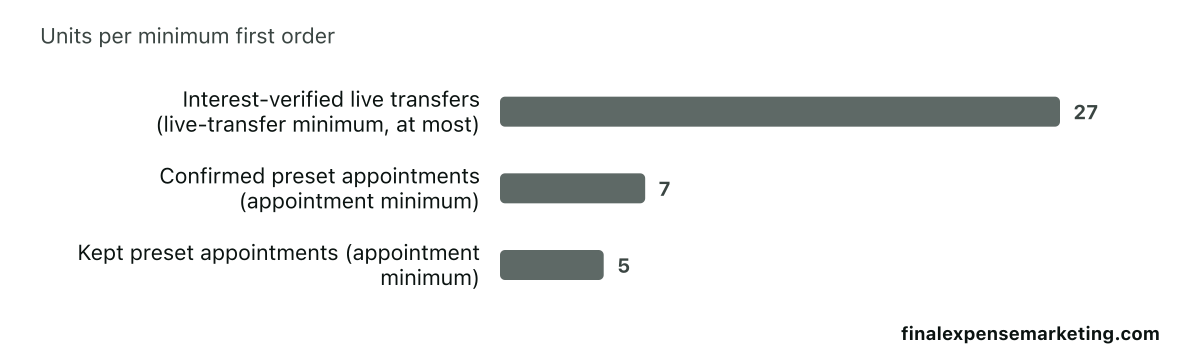
| Row | Units per minimum first order |
|---|---|
| Interest-verified live transfers (live-transfer minimum, at most) | |
| Confirmed preset appointments (appointment minimum) | |
| Kept preset appointments (appointment minimum) |
Source: Final Expense Marketing published rate card, as of 2026-10-15. Units bought, not sales.
Preset appointments and live transfers bill for different events. A preset appointment is a booked meeting: $175 once booked and confirmed, or $225 per kept appointment. An interest-verified live transfer is a call already connected: $110, billable only when five rules hold, including 90 connected seconds. Your sit rate and missed transfers decide which costs less per conversation.
This guide compares preset appointments vs live transfers for licensed final expense agents, agencies and call centers: what triggers each bill, what a first order buys, who has to be ready to take the call or keep the meeting, and how to work out cost per kept conversation. Every price comes from one published rate card. We publish no sit rates or close rates, so every rate in the math below is yours to supply.
Preset appointments vs live transfers: what each one sells you
Both products get a licensed agent talking to a final expense prospect without dialing a list. The difference is the thing you pay for: a time on your calendar, or a conversation already under way.
A preset appointment: you buy a booked meeting
A preset appointment is a time on your calendar that a prospect has agreed to keep. You buy the meeting; the selling, from the first question to the application, is yours. Each appointment is booked for one agent and billed on one of two bases, chosen when you order:
- Confirmed, $175: Booked and confirmed with the prospect.
- Kept, $225: The prospect attended, or completed a substantive telephone consultation.
An appointment can be a scheduled phone consultation or an in-home visit at the kitchen table, and the kept definition covers either format. Ask which of the two formats is offered in your licensed states before you order. The product page sets out preset appointments, billed confirmed or kept, with every no-show term.
A live transfer: you buy a call already connected
On an interest-verified live transfer, a screener confirms the prospect's interest, age and state, then warm-transfers the call to you, with the prospect still on the line. It is not underwritten, so no health or medication questions are asked and no product tier is estimated before the handoff. Each transfer is connected live to a single agent and costs $110 once it is billable. Read the five billing rules for interest-verified live transfers before you compare prices.
A second transfer product adds screening. A pre-vetted transfer adds health and medication questions and estimates a Guaranteed Issue or Level/Graded tier before the handoff, at $250 or $300 per transfer by tier. The tier is an estimate; the carrier makes every underwriting decision. The details are on the page for pre-vetted transfers, priced by tier. Below, “transfer” means the interest-verified product unless a line names the pre-vetted one.
Neither one is a setter desk
Buying a meeting is not the same as hiring people to book meetings from your own leads. If you already have leads and the gap is follow-up, the purchase you want is a setter desk that follows up the leads you already have, priced per seat each month with lead costs separate. This guide compares only the two products sold per unit.
What triggers the bill: the billing rules side by side
A price means little until you know the event that triggers it. On a transfer, the bill attaches to the call and to five conditions inside it. On an appointment, it attaches to a status, confirmed or kept, that you choose when you order.
| Term | Interest-verified live transfer | Preset appointment, confirmed | Preset appointment, kept |
|---|---|---|---|
| Price per unit | $110 per transfer | $175 per appointment | $225 per appointment |
| One unit is | A live call a screener warm-transfers to you | A meeting booked and confirmed with the prospect | A meeting the prospect attended, or a substantive telephone consultation they completed |
| The bill attaches when | All five billing rules hold on the call | The appointment is booked and confirmed | The appointment is kept |
| What protects you | A call that fails any of the five rules is not billable | One free rebooking attempt if a confirmed appointment no-shows. Replaced if the prospect denies ever agreeing to the appointment. | A no-show does not count as kept |
| What you still pay for | No close, answers you dislike, a change of mind after a valid conversation, and a transfer you miss after confirming you were available | A meeting that ends without a sale. No automatic refund for every no-show. | A kept meeting that ends without a sale |
| Minimum first order | $3,000 | 5 appointments or $1,250, whichever is higher | 5 appointments or $1,250, whichever is higher |
A transfer is billable only when all five rules hold:
- The agreed prospect is connected to you
- The call lasts at least 90 seconds
- They confirm interest in final expense coverage
- They meet your agreed state, age and eligibility filters
- You, or someone you authorise, are available to take it
Transfer vendors set their own billing triggers, so compare the trigger as well as the price, along with the other terms to check across vendors before you buy.
Same failure, different bill
Failures show the difference fastest. Each one below lands on a different side depending on the product, under the published terms.
| What goes wrong | Interest-verified live transfer | Preset appointment |
|---|---|---|
| The prospect is gone before a real conversation | Not billable: the connection must last at least 90 seconds | Confirmed: billed, with one free rebooking attempt and no automatic refund. Kept: a no-show does not count as kept. |
| The prospect says they never asked for this | Not billable: the prospect must confirm product interest | Confirmed: replaced if the prospect denies ever agreeing to the appointment |
| You talk, and the prospect does not buy or changes their mind | Billable, and not refundable | Billed on either basis: the unit is the meeting, not the sale |
| You are not free when it arrives | Not refundable if you had confirmed you were available | Does not arise the same way: the time is booked in advance |
Read the table as a split of risk. On transfers, the seller carries the short call and the uninterested prospect, and you carry your own availability. On confirmed appointments, you carry most of the no-show risk, softened by one rebooking attempt; kept billing moves that risk to the seller at a higher price per appointment. The no-sale risk stays with you on every product here, because none of them is billed per sale.
What the minimum first order buys
The two minimums are set differently. Interest-verified transfers launch at one dollar figure, $3,000. Preset appointments start at 5 appointments or $1,250, whichever is higher. Five appointments cost $875 on confirmed billing and $1,125 on kept billing, both under $1,250, so the dollar figure sets the appointment minimum at either price.
| Product and basis | Minimum | Price per unit | Whole units inside the minimum | Cost of those units | One sale moves your close rate by |
|---|---|---|---|---|---|
| Interest-verified live transfers | $3,000 | $110 | At most 27 | Up to $2,970 | At least 3.7 points |
| Preset appointments, confirmed | $1,250 | $175 | 7 | $1,225 | 14.3 points, more if some no-show |
| Preset appointments, kept | $1,250 | $225 | 5 | $1,125 | 20 points |
Where a price does not divide its minimum evenly, the table counts the whole units the minimum covers; ask how any remainder is applied when you order. The $3,000 launch minimum is published for interest-verified transfers. For pre-vetted transfers, your quote states the order minimum.
Why order size matters when you judge results
A first order is also your first sample. One sale out of 27 transfers, the most the transfer minimum covers, moves a measured close rate by about 3.7 points; one sale out of 5 kept appointments moves it by 20. The appointment minimum is 41.7% of the transfer minimum, a smaller commitment, but it covers 5 to 7 meetings, so read its result as a first look rather than a verdict. The transfer minimum costs more and can return more conversations to count. Whichever you buy, judge it on conversations counted, not on units bought.
Staffing and coverage: who must be ready, and when
The two products ask different things of your day. A transfer needs a licensed person free at the moment a call connects. An appointment needs a free slot at a time agreed in advance. Your team's shape decides which demand is easier to meet.
Transfers need someone free the moment a call connects
Availability is the fifth billing rule: “You, or someone you authorise, are available to take it.” The not-refundable list covers the other side: “You were unavailable after confirming availability.” Together they mean a transfer that arrives after you confirmed you were available is yours to answer, and a missed one is not refundable. Confirm only the hours someone can actually pick up.
The words “someone you authorise” matter for agencies: the call need not reach you in person, so an agency can route transfers to whichever licensed agent is free. A solo agent covers the whole window alone, between every other call and appointment. The share of transfers lost when every agent is busy, one part of your missed-transfer share below, rises with hourly volume and handle time, and falls with every agent added.
The presentation happens on the transferred call, and so does any application. Carriers publish their own phone-sale procedures, and Columbian's public telesale disclosure packet shows what they can involve: the applicant's “voice signature was secured by digital recording,” and the applicant then receives printed versions of the documents “read to you during the application process.” Take the signature method, any deadline for sending disclosures and the e-app's hours from each carrier's agent guide and your state's rules, and check them against the transfer window you set.
Appointments need calendar capacity, and sometimes a drive
An appointment is a slot you commit to before the prospect picks up the phone or opens the door. A phone appointment costs the length of the consultation. An in-home visit adds the drive both ways, and a no-show costs the slot in either format. On confirmed billing, a no-show also costs the appointment price unless the free rebooking attempt produces a kept meeting. If you text the prospect before the meeting, the consent you hold and how you send it decide whether you may text at all, and what a reminder text may say.
In-person sales carry their own paperwork. Columbian's November 2020 overview for agents, for one, lists a point-of-sale underwriting decision with a paper application. Check each carrier's agent guide for what an in-person sale requires, and budget that time into every visit.
Before your first order
- Write down your coverage. For transfers, the hours a licensed person is free to answer. For appointments, the slots you can hold each week.
- Name who takes each unit. Transfers can go to you or “someone you authorise”; each appointment is booked for one agent.
- Check carrier procedures by format. Signatures and disclosures for phone sales; paperwork and any point-of-sale decision for in-person sales.
- List your licensed states. Order only states where you can write the policy, and use each carrier's forms for the prospect's state: Columbian's 2020 overview, for one, says “Product specifications and availability may vary by state.”
- Decide how you will record outcomes. Count missed transfers, no-shows, rebookings and sales by product, so the cost math below runs on your own numbers.
Which fits telesales, face-to-face or a call floor
Fit follows from the unit. A transfer is a phone call that arrives live, so it suits people who sell by phone and can answer on demand. An appointment is a time set in advance, by phone or at the kitchen table, so it suits agents who run a calendar. The table is our reading of how the products work, not a measured result.
| How you sell | Live transfers | Preset appointments | What decides it |
|---|---|---|---|
| Telesales agent | Fits: you present and take the application on the live call | Fits as phone appointments | Whether you would rather stay on call through set hours or work from a calendar |
| Face-to-face (field) agent | Weak fit: a transfer is a phone call, so the sale has to happen by phone | Fits as in-home visits, where that format is available in your states | Which formats your licensed states offer |
| Agency with several agents | Fits when transfers can go to whichever licensed agent you authorize is free | Fits when each agent keeps a calendar, since each appointment is booked for one agent | How you route work across the team |
| Call center floor | Fits: licensed agents on seat take live calls inside a window | Usable as phone appointments, though the floor must also run a schedule | Whether the floor is built for live calls or for set times |
| Smaller first budget | Needs $3,000 to start | Starts at $1,250 | The minimum, and how many results you need before you judge it |
Mixed teams can buy both: transfers for agents who take live calls, appointments for agents who work from a calendar. They are separate products with separate minimums, and one quote request can cover several products. To weigh either against records you dial yourself, compare every final expense lead type in one table.
Cost per kept conversation, with your own numbers
Price per unit is the wrong comparison, because the units are different events. A fairer one is cost per kept conversation: what you pay for each conversation with an interested prospect that actually takes place. On a transfer, that is a transfer you answered. On an appointment, it is a kept appointment. Two rates from your own records convert each price into it:
- Missed-transfer share: transfers you paid for but missed after confirming you were available, divided by all transfers you paid for.
- Sit rate: kept appointments divided by the confirmed appointments you paid for, counting a rebooking that was kept.
| Product | Price per billed unit | Cost per kept conversation | The rate you supply |
|---|---|---|---|
| Interest-verified live transfer | $110 | $110 ÷ (1 − missed-transfer share) | Missed-transfer share |
| Pre-vetted transfer, Guaranteed Issue | $250 | $250 ÷ (1 − missed-transfer share) | Missed-transfer share |
| Pre-vetted transfer, Level/Graded | $300 | $300 ÷ (1 − missed-transfer share) | Missed-transfer share |
| Preset appointment, confirmed | $175 | $175 ÷ sit rate | Sit rate |
| Preset appointment, kept | $225 | $225 | None: each kept appointment is one kept conversation |
If you never miss a transfer, each one costs its price per kept conversation. Every missed transfer raises the figure, because it is not refundable, and every confirmed no-show the rebooking does not rescue does the same to an appointment. Neither figure counts your time: the hours you hold open for transfers, or the drive to an in-home visit. Add those to your own cost model.
Where the prices break even
Three thresholds follow from the prices alone, with no rate of ours involved:
- Confirmed vs kept billing. $175 ÷ $225 = 77.8%. Above a 77.8% sit rate, confirmed billing costs less per kept appointment; below it, kept billing does.
- Transfer vs appointment, per conversation. Even if every confirmed appointment were kept, it would cost $175 per kept conversation against $110 for an answered transfer. The transfer costs more per conversation only once you miss more than 37.1% of the transfers you pay for (1 − $110 ÷ $175). Against kept billing, the line is 51.1% (1 − $110 ÷ $225).
- Pre-vetted transfer vs kept appointment. At $225, a kept appointment costs less per conversation than either pre-vetted tier. The pre-vetted price buys screening before the handoff, not extra conversations.
From conversation to cost per sale
Cost per kept conversation is not cost per sale. Divide it by your close rate on those conversations, and record close rates separately for transfers and appointments, because a planned meeting and a live call are different selling situations. For the same cost per sale, a kept appointment has to close at 2.05 times your close rate on answered transfers ($225 ÷ $110); missed transfers lower that multiple. A confirmed appointment has to close at 1.59 times, divided by your sit rate ($175 ÷ $110 ÷ sit rate).
Run your own rates through the cost-per-sale calculator, where every rate field starts blank. For transfers, enter 1 minus your missed-transfer share as the contact rate; for confirmed appointments, enter your sit rate. The results are costs and thresholds built from published prices and your inputs. They do not forecast sales or income.
Credits, risks and what stays with you
What the terms cover
Each product has its own remedies, and they do not carry across. Transfers protect you through billability: a call that fails any of the five rules is never billed, while a billable one that ends without a sale, or that you missed after confirming availability, is not refundable. Confirmed appointments protect you with one free rebooking attempt for a no-show and a replacement when the prospect denies ever agreeing to meet; no-shows are not refunded automatically. The 72-hour claim window in the replacement policy is written for leads, so ask how a transfer or appointment dispute is raised before you order.
What buying either one does not hand off
Someone speaks to the prospect before you do: a screener before a transfer, a booking caller before an appointment. What that caller may say depends on the state. In Florida, Fla. Admin. Code R. 69B-222.060, which governs unlicensed insurance agency personnel, lets an unlicensed person “telephone persons to set appointments for licensed and appointed agents,” but adds that “the unlicensed person may not engage in a substantive discussion of insurance products.” New York's insurance regulator drew a comparable line in OGC Opinion 04-04-20 (2004): non-licensees, including telemarketing firms, may make outbound calls to prospects “to determine their interest in speaking to licensed insurance agents and brokers about insurance products,” provided specific policy terms and conditions are not discussed and the callers' “compensation is not based on the purchase of insurance.” Where the screener or booking caller is unlicensed, expect the first product conversation to be yours, on either product.
Calling-law exposure stays with you as well. In its 2013 DISH ruling, FCC 13-54, the Federal Communications Commission said that while a seller does not generally initiate calls made through a third-party telemarketer, “it nonetheless may be held vicariously liable under federal common law principles of agency” for violations those telemarketers commit. Ask any seller of transfers or appointments what consent the prospect gave and whose name it carries. Your calling hours, do-not-call list and scripts stay your responsibility on every call you make or return.
How to choose in five questions
- Do you sell by phone or in person? Phone sellers can use either product. A live phone call does little for an agent who only sells face to face, so field agents should look at in-home appointments.
- Can someone answer the moment a call connects? If yes, transfers fit. If your day runs in booked blocks, appointments fit.
- What is your first budget? $3,000 launches transfers; $1,250 starts appointments.
- Who should carry the no-show? Confirmed billing leaves it with you, softened by a rebooking attempt. Kept billing moves it to the seller at $225. Your sit rate against 77.8% decides which costs less.
- What does a kept conversation cost you? Put your missed-transfer share and sit rate through the table above, then your close rates through the calculator.
When the answers point one way, price it on the product page: order interest-verified transfers or order preset appointments. Each page carries the quote form, and one request can cover both.